

 LinkedIn
A citation starts with a buyer’s question, not your reputation
A finance director asks an AI assistant which subscription billing platform fits a mid-market SaaS company using usage-based pricing. Your company has a respected name and a polished product page. A smaller competitor gets cited instead.
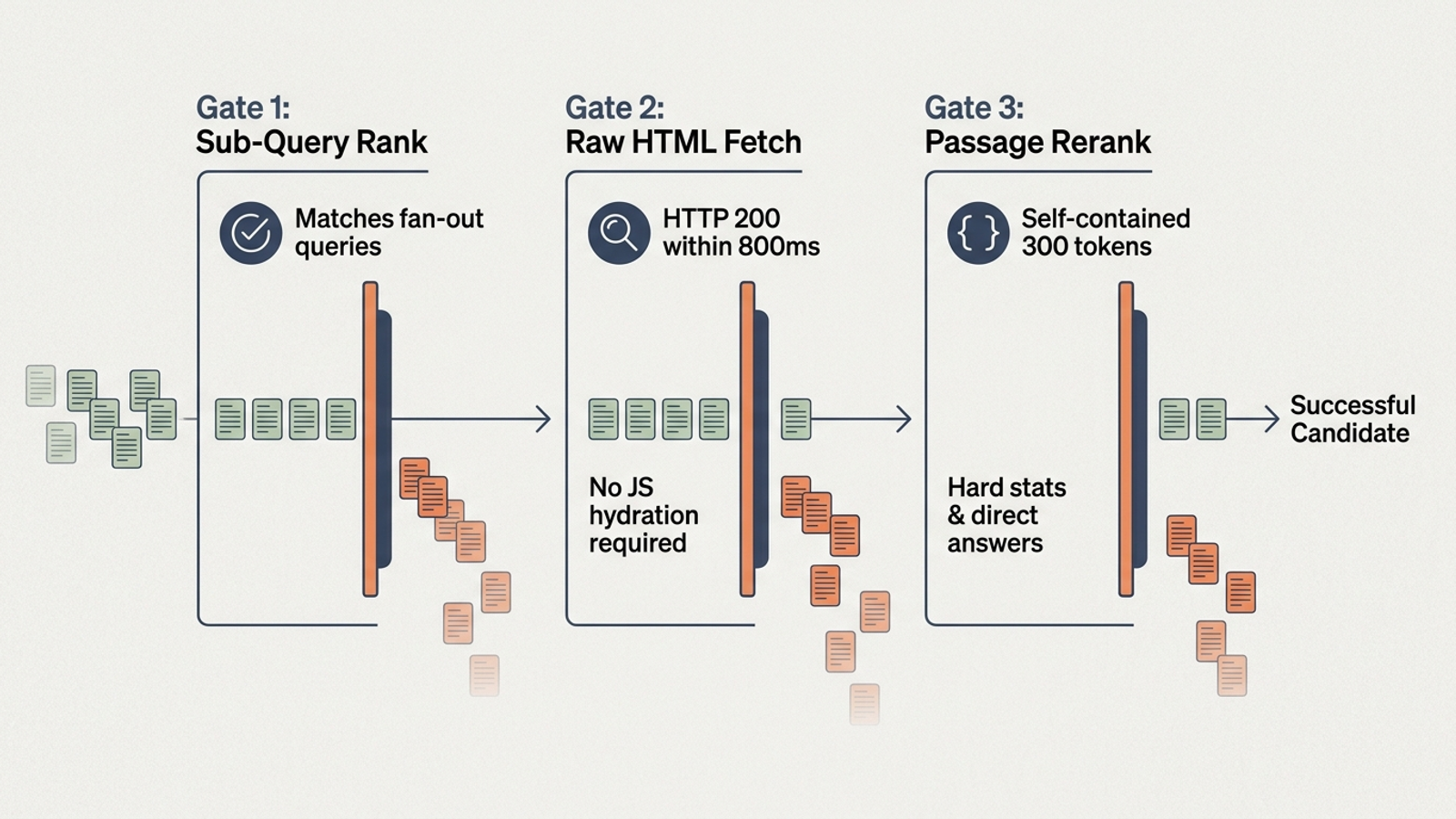
The useful question is not, How do we build more authority? It is, At what point did our page leave the answer? For a live answer, the practical path is a search, a fetch, and a passage pick. If your page fails one of those steps, its reputation may never enter the room.
I watched performance marketers make a version of this mistake in paid search. They treated Quality Score like a character reference for the company when the immediate problem was often much closer to the ad and landing page. It is tempting to answer a mechanical problem with a brand campaign. Tempting, and usually slow.
Brand presence can help a page become a candidate or make a claim more credible. It cannot supply an answer that the system did not find, could not fetch, or could not lift from the page. Start with the mechanics.
Step 1: The buyer’s question becomes searches
Our finance director types: “What is the best subscription billing platform for a mid-market SaaS company using usage-based pricing?” The assistant may return a three-vendor comparison with footnotes. To assemble it, a search-enabled system can break that broad request into narrower searches for the facts the comparison needs. That process is often called query fan-out.
In query fan-out architectures, an orchestration model generates targeted background queries and runs them against search indexes. For the billing question, those queries might look like this:
"usage based billing API latency SaaS benchmarks""mid market subscription billing pricing percentage vs flat fee""billing software automated revenue recognition ASC 606 compliance""metered billing software implementation timeline weeks"
The exact queries depend on the question and the system. The point is what they ask for: latency, pricing structure, revenue recognition, implementation time. A page optimized only for “subscription billing software” may miss the more specific searches that supply the answer.
That changes the first content test. Suppose your product page calls your software an “industry-leading billing platform” but gives no accessible detail about metered usage or pricing. It may be a good-looking page. It gives the search little reason to surface it for either constraint. If the page does not appear among the candidates, its copy never gets a chance to persuade.
The practical takeaway: write for the concrete questions inside the buyer’s question, not just the broad category on your editorial calendar.
Step 2: The engine has to fetch the page
Say your billing page does appear among the candidates. The next hurdle is less glamorous: the engine has to retrieve content it can read. A search result pointing to your URL is not the same thing as an answer-time fetch returning useful text.
A bot visit does not prove the answer saw your page
Site owners often see an AI-related user agent in their logs and assume their content is available for live answers. But different bots do different jobs. OpenAI’s bot documentation distinguishes GPTBot, used for training, from OAI-SearchBot, used for search indexing, and ChatGPT-User, which can fetch a page in response to a user action. Likewise, ClaudeBot and Claude-User serve different purposes. Perplexity also has its own retrieval process.
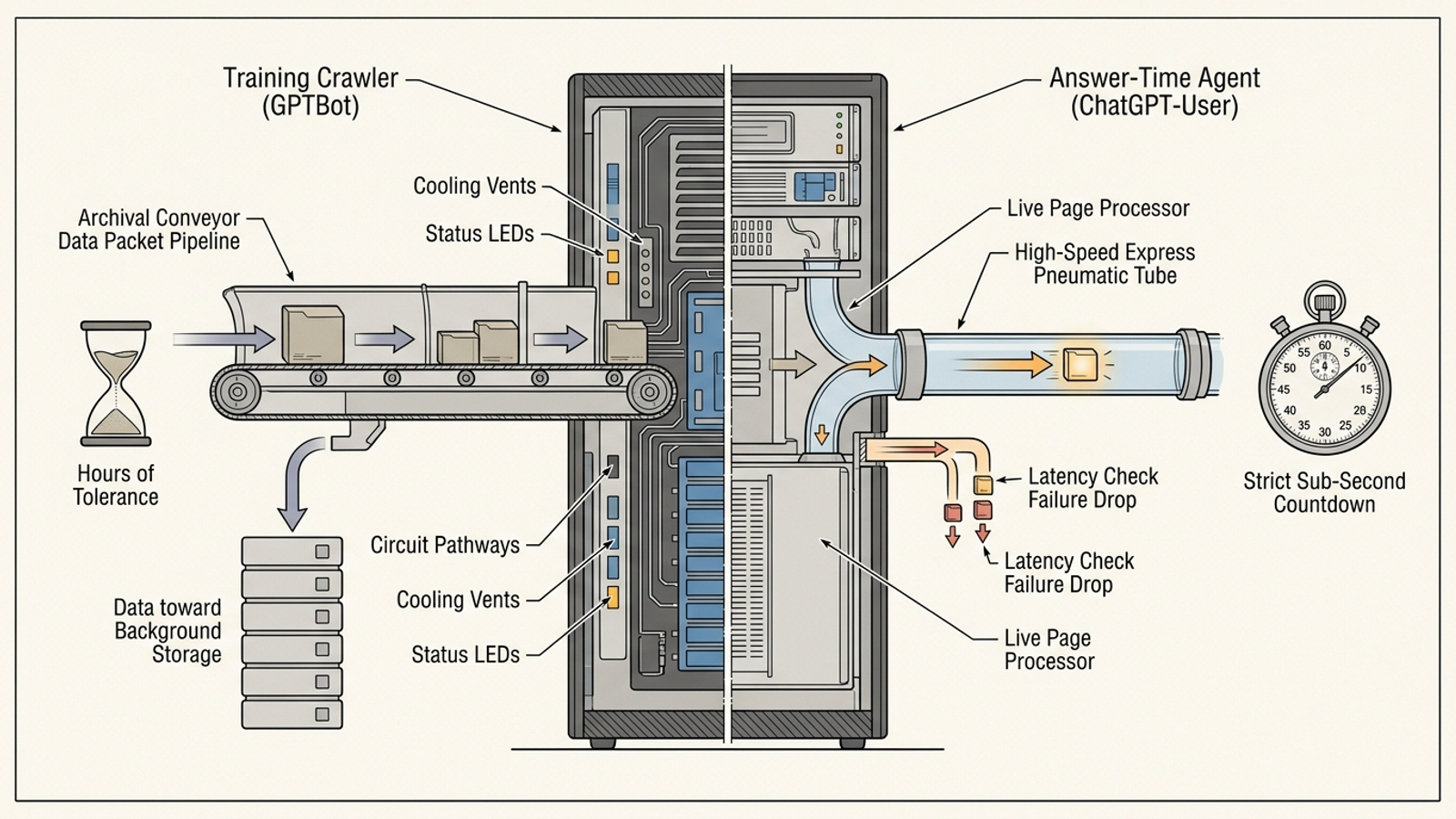
The visit you need to inspect is the one relevant to the page and retrieval path you care about. A training crawler reaching your homepage does not establish that an answer-time agent can read your billing details. Nor does a successful fetch establish that the details made it into the final answer.
A live retrieval also has less room for failure than an offline crawl. If a firewall blocks the request, an origin server responds slowly, or the returned HTML contains almost no useful content, the system can move on to another candidate. For our finance director, that may mean a competitor’s pricing explanation becomes the source simply because yours was unavailable when needed.
Three ways a useful page becomes unreadable
Check these before commissioning another article:
- Firewall or WAF challenges. Cloudflare, AWS WAF, or another security layer may return a 403 or an interactive challenge to a retrieval agent. The page can look fine in your browser while the agent receives no usable content.
- Robots and indexing rules. A blanket rule intended to limit scraping can also interfere with the bots that discover or retrieve your pages. Keep the distinction between training, indexing, and user-initiated fetches clear when you review those rules.
- Slow or empty responses. A sluggish server can make retrieval unreliable. A fast response is no help, either, if it delivers only an application shell while the important text appears later in the browser.
You can check whether AI crawlers can read your site by looking at the relevant requests and responses in your edge logs. Look for an actual successful response to the page in question, not merely a bot name somewhere in the traffic report.
The last failure is common on software sites. Pricing, usage limits, and integrations may live inside a React or Vue component rendered after the initial page loads. Answer-time retrieval may not execute the scripts or wait for the page to hydrate; AI crawler rendering capabilities vary. If the initial HTML contains an empty shell rather than the pricing explanation, the page that your sales team sees is not necessarily the page the fetcher sees.
The practical takeaway: make the answer available in the returned content, then confirm that the relevant agent can retrieve it. A beautiful pricing grid cannot earn a citation from a response that contains no pricing.
Step 3: The engine picks a passage
Now give our billing page the benefit of the doubt. It appears in the search results. The server returns readable HTML. There is still no guarantee of a citation, because the system needs a passage it can use to answer the finance director’s question.
A long page contains navigation, related links, calls to action, and explanations aimed at different readers. Rather than treat every word as equally useful, retrieval systems isolate candidate passages and rank them against the query. Work on rerankers in generative search describes the distinction between broad candidate retrieval and closer evaluation of text blocks. Perplexity’s architecture notes discuss chunking content into self-contained spans before it enters the answer process.
Make the paragraph work without its neighbours
Imagine the billing page says, “This approach also supports it. Contact us for details.” The writer may know that “this approach” refers to usage-based pricing and “it” refers to revenue recognition. A passage lifted out of context does not. The paragraph asks the retrieval system to do detective work while a competitor’s paragraph states the subject and the constraint plainly.
A self-contained passage names what it is about and answers the specific question. If the page contains a pricing threshold, an API constraint, or an implementation timeline, place the relevant detail beside the thing it describes. Do not separate the claim from its subject by three headings and a testimonial carousel.
This does not mean turning every page into a stack of robotic, sixty-word answers. People still need a coherent explanation. It means each important factual passage should survive being read alone. The analogy is a clipped paragraph passed across a desk: if the reader needs the previous four pages to know what “it” means, the clip is not ready.
Give the system something specific to use
A benchmark by researchers from Princeton, IIT Delhi, Georgia Tech, and the Allen Institute for AI (Aggarwal et al., KDD 2024) tested content modifications across 10,000 search queries. In that test, adding quotations and statistics improved the study’s measure of source use; generic readability changes, emotional appeal, and keyword stuffing did not deliver the same lift.
That is not permission to manufacture a number or tuck an executive quote into every paragraph. It is a reason to publish the real specifications, thresholds, and clearly attributed claims a buyer needs to make a decision. Our finance director asked about usage-based billing. “Flexible solutions for growing teams” contributes little. A clear explanation of how the pricing structure works contributes something the answer can actually use.
Engines also differ in how many sources they show and how much they draw from each. Citation benchmarking across domains describes different source-selection patterns for Perplexity and ChatGPT Search. You do not need to assume one universal citation formula to apply the lesson: a page has a better chance when its relevant facts are easy to find, read, and isolate.
The practical takeaway: inspect the paragraph that answers the constraint, not merely the article wrapped around it.
Where authority fits, and where it cannot help
Brand authority is not imaginary. An established source may be more likely to enter a candidate set, and corroboration matters when sources disagree. If two passages make conflicting claims about a billing platform’s price, the system has reason to weigh where those claims came from.
But authority cannot answer a sub-query on its own. A well-known company’s page full of abstract promises may offer less usable material for an implementation-time question than a smaller company’s page that states its process clearly. That is not a general verdict on either company. It is what happens when the immediate job is to resolve a specific constraint.
This is the limit of the reputation analogy. Reputation may affect which documents get considered and how conflicting claims are weighed. It does not make absent text appear in an HTML response, or turn “seamless scalability” into a usable answer about metered billing.
Diagnose the gate your page fails
When someone tells me their company is invisible in AI answers, I start with the buyer question and the page they want cited. I do not start by ordering ten new articles. The order matters because a Step 3 rewrite will not fix a Step 2 block.
- Test the searches. Enter the buyer prompt into ChatGPT Search or Perplexity and inspect any search trace the product exposes. Which narrower questions is it pursuing? Search for those constraints as well. If your page appears only for a broad category term, work on the missing answer before declaring a general authority problem.
- Test the response. Check edge logs for relevant bot requests, status codes, and the URL returned. Then inspect the raw HTML without relying on browser-side scripts. For a page that should mention usage-based pricing, a quick check might be
curl -s -A "ChatGPT-User" https://yourdomain.com/pricing | grep "usage-based". That command is a diagnostic, not proof that a particular assistant will cite the page. An empty result tells you to inspect the response more closely; a 403 in your logs tells you the fetch needs attention. - Test the passage. Copy the paragraph that answers the buyer’s constraint into a blank document. Can you identify the product, the relevant detail, and what that detail means without its heading or preceding section? If not, revise the passage before writing a new page.
Treat a content gap as a missing answer first
Legacy SEO tools can make every visibility problem look like an absent keyword cluster. Sometimes a new page is warranted. But the gap may be three sentences missing from a page that already ranks: the pricing threshold, the architectural constraint, or the direct explanation of a feature. Work on answer-engine optimisation gaps is useful here because it pushes the diagnosis toward what an answer can actually use.
That is also where the old operating model gets expensive. A monthly editorial calendar and a quarterly report can keep producing pages while nobody checks whether a relevant fetch returns a 403 or an empty shell. At groas, our organic engine and groas MCP tools are built around these mechanical friction points: checking crawler access, locating buyer prompts where pages drop out, and making passages easier for answer engines to use. Continuous execution matters because an advisory deck cannot fix the response your server returns today.
The practical takeaway: find the failed gate before you fund the fix. Otherwise you may buy more content for a site the answer engine cannot read.
Try the model on the next buyer question
Take a new prompt: “Which subscription billing platform charges a flat fee rather than a percentage-based fee?” Do not begin with brand mentions. Follow the answer.
First, ask whether your pricing page can surface for searches about flat fees and percentage-based pricing. If it cannot, the relevant comparison never starts. Next, check what an agent gets when it fetches that page. If the pricing distinction lives only in a browser-rendered grid, a successful-looking URL may still return no usable answer. Finally, lift out the paragraph that explains the fee structure. If it says only “transparent pricing built for growth,” there is nothing there to settle the buyer’s question.
The fixes follow the failures: address the specific search, return readable content, and state the pricing distinction in a passage that makes sense on its own. If you do not have that distinction, do not invent it for a citation. If you do, make it findable.
That is the part reputation-first advice skips. A citation is earned in the retrieval event in front of the buyer. Before you commission a PR campaign because a smaller competitor appeared in an AI answer, check the searches, the server response, and the paragraph. Your reputation can enter the room once the machine can read what you actually say.