

 LinkedIn
Executive Summary: The Index Rose; Citations Did Not
Your Answer Presence Index rose from 31 to 35 points out of 100. Your clickable citations across Google AI Overviews and ChatGPT remained at zero. We are pleased to deliver your third-quarter AI Visibility and Generative Share of Voice (GenSOV) Audit. The invoice is attached.
Over the past 90 days, our monitoring infrastructure queried the primary generative models across 1,200 commercial prompts representing your category. The four-point index gain constitutes a 12.9% quarter-over-quarter expansion and validates our August decision to track 400 additional long-tail conversational variants. The prompt set changed. So did the score.
Executive leadership should not interpret the zero-citation result without consulting Methodology Note 14: Non-Hyperlinked Semantic Co-Occurrences. As outlined in emerging frameworks on measuring AI share of voice, our scoring engine combines unlinked entity mentions, second-tier prompt associations, and competitor comparison inclusions into one composite. After filtering out queries where the engine returned no commercial recommendations, a normalization approach used in AI visibility monitoring, your relative answer density expanded across three of the four evaluated models. A smaller denominator has proved especially supportive of this result.
The distinction between an index point and a citation deserves emphasis. An index point tells you how our system classified an answer against our prompt set. A citation gives a reader a route to your site. We report both, but the larger type on the dashboard is reserved for the measure moving in the preferred direction.
Referral traffic from generative engines accounts for 0.14% of total web sessions, alongside the broader enterprise benchmark of under 0.2%. While those visits remain non-material, your brand’s qualitative resonance within model latent space is, according to our dashboard, compounding. Please find attached:
- A 74-slide visual breakdown of the quarter
- A raw export of 2,400 prompt logs
- A list of 60 urgent technical tasks for your internal team
- Our quarterly platform-access invoice
The following sections explain why the first two attachments demonstrate progress and why the third belongs to you.
Where Your Brand Appeared: One Prompt, No Link
Prompt 842 Earns Tier-1 Brand Awareness
Across our 90-day sweep of Google AI Overviews, Perplexity Pro, and ChatGPT Search, your domain registered one textual appearance. It occurred on August 14 at 03:12 UTC under the query ‘[Your Brand] vs. [Primary Competitor] enterprise features and reliability.’ The engine drew on three forum threads and an aggregator review to produce an evaluation. It recognized your brand as an existing vendor, meeting our benchmark for Tier-1 Brand Awareness.
The answer recommended your competitor and described your software architecture as ‘legacy tooling burdened by manual maintenance overhead.’ It did not hyperlink to your domain. We have therefore recorded zero clickable citations and one successful entity detection, rather than collapsing two distinct achievements into a single disappointing figure. Your name entered the answer. The answer then moved on.
This is the value of separate reporting fields. A reader looking for software could not click through from that answer, and the answer offered little reason to look for you elsewhere. Our entity-detection field, however, can register the appearance without judging what the model said about you. It measures recognition, not persuasion. Keeping those measures apart protects the integrity of the chart and, conveniently, the upward direction of the chart.
For the board presentation, we recommend displaying the entity detection before the answer excerpt. This preserves the sequence in which progress became visible to our analysts and gives leadership adequate time to appreciate it. The excerpt can follow once the trend line has established the appropriate mood.

Where Your Brand Did Not Appear: The 400-Row Opportunity Map
Appendix C contains our flagship deliverable: a 400-row interactive heatmap across twelve spreadsheet tabs. Deep crimson marks absent mentions; soft amber marks prompts where a competitor was cited twice. High-intent queries include ‘best enterprise workflow software for mid-market teams’ and ‘automated solutions to replace agency retainers.’ The color scheme was selected to make the category opportunity legible at a glance. We advise against zooming out far enough to see the whole sheet.
The heatmap makes absence unusually easy to inspect. You can find a prompt, identify its color, and locate the corresponding row in the raw export. What you cannot do from that row is change the page an engine might retrieve or persuade a third party to mention your product. Those activities sit outside the map. The map will faithfully show the gap until somebody closes it.
In traditional search reporting, an empty result may indicate lost pipeline. Our Generative Engine Optimization framework calls the same empty result latent potential. We conducted repeated API sweeps to benchmark that potential, despite the variation described in tests of AI visibility tools and model responses. The dashboard smooths those changes into a 30-day moving average. Leadership can now review a stable line even when individual answers refuse to stay put.
Financial stakeholders have asked why the platform cannot fix the gaps it identifies. The distinction is operational. As practitioner accounts of generative rank tracking describe, a tracker can query an endpoint, log the presence or absence of a brand, and display the delta. Our product performs those functions, adds an executive-ready color palette, and sends the findings to the people who can change the site.
We provide the diagnostic mirror. Your in-house team owns the manual work of changing what the mirror reflects. Automating that downstream work would also reduce the need for a quarterly diagnostic deck, a consequence that warrants careful governance review.
Sentiment Analysis: No Brand, No Negative Sentiment
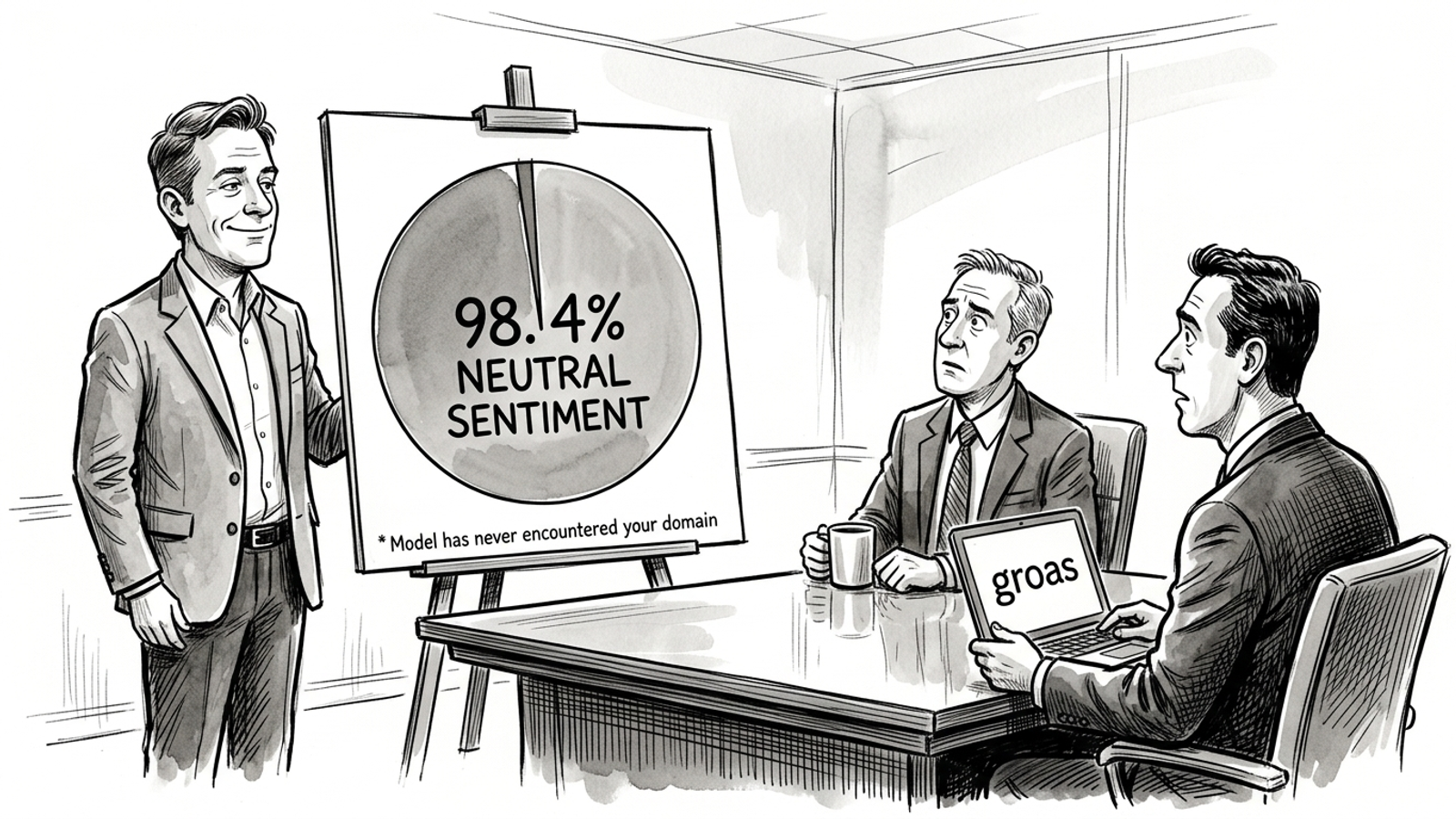
ChatGPT Returns 98.4% Neutral
Our sentiment pipeline graded the quarter’s responses as Positive, Negative, or Neutral, with a separate Developing classification where the source material invited further inquiry. Across ChatGPT Search sessions, your brand achieved 98.4% Neutral Sentiment. This rating is especially reassuring because the model generally did not connect your company name to your software category.
It produced no negative product-outage anecdotes and no unfavorable customer accounts in those sessions. When prompted with your name, it reliably defined the Latin roots of words in your trademark. Our taxonomy classifies this as Foundational Authority Neutral. In ordinary language, the system did not seem to know what you sell. Ordinary language is outside the scope of the sentiment chart.
A sentiment score can only grade the material placed in front of it. When the model does not discuss your product, there is little product criticism to count. That makes the neutral share attractive on a slide, though less useful to anyone asking whether buyers encounter your company in a relevant answer. For that question, please return to the citation field in the executive summary.
We recommend using the 98.4% figure in the executive summary and retaining the trademark example in the appendix. Both are accurate within their assigned reporting fields. They serve different audiences.
Perplexity and Google AI Overviews Remain Safely Inquisitive
On Perplexity Pro, sentiment settled at 64% Neutral and 36% Developing. The Developing share came from a recurring 2021 forum discussion in which a former user asked whether your primary product was still being maintained. Following AI visibility audit grading guidance, our classifier categorized the thread as Inquisitive Market Exploration, not negative friction. The question remains visible; the label makes it easier to present.
Google AI Overviews returned zero adverse statements about your pricing or onboarding velocity. It also declined to trigger an answer card on 88% of your category queries, showing standard organic links instead. We mark the absence of an answer as Latent Algorithmic Harmony. Competitors cited and analyzed in answer carousels experienced more volatile sentiment because their claims were available for scrutiny. Your relative stability should be read in that context, not mistaken for an increase in links.
These classifications complete the sentiment picture. No adverse statement, no product connection, and no answer card can each appear reassuring when reported alone. Together they describe a visibility problem. We have kept them in separate panels so the dashboard remains usable at presentation size.
Recommended Next Steps: Client Delivery Responsibility
Our advisory mandate covers surveillance, prompt classification, and prioritized diagnostic intelligence. Your team owns execution. That includes changing site copy, repairing structured data, and pursuing third-party mentions. Candid discussions of passive AI visibility tools have described a similar division of labor. We prefer to call it a clearly bounded engagement.
To convert the rising Answer Presence Index into clickable citations, please schedule and resource the following work before the close of Q4. The order reflects our preferred presentation sequence, not a guarantee that completing either item will cause a model to cite you. Our contribution is to identify the work and continue observing the prompts. Your contribution is to find the people, make the changes, and determine whether any change mattered beyond the index.
Action Item 1: Rewrite 60 URLs and Repair JSON-LD
Your editorial team should revise the opening 60 words of each category and landing page into factual, answer-first copy. Engineering should then review the structured-data pipeline and confirm that crawlers can retrieve the product information those pages contain. Generative search optimization checklists identify schema errors and content inaccessible behind client-side JavaScript as issues worth investigating.
For this sprint, please assign owners to:
- Rewrite the opening copy across the 60 identified URLs.
- Validate JSON-LD and complete
@graphnesting on the affected templates. - Check whether important product content is available without relying on client-side rendering.
- Review server logs for successful responses to relevant crawler requests.
The list is intended to travel from the report into your team’s work queue. It is not itself the revised copy, a repaired template, or a successful crawler response. That distinction may be obvious to the people doing the work. It is less obvious in a slide titled Implementation Roadmap, so we record it here for clarity.
Our platform will continue to monitor the associated prompts while your team completes this work. Should the prompts change before implementation is finished, the next report will document that development in full.
Action Item 2: Pursue Authoritative Third-Party Mentions
Your outreach team should seek independent editorial mentions in relevant publications, directories, and practitioner discussions. External authority may help a retrieval system find a brand worth citing; our audit identifies places where such mentions are absent. Under the engagement scoping model described for generative search retainers, pitching, outreach, and any publisher costs remain client-managed activities.
An unpopulated 80-row Google Sheets template is attached for your PR department. Each row includes fields for a prospective publication, outreach owner, status, and resulting mention. We have deliberately left those fields blank to preserve the integrity of your team’s work. A completed sheet will make an excellent addition to next quarter’s appendix, whether or not an answer engine links to any of its entries.
The template is ready for use immediately. The mentions are not. Please do not confuse the availability of an outreach tracker with the existence of outreach, or the existence of outreach with a citation. Our reporting framework has a field for each stage, and we intend to use all of them.

Optional Upgrade: Faster Notice That You Are Still Missing
Enterprise accounts may add Synthetix Pulse Real-Time Sentinel for $499 per month. Instead of waiting for a weekly digest or a quarterly PDF, your executive Slack channel will receive an alert when one of our own monitoring queries finds that your company is absent from an answer. Each alert includes a link to create a Jira task for engineering.
The upgrade changes the time between our observation and your notification. It does not change the answer, write the task, or assign someone to complete it. For leaders who prefer to learn about an omission before the quarterly meeting, that distinction is the product. The alert can arrive promptly even if the repair waits in a queue; notification speed and execution speed occupy separate lines in our service description.
A sample invoice shows the upgrade alongside your standard Q3 platform audit fee of $3,500. Please process it at your convenience; prompt logs and the 400-row opportunity map will remain available in the portal. If procurement asks what changed on your website this week, refer them to the client delivery responsibilities above. If they ask what moved attributable revenue, refer them to the next reporting period.
I spent a decade watching impression-share decks stand in for revenue, and groas exists to replace that loop with autonomous search execution and a named human strategist, not a faster receipt for being absent.