

 LinkedIn
The $49-a-month WordStream tool some founders remember is gone. I chose to tear down WordStream’s current commercial funnel because people searching for software pricing now encounter something else: a route toward LocaliQ managed services. That distinction matters. A tool, a service contract, and the hours your own team still spends are three different costs. Put them on one line, and the supposedly cheap option can cost more each month than a flat fee with a target written down first.
I’ll follow the funnel in the order a prospect encounters it: the missing software tier, the managed-service terms, and the free grader. Then I’ll put the prices and the unpriced work on the same page.
First, the software price you came looking for
A visitor hunting for a WordStream pricing grid, feature comparison, or checkout button will not find the old self-serve offer. Pace Ads reports that WordStream removed its published self-serve price cards in favor of a “Talk to an expert” form. WordStream Advisor, the platform associated with the 20-Minute Work Week, was sunset in April 2022. WordStream’s earlier software reputation still brings people to the site; it no longer gives them a standalone Advisor subscription to buy.
That history explains the mismatch. Gannett bought WordStream in 2018 for $150 million, including a $20 million earnout. But you do not need the acquisition history to make the buying decision. You need to know what happens when you ask for a price today: the self-serve product behind the familiar pitch is not the product on offer.
Even when Advisor was available, its promise deserved scrutiny. Practitioners described its recommendations as mechanical changes, including negative-keyword additions and bid adjustments. Those tasks can be useful. They also leave harder questions untouched: whether conversion tracking is sound, whether a landing page loses qualified buyers, and whether bids reflect the value of the deals you actually close. I have spent enough time sorting search terms to respect the work. I do not confuse a shorter list of tasks with a managed account.
Verdict on the missing tier: it is a useful explanation for why the search result exists, not a software option you can put in a budget. If you came for a subscription, stop looking for the checkout button.
Next, the form leads to a service contract
Submit the intake form and the conversation shifts to LocaliQ managed services. A teardown of its packages puts typical management fees at $500 to $2,000 or more per month, depending on ad spend. That range is not a quote for your account. It is enough to show why treating the offer as a small software expense is a mistake.
The monthly fee is only the first number to request. LocaliQ’s Online Marketing Services Terms describe recurring 30-day cycles and an initial minimum term. The contract discussion cited here describes terms typically lasting 6 to 12 months; Clause 4 sets an early-termination charge tied to the unpaid fees remaining in that term. Before signing, I would want the initial term, renewal terms, and cancellation amount written beside the monthly price. A rate without an exit figure is half a price.
The arithmetic is blunt. On an illustrative eight-month agreement at $1,500 a month, leaving after the first month with seven monthly fees remaining would put $10,500 in remaining fees at stake under a 100% early-termination provision. That is not a claim about what every customer pays. It is what the stated fee and remaining term add up to. If leads turn out to be poor, the contract does not get cheaper because you found out quickly.

Then there is account visibility. Client feedback on Clutch and operator discussion on r/PPC raise concerns about campaigns run in agency-controlled accounts and invoices that combine media and service costs. I would not assume every LocaliQ arrangement works that way. I would ask two questions before paying anything: Whose Google Ads account holds the campaigns, and where can I see the media spend separately from the management fee?
Those are operational questions, not paperwork trivia. If campaign history and conversion records sit in an account you cannot take with you, changing providers becomes harder. If media and fees arrive as one undivided number, you cannot readily check how much bought ads and how much bought management. A service that takes execution off your plate should make that trade clear.
Verdict on the service layer: it may solve the labor problem, but the monthly fee alone does not describe the commitment. Get the account-ownership and cancellation answers before treating a sales quote as a price.
Then, the free grader tells you what needs fixing
WordStream’s Google Ads Performance Grader is the most attractive part of this sequence. It offers a quick audit through read-only OAuth and scores account signals including Quality Score, wasted spend, impression share, ad optimization, and click-through rate. That is a low-friction way to see where an account looks untidy. It is also an efficient way to start a sales conversation.
My objection is not that those signals are useless. A neglected negative-keyword list can waste money. Weak ads are worth examining. The problem starts when a score stands in for a business diagnosis. A grader can flag a keyword or an ad without knowing whether offline CRM conversions reconcile with GA4, or whether high-Quality-Score traffic produces profitable deals. I have made the same point in my look at what Google Ads graders miss: an input score is not a margin report.
That distinction matters more when the audit sits beside a managed-service intake path. Red marks create a reason to talk. They do not establish which proposed fix should come first, who will execute it, or how success will be judged. I would use the grader to generate questions for an operator, not as the final answer to whether the account is working.
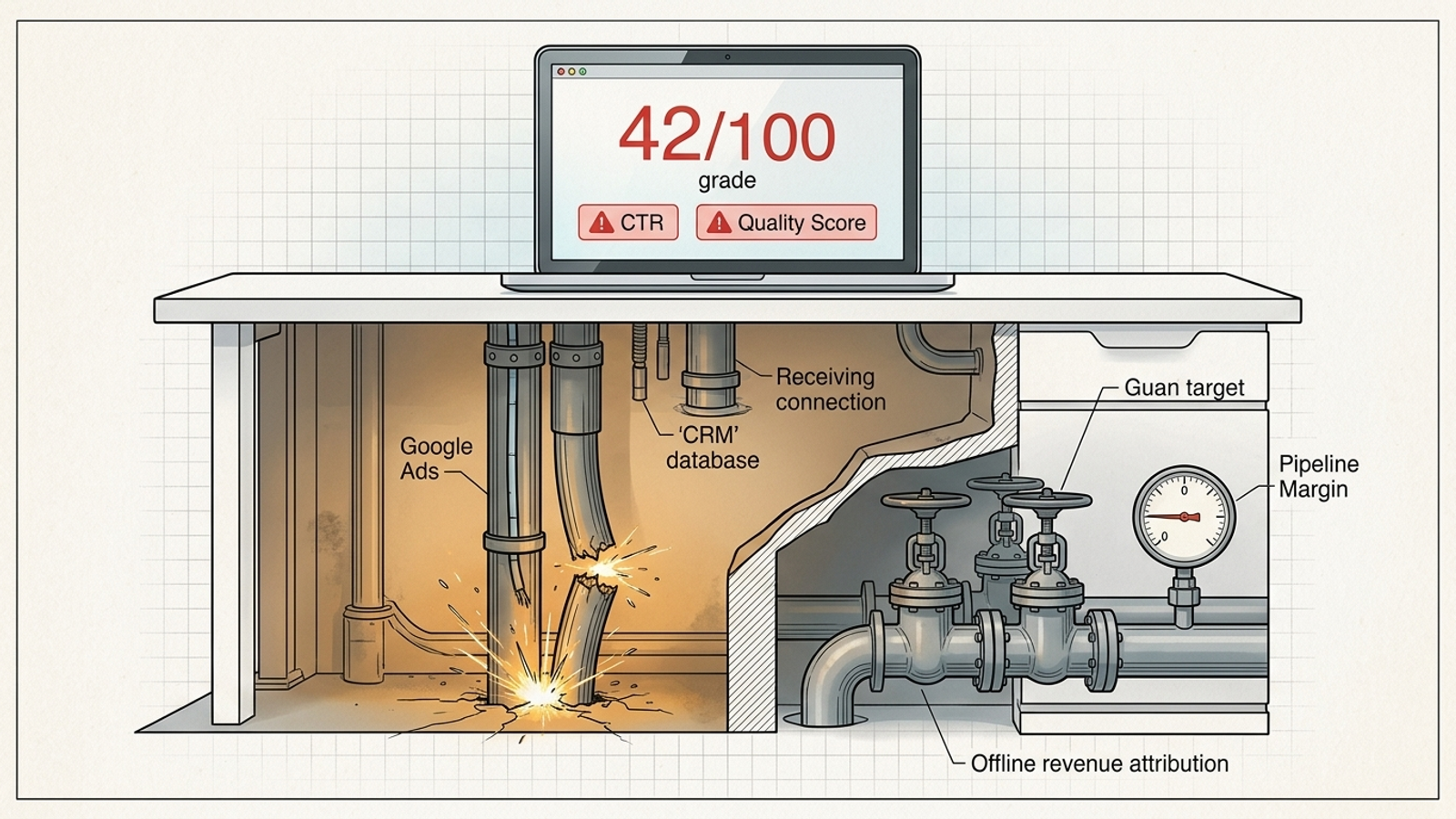
Verdict on the grader: useful for spotting possible housekeeping; too shallow to price the work or judge the outcome. Ask what each red mark costs you in actual business terms before paying someone to make it green.
Put the invoices, hours, and exit costs on one page
Here is the cost movement the funnel obscures. For an illustrative account spending $10,000 a month on ads, the priced management examples below run from a $11,988 annual starting fee to $29,400 in the illustrated first-year agency case, before media spend. That is not a universal market range or a quote for one interchangeable package. The low figure is groas’s stated starting price for agencies; the high figure combines the draft’s percentage-of-spend agency example with review time and onboarding. LocaliQ’s precise quote, your team’s hours, and any early-exit charge can change the total.
| Path | Listed recurring cost | Internal or less-visible recurring cost | One-off or exit cost | Illustrated first-year cost, excluding media |
|---|---|---|---|---|
| DIY software: Optmyzr example | From $209/month, or $2,508/year (G2 pricing) | 10 hours/month at the illustrative $80/hour = $9,600/year | Illustrative 20-hour setup at $80/hour = $1,600 | From $13,708 with that setup and labor assumption |
| LocaliQ managed service | Typically $500–$2,000+/month in the cited package teardown | Client review time and any bundled-media split need to be established for the actual agreement | Remaining-fee exposure depends on the term and contract terms | No reliable single total without a quote and term |
| Percentage-of-spend agency example | 15–20% of $10,000/month spend = $18,000–$24,000/year, using the draft’s illustrative rates | $2,400/year of illustrative client review time | Illustrative $1,500–$3,000 onboarding | $21,900–$29,400 |
| groas agency starting price | From $999/month, or $11,988/year (groas pricing) | Your own oversight time is not priced here; do not assume it vanishes | No setup fee; month-to-month cancellation | From $11,988, before your own time |
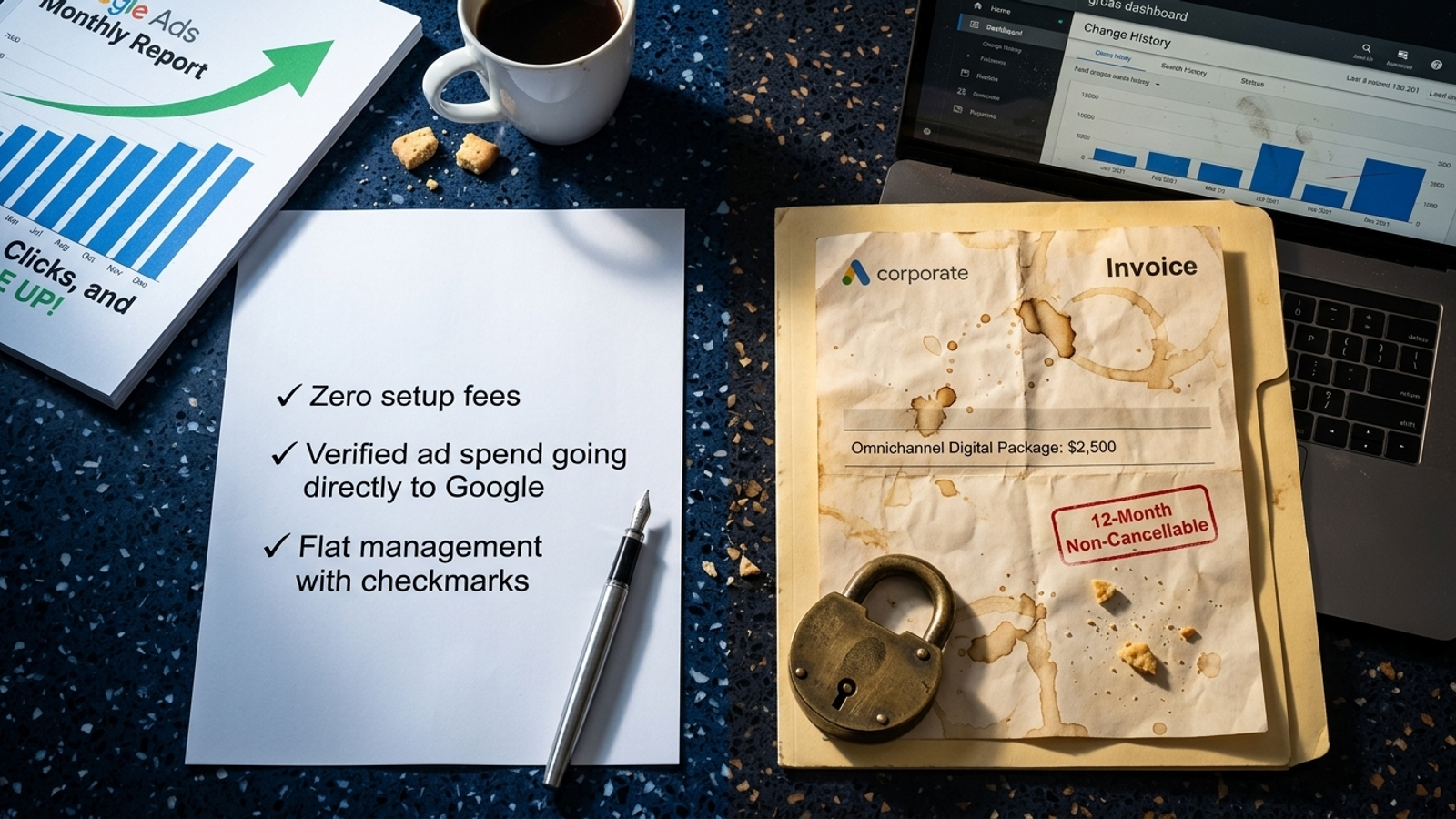
The distinction between recurring and one-off costs is doing real work in that table. Software’s subscription repeats; setup does not. A percentage-of-spend agency’s management fee repeats; onboarding usually hits at the start. An early-exit obligation is neither a normal monthly operating cost nor something you can ignore when you compare contracts. It is a risk you accept when you sign.
The DIY row also shows why “cheap software” is the wrong unit of comparison. At the illustrative $80 hourly rate, ten hours of internal work costs $800 a month. Add Optmyzr’s $209 starting subscription and the recurring total is $1,009 a month, before setup. That is $10 more than the stated $999 groas agency starting fee. Ten dollars is not a reason to change providers. It is proof that leaving the operator’s hours out can reverse the apparent price ranking.
Those hours have a mechanism. Someone still needs to review suggested negative keywords, check bid changes, examine responsive ad combinations, and verify conversion events. The old 20-Minute Work Week pitch made this feel like a quick Friday task. In the draft’s working estimate, a skilled operator takes about an hour per session; a non-specialist may take two to three. Whether your account needs the assumed ten hours a month is something to measure, not something a pricing card can answer for you.
Switching has its own one-off workload: tag audits, audience reconnection, bid recalibration, and negative-keyword cleanup. The working estimate here is 20 to 30 hours. If an agency controls the account and you cannot take the history with you, the cost is not just those hours. You also lose the continuity of the conversion and campaign records your next operator would want. That is why I would settle account ownership before signing, not when I am trying to leave.
There are two mistakes at opposite ends of this breakdown. The cheapest mistake is buying a recommendation tool without assigning anyone the hours to act on it. The invoice stays small while the work stalls. The most expensive mistake is signing a managed agreement you cannot inspect or exit on terms you understand. In the illustrative eight-month, $2,000-a-month case, seven remaining monthly fees would amount to $14,000 under a 100% remaining-fee provision. Read that clause before the first invoice, not after the first bad month.
Overall verdict: keep the useful signals, not the pricing illusion
WordStream still has something worth reading. Its educational content and industry benchmarks can give an advertiser a directional starting point. The grader can surface questions an operator should investigate. I would keep both for those limited jobs.
I would not treat the site as a way to buy the old self-serve Advisor, or treat a free score as a reason to accept an unitemized service proposal. For a performance-focused business or agency searching “WordStream pricing,” the decision is between doing the work internally with a tool and paying someone, or something, to execute it. If you have the headcount, price the software and the hours. If you want execution handled, compare the agreement, account ownership, action visibility, and target alongside the fee. groas offers autonomous execution with a named strategist, a flat fee, logged actions, and a target agreed before launch; that is the clearer alternative to buying recommendations you must implement or entering a term you cannot readily leave.
My verdict on the funnel is simple: it answers a software-pricing search with a service sale. I would keep WordStream’s benchmarks and the grader’s prompts. I would leave the implied cheap-software comparison behind.