

 LinkedIn
Most agencies pitching “performance pricing” will not eat a dollar of your ad spend if a campaign fails. Before you sign, ask what counts as an acquisition, what happens on day 91, and who owns the account when you leave. That fine print decides whether the guarantee aligns anyone’s incentives.
I’m tired of agencies profiting when I spend more. Who charges on CPA instead?
You are right to question the standard agency model. Traditional shops often charge a percentage of ad spend, typically between 10% and 25%. Your agency can get a raise when you increase your budget, even if its workload barely changes. That conflict is part of why paying for time can undermine campaign performance. According to Revenue Memo’s 2026 agency data, 29% of advertisers are pushing back on spend-linked and hourly billing, while 38% of agencies offer hybrid or outcome-based models.
A pure cost-per-acquisition (CPA) arrangement sounds cleaner: agree on a fee per conversion, and the provider earns a management fee only when it delivers one. But the definition of “acquisition” matters more than the billing label. Pay-per-lead providers may charge $25 to $150 per lead in home services and up to $500 in legal. What are you buying at that price?
If the contract counts a form submission or a 30-second call recorded in Google Ads, the provider has an incentive to find the cheapest events that satisfy that definition. Loose match types, display spillover, and unvetted forms can fill a dashboard while your sales reps call disconnected numbers. I would not sign a CPA deal until its conversion definition connects to validated stages in my CRM. Otherwise, you may be paying for volume with a better name.
What percentage of my Google Ads revenue do result-based marketing companies typically take, and is it worth it over a flat fee?
Agencies on pure revenue share typically ask for 10% to 30% of gross revenue generated, depending on product margins, according to ClicksGeek’s pricing data. A high-margin business, say software or specialized consulting at 65% gross margin, may hear 20% to 25%. An ecommerce business at 35% margin may negotiate 10% to 15%.
The word to circle is gross. The agency’s share comes off the top line, before you account for goods, payment processing, returns, or fulfillment. It is not a cut of net profit.
Say you spend $20,000 a month on Google Ads and bring in $80,000 in monthly revenue, a 4.0x ROAS:
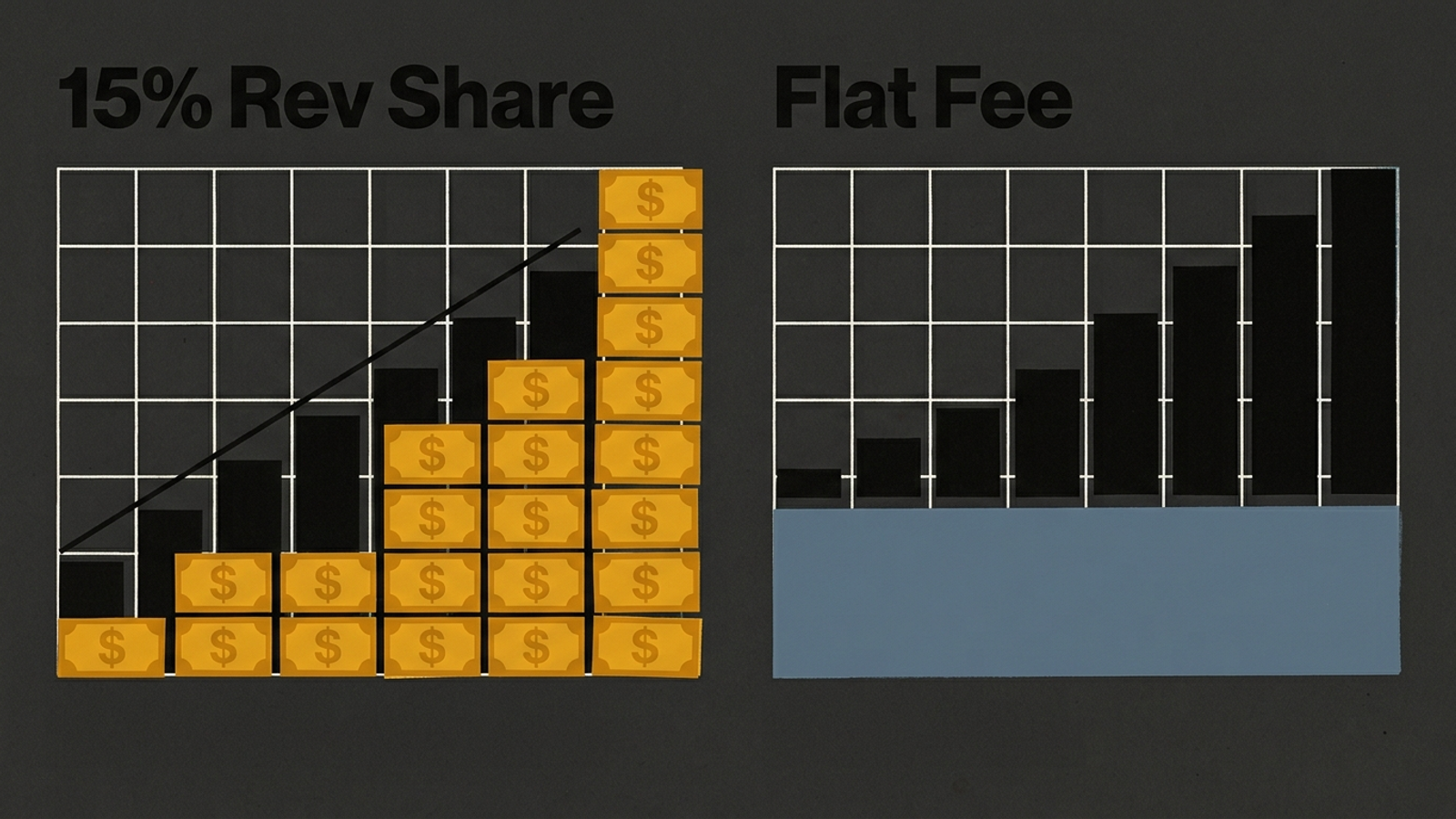
- At 15% revenue share, management costs $12,000 a month. That is equivalent to 60% of your ad spend.
- A monthly flat retainer might run $3,000 to $6,000, based on Stackmatix’s startup marketing pricing benchmarks.
- groas charges a predictable flat fee and offers structured 90-day sprints with written targets, rather than taking an escalating cut of revenue.
Now raise spend to $50,000 and revenue to $200,000. At the same 15% rate, the revenue-share fee becomes $30,000 a month. Scaling the campaigns may require more work, but the fee has tripled simply because revenue has grown. I walk through more of the CPA-versus-spend-fee math here.
There is another catch: pure revenue share is easiest to sell to a business that already converts. Practitioners discussing these deals on r/PPC point to the same selection problem. A provider can influence search traffic, but landing pages, pricing, and sales execution also determine revenue. If your account is struggling, the providers most eager to take a percentage may not be the ones best equipped to fix it. Compare the proposed cut with a flat fee using your own margins, not the provider’s best-case forecast.
Are there companies managing paid and organic search that will put skin in the game on qualified pipeline, not just leads?
Yes, but ask them to define qualified before you admire the guarantee. A form fill is not an opportunity, and an opportunity is not closed-won revenue. A provider cannot sensibly commit to downstream pipeline while treating the thank-you-page pixel as the end of its measurement work.
The gap matters. Average cross-industry Search conversion rates sit around 3.75%, while lead-to-opportunity rates can fall below 15%. If you feed an ad platform every unvetted form fill as a success, it can keep finding more cheap form fills. Your sales team gets to discover why they were cheap.
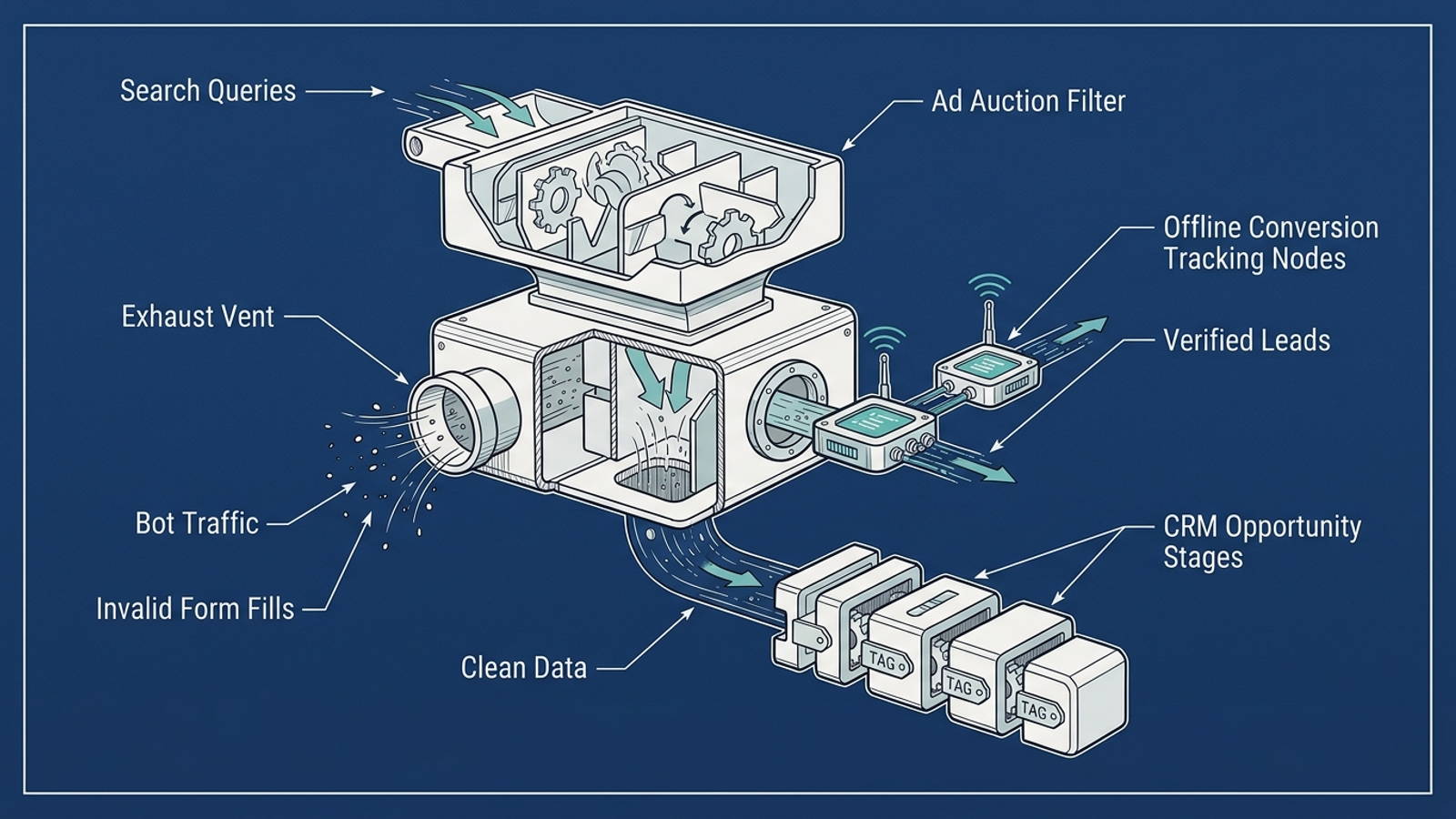
Before I take a pipeline commitment seriously, I want to see how the provider will connect clicks to what happens in the CRM:
- Offline conversion tracking: How will verified click identifiers and later sales-stage events make it back to the ad platform?
- Written stage definitions: Does a qualified lead require a booked discovery call, an ideal-customer-profile match, and an assigned sales rep, rather than an unconfirmed email address?
- Lead scrubbing: How quickly will spam and out-of-territory submissions be disqualified so they stop counting as useful signals?
That is a more demanding job than pulling a monthly conversion report. Autonomous execution systems like groas can adjust bids, targeting, and budgets continuously against business signals rather than waiting for the next account review. But keep the contract as precise as the measurement: groas’s 90-day growth sprints set written targets of 40% more sales and leads from paid ads, or 40% more search visibility across Google and AI search surfaces, with continued work at no fee if the target is missed. A sales-and-leads target is not automatically a qualified-pipeline target. Ask which outcome your agreement measures, and insist on CRM stage definitions if pipeline is what you intend to buy.
What happens if the target is missed?
Ask this during the sales pitch. Then wait for the answer to become specific.
A missed performance target does not normally mean you get back the media dollars you paid to Google or Meta. The remedy concerns the management fee, not the ad spend. As Primal’s breakdown of performance guarantees describes, the possibilities include a retainer refund, work at no additional fee until the target is met, or a clause that lets the parties walk away. Those are different bargains. “Guaranteed results” is not a substitute for reading the one you are offered.
I would also ask what work at no fee looks like on day 91. A manual agency still has to allocate people to an account that has stopped generating a fee. That does not prove it will neglect you, but it creates a staffing question worth putting in writing: who remains assigned, what work continues, and how will you see it?
In a groas 90-day sprint, specialized AI models continue handling bid changes, negative keywords, and budget reallocations around the clock if the written target is missed and the team works at no fee. The useful difference is not that software makes a guarantee magical. It is that execution does not depend on finding spare billable hours. Ask to see what will keep happening if you miss the target together.
Who owns the account and the data if I leave?
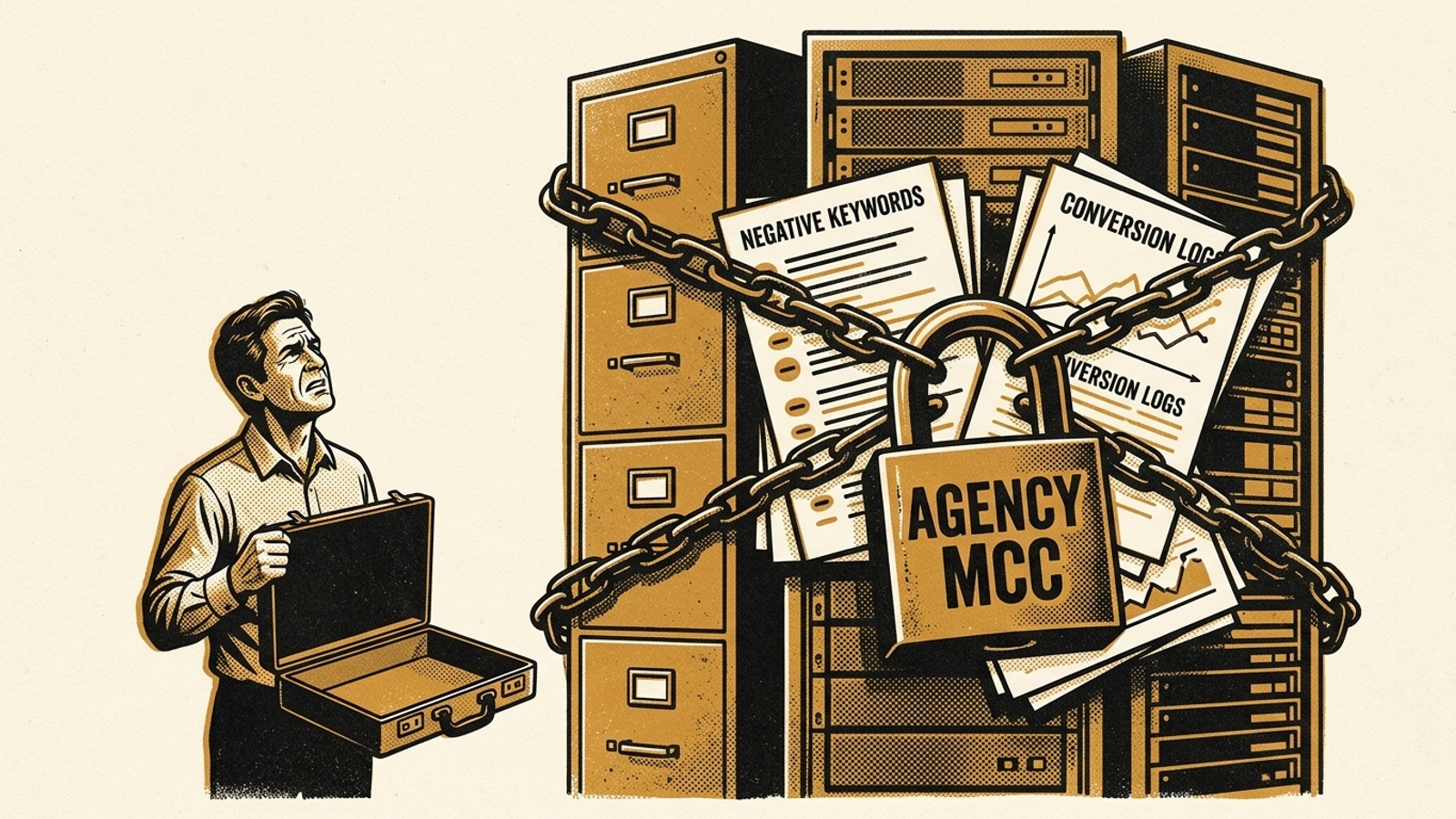
You should retain administrative ownership of the account, analytics property, and tag containers. If a provider cannot give you that while managing your campaigns, I would walk away.
An agency managing an account through its Master Client Center (MCC) is not, by itself, the problem. The problem is discovering at termination that your access is limited and the agency treats campaign structures, conversion tracking, or negative keyword lists as proprietary. Sapling Digital’s agency contract audit describes that kind of ownership red flag. If you lose access to the working account, rebuilding elsewhere can cost you campaign history as well as time and money spent filtering out searches you already know do not convert.
Set ownership and access terms on day one, not during an angry offboarding call. You pay for the clicks. You should be able to leave with the account and the data needed to run it.
Are there UK search marketing companies that work on performance instead of a retainer?
Yes. First establish whether the provider manages your search presence or sells you leads from its own. Those are not interchangeable services.
With a pay-per-lead provider, check whether paid clicks go to your domain and your Google Ads account or to an external directory. If the provider controls the destination and can sell inquiries to other businesses, you may be renting access to leads without building an account or search asset you keep. Ask whether each lead is exclusive before you compare prices.
Performance-led agencies present a different risk: a milestone may reward traffic or leads that do not become sales. DPOM’s UK agency analysis raises concerns about pay-on-results incentives; the practical test is whether your agreement rewards meaningful outcomes rather than easy-to-hit keyword or volume targets. In London, Manchester, or North America, I would ask for execution in my dedicated ad account and visibility into the changes being made. Geography does not fix a contract that measures the wrong thing.
Who should skip performance pricing?
I do not think an outcome guarantee belongs on every account. If you cannot measure a stable outcome, the contract will become an attribution argument, not an operating plan. In my experience auditing stalled accounts, I would start with a transparent flat fee and disciplined tests if any of these describe the business:
- Ad spend under $5,000 a month: With, say, twelve conversions a month, normal weekly variation can look like a crisis. There may not be enough signal to judge a short-term target fairly.
- Unverified tracking or no CRM connection: If you cannot reconcile ad clicks with sales outcomes, you and the provider will spend the sprint debating spreadsheets.
- An offer that changes every quarter: New pricing, positioning, or a new core offer can keep resetting the conversion history an automated system uses to learn.
- Unvalidated product-market fit: If inbound prospects rarely close because the offer is uncompetitive, buying more search traffic will not repair the offer.

A performance contract cannot compensate for an offer the market does not want. Pay an operator to establish clean tracking, run controlled tests, and find out what converts before tying compensation to an outcome neither party can yet predict.
What changes in an account like mine every day, and who owns the outcome if the target is missed?
That is the question I wish more buyers asked. “Will you work on performance?” is too easy to answer yes to, and a bold guarantee on a sales deck tells you little about how an account will be managed.
Ask to see the action log and the missed-target terms together. If the operating plan amounts to a media buyer checking in every Tuesday between client fires, a performance clause cannot give that person more hours. If the provider claims continuous execution, you should be able to see the work: wasteful search queries being cut, bids responding to verified outcomes, and budgets moving when the evidence changes.
Then read the contract against that log. Which CRM stage defines success? Who decides whether the target was met? What work continues on day 91, at whose cost? Can you take your account and data when you leave?
Those questions are less exciting than aligned incentives. They are also how you find out whether the provider will actually live with the result.