

 LinkedIn
You can buy an ad next to a Google AI Overview. You cannot buy a citation inside one. After years in Google Ads, I understand why that distinction is easy to miss: when Google puts a new box near the top of the results page, an operator’s first instinct is to find the inventory, price the click, and bid.
That instinct works for rented space. It does not get your company named as a source in an answer. Yet PPC operators walk into AI visibility with the same reflexes: buy the placement, target the keyword, chase position one, check the dashboard tomorrow. Each fails for a different mechanical reason. The most costly mistake is confusing an ad beside an AI answer with a citation inside it. You can spend money on the first while making no progress on the second.
Here are the six beliefs I would leave outside the Google Ads interface, and what I would do instead.
Belief 1: “AI Overview ads are how I get my foot in the door”
If you have spent your career buying search real estate, the question is immediate: where is the checkbox for AI Overviews? Google introduces a format, you find the auction, set a cost-per-acquisition target, and compete for the space. It is a sensible paid-search question. It is the wrong citation strategy.
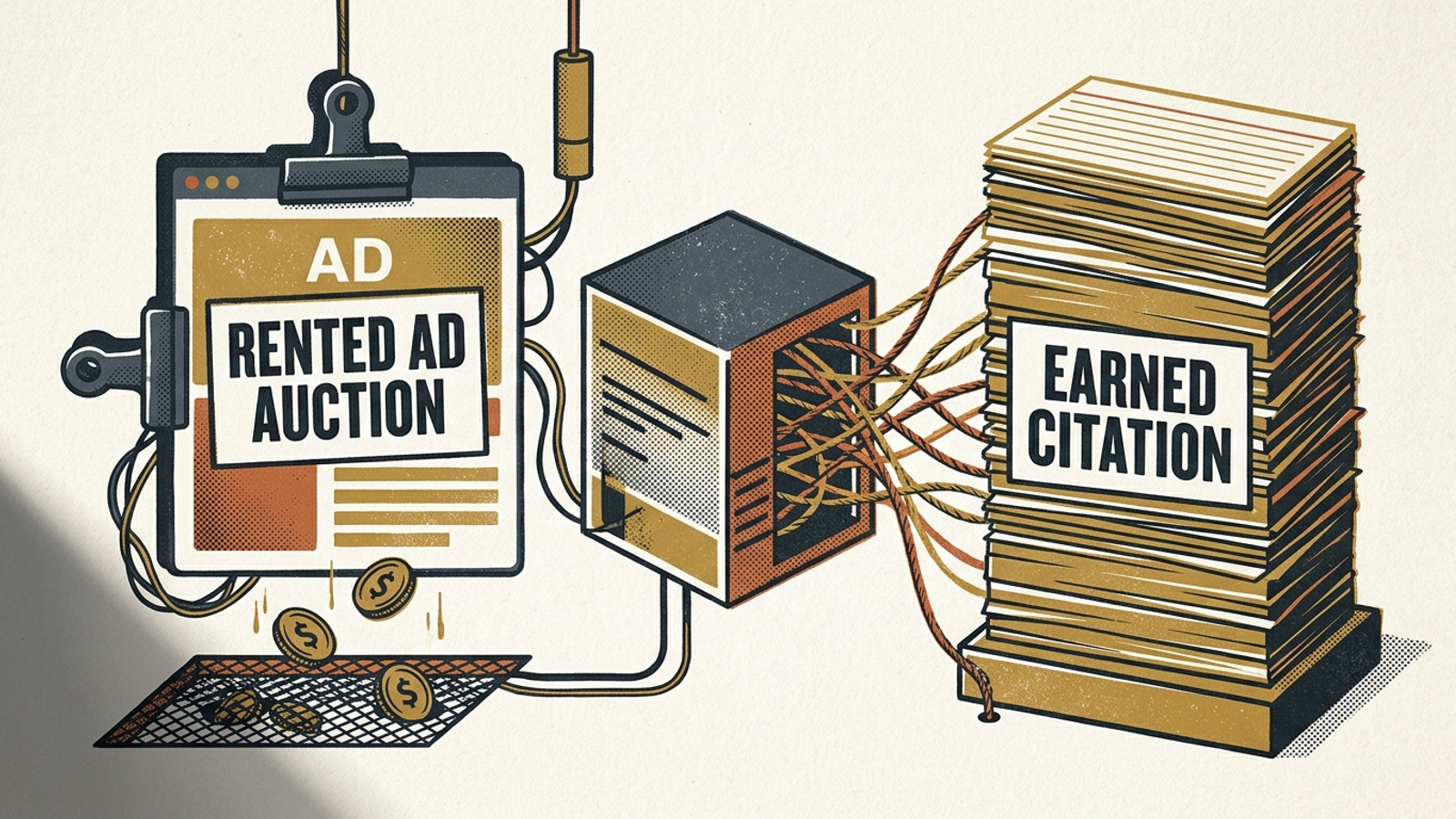
According to Google Ads documentation on AI Overviews, you cannot isolate AI Overviews as a standalone ad placement. Eligible Search, Shopping, and Performance Max ads may appear around or within them, but you cannot build a dedicated AI Overview campaign and buy your way into the answer’s sources. As operators note in r/PPC discussions on AI Mode, placement controls and prompt-level reporting do not give you the tidy levers you might expect from a new inventory type.
More important, the objects do different jobs. A sponsored unit is an auction result. A citation is a source selected for the generated answer. Paying for the former does not make the latter more likely. If you collapse both into a single “show up in AI” budget, you risk buying loose informational traffic and then calling it progress on organic visibility. Semrush’s AI search data also points to how much AI Overview activity sits around informational rather than transactional queries. That is a poor reason to turn broad match into a citation plan.
Do instead: Keep paid ads for commercial demand and give earned citations their own content work and scorecard. If the terms are getting tangled, start with our AEO glossary for people who learned search in Google Ads. Do not let one placement stand in for the other.
Belief 2: “Pick the keyword, build the page”
A clean Google Ads build starts with the phrase. Find “commercial refrigeration repair,” make an ad group, write the ads, and send the click to a relevant landing page. The structure is satisfying because you can see where every term belongs. It is tempting to carry that structure into AI visibility: find a phrase such as “best B2B billing software,” then commission a page around it.
But a buyer can ask an answer engine something closer to this: “We are an 80-person B2B SaaS company moving from flat retainers to usage-based billing on Stripe. What software prevents revenue leakage without custom engineering?” That prompt contains several questions. A useful answer may need material on usage metering, reconciliation, and engineering work, not one page repeating the root keyword.
Research from Oltre AI on citation patterns describes citations drawn from self-contained answer passages, often near the top of a page. A page must answer a buyer’s compound question in passages an engine can use, not merely announce that it targets the right term. A long promotional overview can rank for a phrase and still give the answer engine little worth extracting.
Do instead: Map the questions buyers ask during an evaluation. Put direct, factual answers beneath clear subheadings, with the relevant constraint or comparison in the passage itself. Keep the keyword if it helps a human find the page; do not mistake it for the whole assignment.
Belief 3: “Position one means I get cited”
Position one was the prize in traditional search. In paid accounts, operators watched Absolute Top of Page; in SEO, teams fought to move a result up a few slots. So it feels natural to assume an AI Overview will summarize the first few blue links.
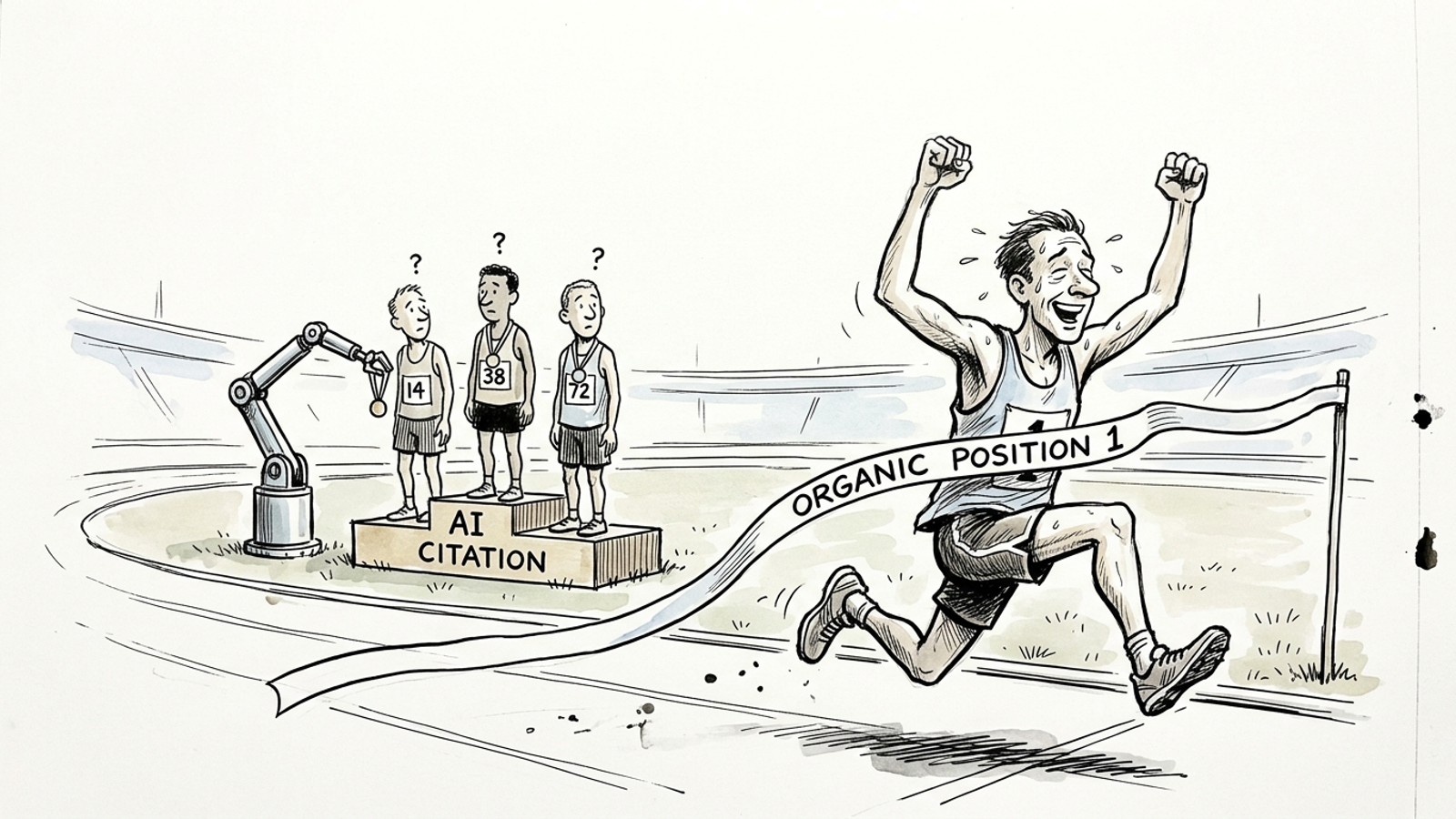
The overlap is not that neat. An Ahrefs analysis of 863,000 SERPs and 4 million AI Overview URLs found that 37.9% of cited pages ranked in Google’s organic top 10 for the query. Another 31.2% came from positions 11 through 100, and 31.0% did not rank in the top 100. BrightEdge’s research on generative answers found a similarly wide gap in e-commerce, with organic citation overlap at 22.9%.
Those figures do not make rankings irrelevant. They do mean position one is not a citation guarantee. An answer engine needs passages that address the question it is assembling an answer to. A page can sit high in ordinary results while burying its useful explanation below an introduction, product pitch, and six paragraphs of “in today’s landscape.”
Instead of treating a move from position 4 to position 1 as the only route to an AI answer, consider fixing an existing page already at position 8. Put the answer where it can be found and understood. That is work you can do without pretending a ranking change buys a citation.
Belief 4: “ChatGPT and Perplexity read my site the same way Google does”
A familiar technical routine is reassuring: submit the XML sitemap, check Google Search Console, confirm the important pages are indexed. It is tempting to call distribution handled. But a Google checkmark tells you what Google can access. It does not tell you how another answer engine will retrieve a source for a particular question.
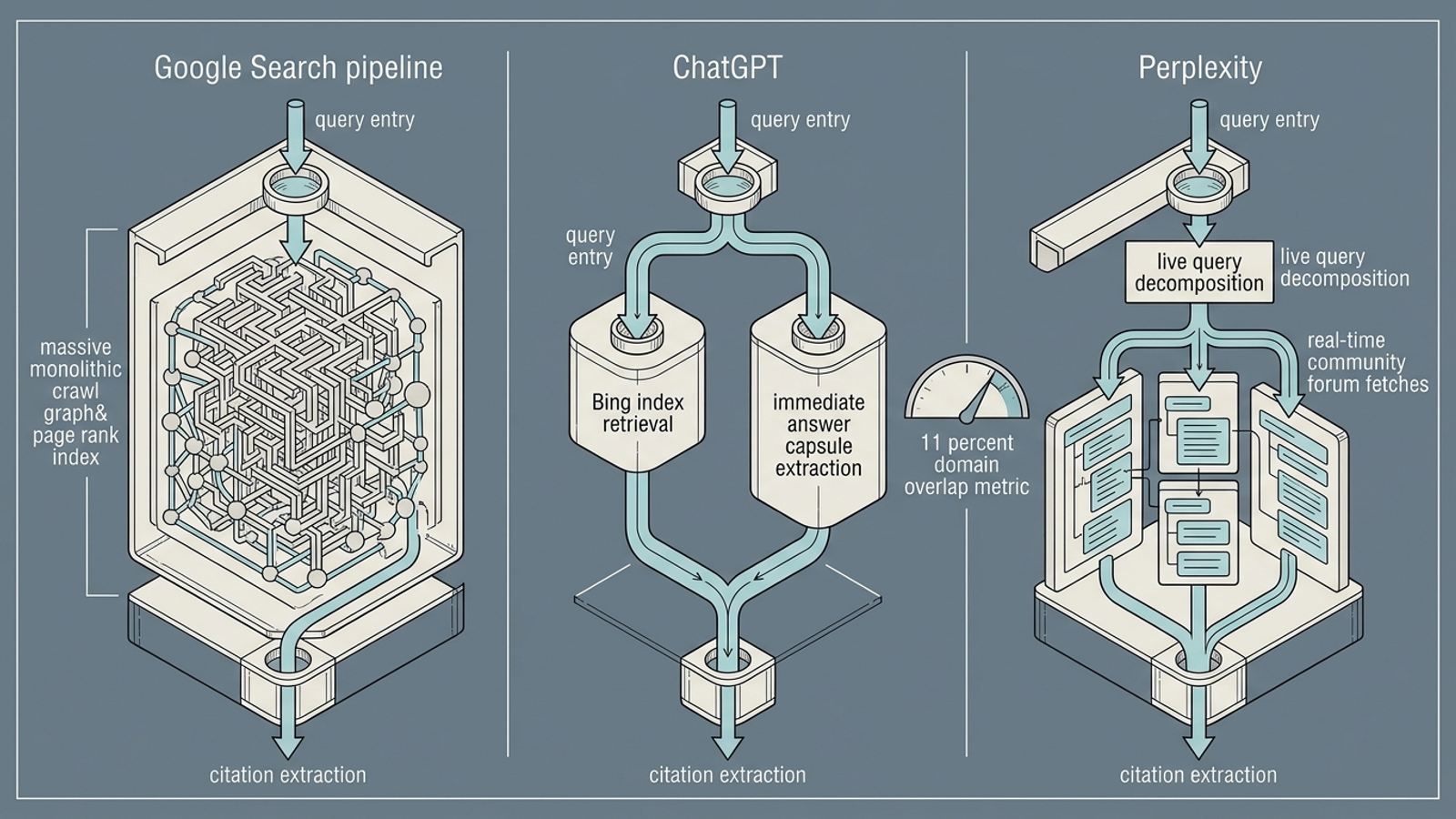
ChatGPT’s search functions draw on Bing retrieval and targeted browser calls; Perplexity combines query decomposition with retrieval and live web fetches. Their source sets can diverge sharply. Meev’s analysis of Perplexity source selection cites research finding that only 11% of domains were cited by both ChatGPT and Perplexity for identical queries. A page that depends on heavy client-side JavaScript can also present differently to a fast live fetch than it does after a fuller render.
That means a Google-only visibility check can leave a real blind spot. The cost is not just a missed technical ticket; it is spending weeks rewriting copy for an engine that may not be retrieving the page as you expect. Our comparison of ChatGPT vs Perplexity vs Google AI Overviews lays out the different mechanics.
Do instead: Check whether your important answers are accessible and show up as sources across the engines you care about. Do not use Google indexation as a proxy for every answer engine’s view of your site.
Belief 5: “If I publish more pages, I’ll show up more often”
In PPC, expanding a useful keyword set can create more chances to enter an auction. It is easy to translate that into a content target: publish 50 posts covering every permutation of your category and give answer engines 50 chances to notice you.
But 50 pages on your own domain are still your company making its own case. They do not provide 50 independent confirmations of a product claim. Answer engines assemble responses from sources beyond a brand’s site, including community discussions, reviews, and technical forums. The draft’s volume logic breaks at that point: more self-promotional pages do not create outside consensus. A focused set of factual product pages, supported by genuine third-party discussion, gives an engine something clearer to check than a pile of near-duplicate posts.
There is a cost to the volume reflex even when the pages are cheap to produce. Someone still has to maintain them, keep product details consistent, and find the answer a buyer actually needs. Fifty thin variations can make that job harder for humans, too.
Do instead: Make the pages you already own accurate and specific. Then look at the external sources answer engines cite for your category. Prioritize a credible presence there over another batch of posts that repeat your claims back to you.
Belief 6: “I’ll know whether it worked from the dashboard tomorrow”
PPC trains you to watch a change closely. Pause an expensive keyword and its spend stops. Change a bid target and you can return to the interface to inspect what happened. It is natural to rewrite two content subheadings on Wednesday, check analytics on Thursday, see no referral spike, and call the citation test a failure.
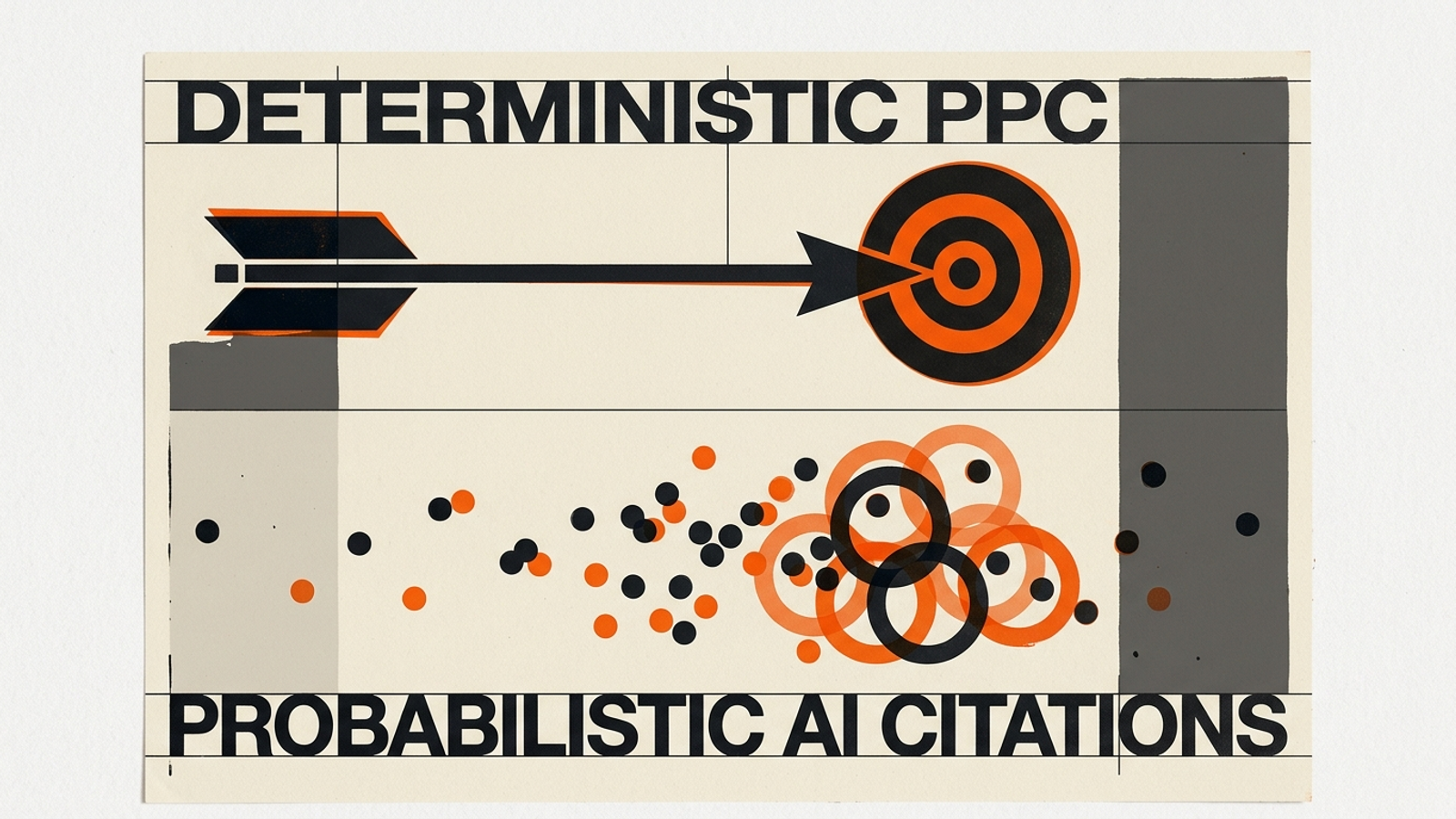
AI answers are a worse fit for that kind of quick read. The same prompt can return different citations across runs as retrieval and answer construction vary. Prominara’s AI visibility methodology argues for repeated tests rather than treating one answer as a stable rank. A single prompt result is an observation, not a performance trend. Neither is one quiet morning in Google Analytics proof that an edit failed.
The alternative is less glamorous than a live dashboard, but more useful: keep a fixed set of buyer prompts, run them repeatedly, record which sources appear, and leave some pages unchanged as a comparison. Then look for a pattern before you declare a win or roll back the work. Otherwise, you can spend a month optimizing for a citation that appeared once by chance.
What I’d tell a PPC operator on day one
I would not tell a Google Ads team to abandon its habits of testing, controlling spend, and asking what reached the pipeline. I would tell it to stop applying auction controls to a sourcing problem. Keep the commercial discipline; change the model of distribution. Three moves are enough to start without buying loose broad-match traffic or ordering twenty generic articles:
- Improve five existing informational pages. Start with the pages that already draw readers. Replace slow openings with direct answers under useful subheadings. Where the page has verifiable facts, pricing ranges, or technical constraints, state them plainly in passages an answer engine can extract without guessing at the context.
- Inspect the sources outside your site. Run your core category questions in Perplexity and ChatGPT. Note which review platforms, community threads, directories, and technical sources appear in the citations. That tells you where another self-promotional post is unlikely to help.
- Make paid and organic teams answer to the same business goal. Separate agency silos can leave one team buying broad informational clicks while another celebrates organic traffic that produces no pipeline. At groas, we run paid ads and organic visibility through one autonomous engine with continuous execution and human strategic guardrails. Media spend and content work should draw on the same business context, even though ads and citations need separate measures.
None of that requires pretending a citation is an ad you have not learned to bid on yet. It requires treating the answer itself as a different surface, with a different reason for including you.
The belief I’m still not sure about: “Citations will pay off like high-intent clicks”
This is the paid-search question I cannot settle by fixing a subheading: how much commercial value does an earned citation produce? With an exact-match search ad, the path is comparatively visible. Someone searches for “enterprise compliance software pricing,” clicks, reaches a demo form, and either enters the pipeline or does not. You can argue about attribution, but you can see the paid click and its cost.
An answer engine can use your site to explain a pricing model or answer a comparison without sending the reader to you at all. That makes a citation meaningful as evidence that your material helped shape an answer, but it does not make the citation equivalent to a site visit, let alone a sale. Some readers will click a source to examine it further. Others will get what they need from the answer and leave.
I know what I would do to give a page a better shot at being cited. I would still measure whether those citations bring qualified visitors and pipeline, rather than awarding them the value of paid conversions on sight. The expensive PPC mistake is to buy an ad and count it as an earned recommendation. The open question is whether an earned recommendation can produce revenue as reliably as the high-intent clicks we know how to buy.