

 LinkedIn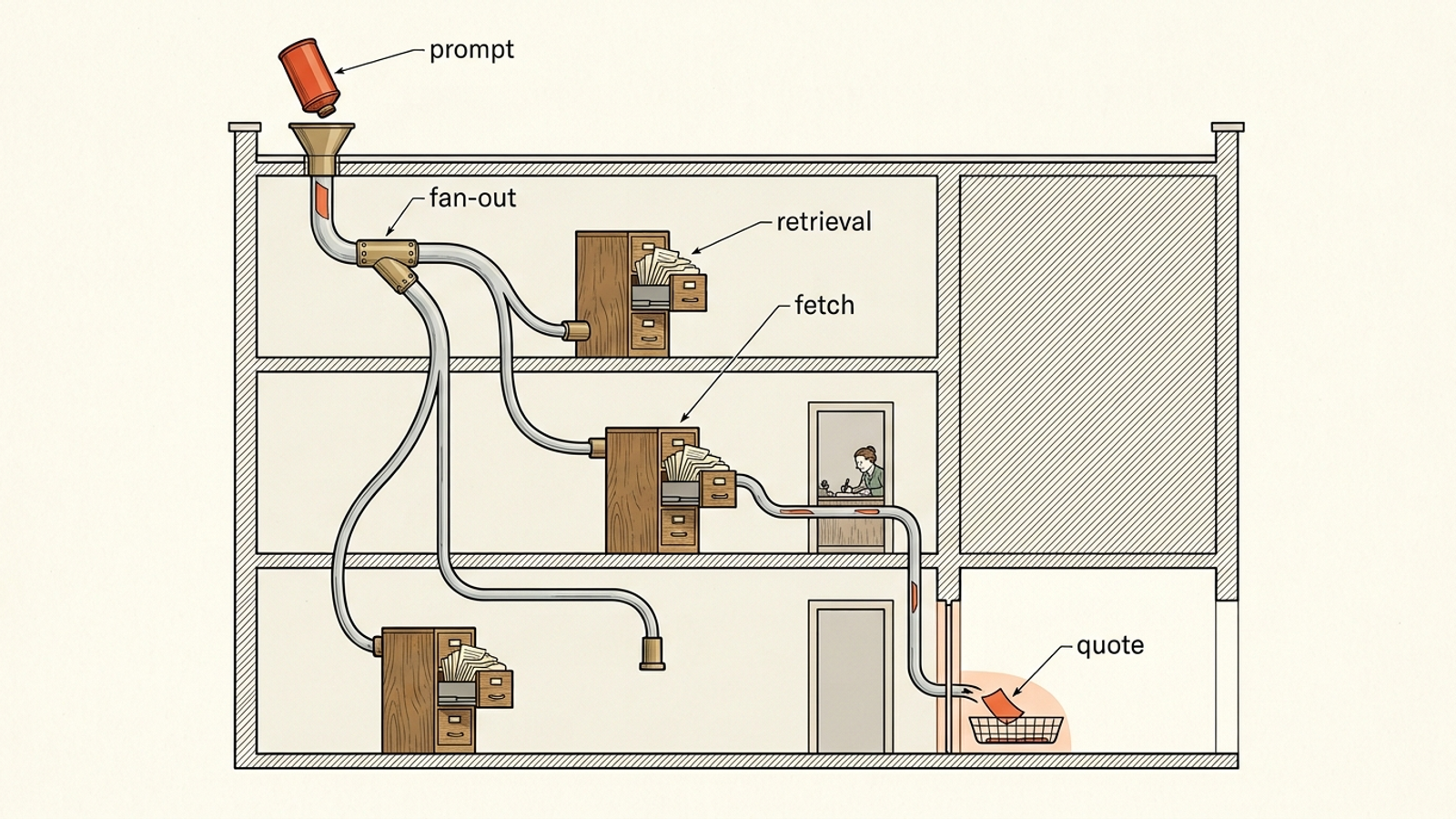
A buyer asks ChatGPT who should manage a $20k-a-month Google Ads account. Your brand gets left out. The tempting question is, “Which prompt did we lose?” That is the wrong place to start.
The buyer’s prompt is not necessarily the search the assistant runs. It can become several background searches; the assistant retrieves pages against those searches, then draws its answer from particular passages. A prompt tracker records the question you supplied and the answer you got. It may leave out the steps that decided whether your brand appeared.
Every PPC person knows the distinction: the keyword is what you bid on; the search term is what actually triggered the ad. I think about AI prompts and background searches the same way. Say a SaaS founder asks ChatGPT, “We spend $20k/month on Google Ads, who should manage it?” The assistant might search for best Google Ads management for SaaS 2026, Google Ads agency reviews SaaS, and Google Ads management pricing $20k spend. Those are illustrative searches, not a transcript of that founder’s session. But they show why ranking for the words in the prompt may not be enough.
First, the prompt becomes a set of searches
Google calls this query fan-out: breaking a question into subtopics and issuing related searches. Its documentation says AI Overviews and AI Mode may use the technique. Independent estimates put AI Mode at 8 to 12 sub-queries per question. In a study of five million ChatGPT fan-out queries, the average was 2.1 background searches per prompt. The systems differ, but the practical distinction holds: the prompt is the brief; the sub-queries are the searches your pages have to meet.
Our founder supplied two useful facts: SaaS and $20k in monthly spend. The assistant can keep those facts while adding language it expects to help answer a buying question. In that ChatGPT sample, best appeared in 15.33% of fan-outs, reviews in 6.84%, and 2026 in 5.44%. That is how a plain question about management can turn into searches about agencies, reviews, and pricing.
The study also describes results being merged with Reciprocal Rank Fusion. For this example, a page that speaks to both SaaS management and pricing has a clearer route into the combined results than a page written only around the broad phrase Google Ads management. That does not mean every page must answer every possible question. It means a buyer’s specific need can disappear between two pages that each answer only half of it.
Before writing anything, I would list the plausible sub-queries and ask which existing page answers each one. That is a better starting point than collecting prompts that contain the brand name.
Next, retrieval narrows the field
Here the PPC analogy is useful, but it has a limit. In Google Ads, you can inspect a search terms report. An AI answer does not hand you an equivalent report showing every background search and every page considered. You have to work with partial views.
An Ahrefs study of 1.4 million ChatGPT prompts found that the assistant pulled around 33 URLs per prompt and cited about half. Being retrieved is not the same as being cited. A page can enter the pool and still contribute nothing visible to the answer. For our founder’s question, that pool might contain agency lists, pricing pages, and discussions of percentage-of-spend fees. The assistant still has to choose what it can use.
In the same study, 88.46% of citations came from general web search, and similarity between a page title and the fan-out query was associated with citation. Cited pages averaged 0.656 similarity. Reddit supplied 67.8% of the non-cited pool, with a 1.93% citation rate. The lesson is not that a matching title guarantees a quote. It is that appearing somewhere in the retrieved pile tells you much less than you might think.
I used to tell clients to write for the head term. For this job, that advice is incomplete. If the assistant searches for SaaS Google Ads agency reviews and your relevant page is titled around generic “growth solutions,” you are making the match harder to see. Give the page a title that describes the question it answers, then make sure the page delivers on it. A title is an invitation to read, not a substitute for an answer.
Then, a live fetch leaves a trace
Background searches happen inside the assistant. A live request to your site is different: it can appear in your server or edge logs. OpenAI documents separate crawlers, including ChatGPT-User for user-initiated requests, OAI-SearchBot for search, and GPTBot for training. If you want to inspect live-answer requests, do not lump all three together. They do different jobs.
Our edge logs show the imbalance. The homepage received 917 ChatGPT live-answer fetches; one changelog post, /post/google-ads-updates-2026, received 228. Category pages received almost none. An earlier account of the changelog and category-page pattern is worth a look if you want to see why the URL-level view matters. An account-wide total would have hidden which pages were getting the requests.
A fetch is evidence that a URL was requested, not a record of the prompt that caused it. Nor does the absence of a live fetch prove a page could not appear in an answer: assistants can work from indexed or cached material. That boundary matters. Across the web, OpenAI’s total crawl tripled after the GPT-5 launch, with OAI-SearchBot up 3.5x, while ChatGPT-User live-fetch volume fell 28% from December to March as more answers came from cache. A zero in your live-fetch column is a clue to investigate, not a verdict on every answer.
Still, the logs give you something a prompt scoreboard cannot: the URLs the assistant actually requested live. For our SaaS example, I would compare the homepage with the pricing and SaaS pages. If the homepage takes the fetches while the more specific pages take none, I would inspect how those pages are titled and linked before rewriting their copy.
Finally, the answer needs a passage it can use
A fetched page is not automatically a cited page. The assistant needs text that answers the question without making it assemble a claim from a slogan, a calculator, and four disconnected paragraphs.
Placement matters, too. In a 100-citation sample of Google AI Overviews, 55% of cited passages appeared in the first 30% of the source page; 21 appeared in the first 10%. The same analysis found 44.2% of 18,012 ChatGPT citations in the first 30%. That is not an instruction to cram every answer into the opening screen. It is a reason not to bury the one answer a buyer came for.
Return to the founder spending $20k a month. A useful page could put a question-style subhead near the top, then answer directly what management covers at that spend and how its fee works. If the business has relevant SaaS proof, put it where the reader can find it. Do not invent a result to fill the space. The mechanism is simple: make the answer easy to find and self-contained enough to use. The fuller account of this retrieval-and-citation pipeline is in Getting Cited by ChatGPT and Perplexity Is a Retrieval Auction.
This is where the analogy to a search terms report stops. A search term helps explain why an ad entered an auction. Here, even after a page enters retrieval, a particular passage may determine whether the brand makes it into the answer. You have to inspect both the match and the words on the page.
Diagnose the broken joint before changing the page
I use content gap to mean a break in that chain, not simply a topic absent from the blog calendar. For the founder’s prompt, three different problems can produce the same disappointing brand-mention report:
- No page answers the likely sub-query. You have a SaaS page and a pricing page, but neither answers the combined question about SaaS management at $20k in monthly spend. Add a direct passage where it belongs; do not default to another broad blog post.
- The relevant page is not getting live fetches. Our category pages showed almost none. That does not prove they never influence an answer, but it gives us a reason to inspect their titles, internal links, and fit with the likely sub-query before polishing a passage nobody appears to request live.
- The page gets fetched but offers no direct answer. A homepage can receive many requests and still make a specific pricing or management question hard to answer. Put the relevant answer under a clear subhead, near the top, with the real number if the page has one.
Notice that these are not three names for “write better content.” Each calls for a different edit. Adding a passage will not by itself explain why the relevant URL is absent from your fetch logs. Improving a title will not make a vague paragraph quotable. Find the broken joint first.
Use prompt tracking as a scoreboard, not a diagnosis
A tool that runs 25 buyer prompts each week and records whether your brand appears answers a real question. I would use it to watch mention rate on the prompts I chose to test. That is a scoreboard. I distrust it when the scoreboard is sold as the explanation.
A brand-mention result alone does not tell me which background searches ran, which URLs entered retrieval, which ones were cited, or whether a page was requested live. When a tested prompt names a competitor instead of you, several explanations remain open. Maybe no page answered the relevant sub-query. Maybe an existing page was passed over. Maybe it was read but offered no passage the assistant could use. The prompt result does not distinguish those cases.
That is why a prompt report without sub-query and page-level evidence resembles a keyword report without search terms. It tells you what happened at the surface. To decide what to fix, you still need to work backward through the chain. Treat guessed sub-queries as hypotheses, fetch logs as URL-level evidence, and a citation as evidence of the passage the answer exposed. Do not pretend any one of them is the whole record.
Try the model on a prompt you have never tested
Say you run a garage door company spending $8k a month on ads. A buyer asks ChatGPT why the leads cost so much. Start with the question, not your mention rate. What might the assistant search? Perhaps garage door lead cost 2026, best garage door marketing agency reviews, or how to lower cost per booked job. Write them down as guesses, not as searches you claim to have observed.
Now follow the chain in order:
- Match the possible searches to pages. Which page has a title that clearly fits each question? Do not count a page merely because it mentions “garage doors” somewhere in the body.
- Look for the answer on each page. If a buyer lands there, can they find a short, direct explanation near the top? If you have a relevant number, is it stated plainly rather than hidden in a calculator or a slogan?
- Check the live-fetch view. Filter your edge logs for ChatGPT-User over the last 30 days and list the requested URLs. Compare the pages you expected to see with the pages that actually appear. Remember that a missing live fetch is not proof of a missing citation.
- Choose the edit that fits the evidence. If there is no matching page or passage, write one. If the specific page is absent from the live-fetch view, inspect its title and internal links. If it is fetched but the answer is scattered, bring the answer together.
I keep a one-page sheet in the shape of the old search terms sheet: buyer prompt, plausible background searches, page that should answer each one, and ChatGPT-User fetch count for those pages. It cannot reveal the assistant’s private query history. It can stop me from rewriting a paragraph when the real question is why I expected that URL to be read in the first place.
For the garage door prompt, the model gives me a next move before I run another prompt test: check whether there is a page that answers cost per booked job, then see whether that page gets requested and whether its answer stands on its own. Track prompts if you like. Fix the sub-query match, the page path, and the passage that the answer can actually use.