

 LinkedIn
The white-label SEO reseller sheet I keep seeing puts the biggest counts beside the work least likely to earn a client an AI citation. I chose this composite sheet because its familiar Starter, Growth and Agency tiers make the problem easy to see: more keywords, more pages, more backlinks and a white-label report, while the work that might get a client cited in ChatGPT or AI Overviews is vague or absent.
This is not one vendor’s PDF. It follows the pattern across reseller pages, including Starter packages with 15 keywords and 5 backlinks scaling to Agency packages with 100 keywords and 30 backlinks. I’ll read it in the order an agency buyer encounters it, grade each line keep, rework or cut, then put the costs beside the work the sheet leaves out.
The package tiers: tidy counts, unclear outcomes
The composite sheet starts with wholesale tiers around $299 a month for Starter, $599 for Growth and $999 for Agency. The familiar lines follow: a keyword count, an on-page page count, a backlink count, local citations and GBP management on local plans, and a monthly white-label ranking report. Starter can be resold for $599 to $799. The counts rise as the price rises. Whether the work improves the client’s presence in an AI answer is a different question.
I understand why providers build sheets this way. They need fulfillment they can repeat across agency accounts, so they sell units a team can count: keywords tracked, pages touched, links built, citations submitted. The agency pitch is 40 to 60% gross margin on a 2x to 3x markup, month to month with no minimums. It sounds clean until a client asks what those units bought them.
My verdict on the tiers: the counts make the package easy to sell, not easy to defend. I would not buy a larger tier just because its backlink and keyword columns get taller. Start with the first line that usually draws the eye.
Line 1: X backlinks per month is the wrong quota
Five backlinks on Starter, 15 on Growth, 30 on Agency. No domains named. No placement standard. Just a count due at month’s end. I used to sell links this way: links were votes, so more links meant more visibility. That explanation misses what a client needs when the goal is to appear in an AI answer.
A link and a quotable independent mention are not interchangeable. Across 25M+ cited links, earned media accounts for 84% of AI citations, against 5 to 10% for brand sites and 0.3% for paid or advertorial content. The same content placed through an independent outlet earned 325% more citations than the brand posting it. In that analysis, branded mentions correlate with citation probability at r=0.664, versus r=0.218 for raw backlink count. Those are correlations, not a promise that any single placement will work. They are still a poor case for buying unnamed links by the dozen.
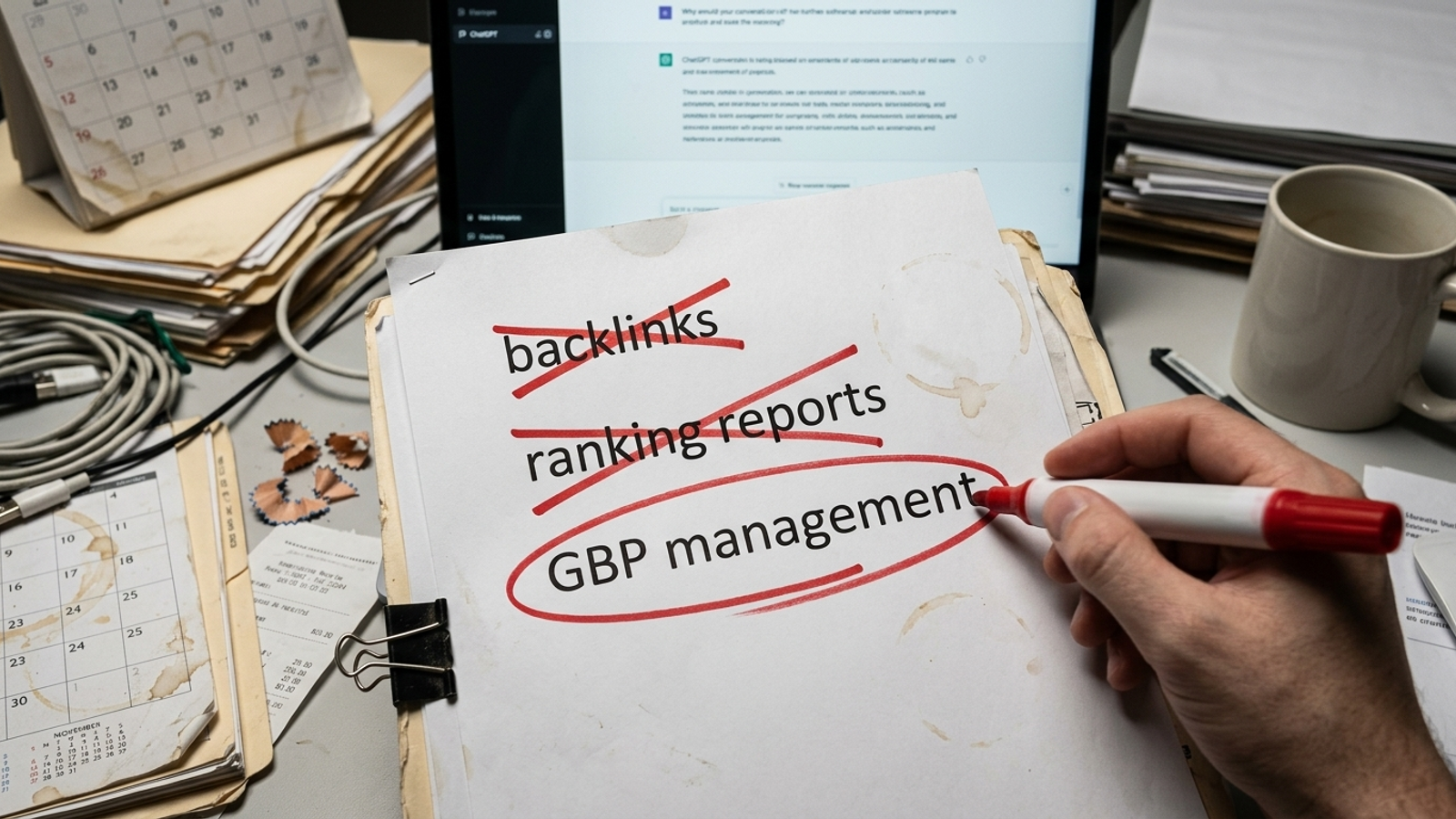
Verdict: cut the monthly backlink quota. An independent mention that says something useful about the client is a better target than a batch of directory links that gives an AI answer nothing to quote. If the provider cannot tell you where a link will appear and why that placement matters, the count is not a strategy.
Line 2: the ranking report measures work it does not do
Next comes the polished PDF. Green arrows sit beside keyword positions; a local Starter sheet may show 25 tracked keywords, while a top local tier can show 150. The client can see movement from position 11 to position 4. It looks like progress because it is a measurement. It is not, by itself, delivery.
Some white-label local SEO plans now add up to five AI prompts alongside keyword counts and an AEO dashboard. The tracked surfaces expand from Google positions to AI Overviews, ChatGPT, Gemini and Perplexity. I would rather see those prompts than another page of green arrows. But adding AI columns to the PDF does not fix the underlying problem: a dashboard can show a citation gap without closing it.
Rankings tell you where a page sits. Citations tell you which passage made it into an answer. AI Overviews cite 3 to 6 passages, and 44.2% of LLM citations pull from the opening 30% of a page. A client can rank third for a term and receive no citation because the direct answer sits behind an introduction and a stock photo. More frequent reporting will not move that answer block.
Verdict: rework the report. Keep per-engine visibility tracking, but require every useful gap to become a page edit, Q&A or outreach decision. If next month’s deliverable is the same gap list with a new date, the agency bought a recurring reminder, not execution.
Line 3: local citations and GBP management earn their place
The local line is easy to dismiss because its units look small. A typical full local plan includes GBP management, 5 citations, 2 local backlinks, Q&A and posts; an à la carte list prices 20 citations at $100 and GBP optimization at $99. Top local tiers scale to 6 GBP posts a month. Compared with a 30-backlink promise, that does not make for dramatic sales copy.
It is also the line I would keep. A complete, active GBP with review content is described as the highest-leverage asset for local AI answers, ahead of best-of lists and consistent NAP mentions. The mechanism makes sense for the local question a customer actually asks: the business needs an accurate profile, evidence of what it does and mentions that agree about who and where it is. A pile of submissions cannot compensate for a half-finished profile.
That does not mean buying citations as volume. I would rather pay attention to ten correct, category-matched listings and a GBP with accurate hours, services, photos, posts and review responses than celebrate fifty submissions while the profile stays incomplete. Those jobs should be checked for completeness, not waved through because a quota was met.
Verdict: keep local citations and GBP management, but buy completeness rather than submission volume. This is the sheet’s strongest local AI citation line. Make the provider show what is accurate, active and still missing.
Line 4: on-page optimisation needs a shipping spec
Then the sheet promises 5 pages on Starter, 15 on Growth or 30 on Agency, plus 2 to 4 articles. It rarely says what will happen to any one page. A title rewrite? A meta description? Headers moved around? I used to bill on-page that loosely. In practice, it could mean whatever the fulfillment team had time to touch that month.
For AI citations, “page optimised” is not a useful acceptance test. The page either offers a direct, self-contained answer a model can quote, with supporting evidence the reader can inspect, or it does not. A 10k-query test across AI engines found that named-source statistics lifted citation rate 41%, expert quotes lifted it 28%, and citing authoritative sources lifted citations for lower-ranked pages 115%; keyword stuffing cut citations 10%. The useful instruction is not “add more keywords.” It is to give the passage a clear answer, attribution and a reason to be trusted.
That makes the page count worth keeping, provided the line says what ships per page: a direct 40 to 60 word answer near the top, a named source where the claim needs one, relevant schema and a check against the chosen prompt set. A provider can still count completed pages. The difference is that the buyer can inspect what completed means.
Verdict: rework with a per-page spec. Do not pay for 30 vaguely touched pages when the passages a client needs quoted remain buried. Define the work before the monthly count goes on the invoice.
Line 5: the sheet omits the checks that can decide a citation
By this point, the pattern is clear. The sheet bills for production units but skips three jobs that can determine whether a client appears in an AI answer at all.
- Check discovery and crawler access. ChatGPT still discovers local businesses through the Bing index, so the site needs to be in Bing Webmaster Tools, imported from Search Console. Server settings should not block model crawlers, and pages need to render clean HTML. I have seen local sites invisible to ChatGPT for months for a reason as ordinary as an unclaimed Bing property. That check does not fit neatly into a monthly quota, which may be why it is missing.
- Map an answer to each important page. The suggested format is a 40 to 60 word self-contained answer near the top, with the business name, city and phone in the block, plus LocalBusiness and FAQPage schema underneath. It is unglamorous work. It also gives an engine a passage it can use instead of asking it to assemble the answer from scattered copy.
- Turn per-engine tracking into fixes. Monitoring ChatGPT, AI Overviews, Gemini and Perplexity earns its fee when a missed prompt leads to a page edit, a Q&A or a best-of-list pitch. Otherwise it belongs in the same folder as the ranking PDF: attractive evidence that the problem still exists.
A file called llms.txt is not my replacement for those jobs. It is ignored by Google AI and ChatGPT. Verdict: add discovery, answer mapping and fix-driven tracking as explicit work. If a proposed AI-era line cannot name the crawler, passage or engine involved, ask what will change when the provider completes it.
Re-pricing the sheet exposes the missing work
The old wholesale total runs $299 to $999 per client per month, before local add-ons. The draft reseller pitch puts local extras at $100 to $400, while the 2x to 3x resale markup is used to support a 40 to 60% margin pitch. The base tiers recur; a citation batch or GBP setup is a different kind of charge. Vendors obscure that distinction when they bundle everything under a monthly package name.
These figures are price anchors, not an additive shopping cart. The base tier bundles work that appears again in à la carte listings, and the replacement lines have different scopes. Where a price varies, the question is what is included, how often it is done and whether the provider names the placement, page or engine.
| Line item | Listed cost and cadence | What I would buy instead | Source |
|---|---|---|---|
| Wholesale base: Starter / Growth / Agency | $299 / $599 / $999 per client, monthly | Rebuild around specified work rather than a bigger quota | Reseller tiers |
| Local citations | Bundled on local plans; 20 submissions priced at $100 à la carte per batch | Correct listings, with accuracy checked before another batch | À la carte list |
| GBP optimization | Bundled or $99 à la carte for optimization; ongoing maintenance is separate | Keep the initial fix distinct from recurring management | À la carte list |
| Backlinks | Quota bundled; 3 local links and 2 guest posts each listed at $150 à la carte | No unnamed monthly quota | À la carte list |
| Full Local Management | $399 monthly for GBP, citations, posts and audit | Keep, with completeness and work visible | Local plan |
| AI visibility tracking | Dashboard add-on; price varies | Monitoring listed at $29 to $489, or $199 per engine on Ahrefs, only when gaps trigger fixes | AEO tool pricing |
| Answer-first pages and schema | 2 to 4 generic articles bundled | Around $1,497 as a mid-range anchor for schema plus 3 to 5 pages; scope is the cost driver | AEO cost anchors |
| White-label execution | Not a defined line on the old sheet | From $199 per domain, recurring, for groas’s agency offering | groas for agencies |
Here is the margin exercise on 10 client domains. Sell the old Growth sheet at $1,199 retail against $599 wholesale and the difference is $600 per client, or $6,000 across ten, before your other costs. It looks fine until the client asks why the ranking report has not turned into a ChatGPT citation. The wholesale bill still arrives whether you can answer or not.
At the same $1,199 retail price, roughly $399 in local fulfillment plus $199 for groas’s tracked execution leaves about the same $600 difference per client before other costs. Those figures do not make every scope interchangeable. They show where I would rather put the spend: into local management and execution I can point to, instead of a larger link count and a report explaining it.
The cheapest mistake is treating a $100 batch of 20 directory submissions as if it bought AI citations. The most expensive is paying $999 a month for an Agency tier led by 30 backlinks while the GBP and the answer block remain untouched. Cut the quota, keep the local work and price the rest against passages and engines.
When the client asks, “Are we in ChatGPT?”
Do not forward the ranking PDF. I used to do that, and it bought me about two weeks before the same question came back louder. The useful answer sounds more like this: here are the prompts we test, here are the answers that cite you, here is where a competitor appears instead, and here is the page edit we are shipping next. The client can see both the miss and the work meant to address it.
That is the point of my open letter to the SEO agency owner asked, “are we in ChatGPT?”. A dashboard can start the conversation, but it cannot stand in for action. If the report is still the retainer, the retainer mistake agencies keep repeating is worth reading before the next QBR.
The practical test is simple: answer with a citation, a miss and a ship date, not a position number. That gives the client something to judge next week besides the colour of an arrow.
Overall verdict: keep the local line, rewrite the sheet
I would cut the monthly backlink quota, stop selling the ranking report as delivery and refuse undefined on-page optimisation. I would keep GBP management and accurate local citations. I would keep per-engine tracking only when it leads to a fix, then add the discovery checks, answer blocks and independent mentions the old sheet fails to specify.
That leaves about a third of the familiar sheet worth keeping. The rest is overhead unless the provider can show what passage, profile or citation opportunity it changes. The cheapest mistake is confusing a completed submission with an AI citation. The most expensive is renewing a bigger tier because the counts went up while the client remains absent from the answer.