

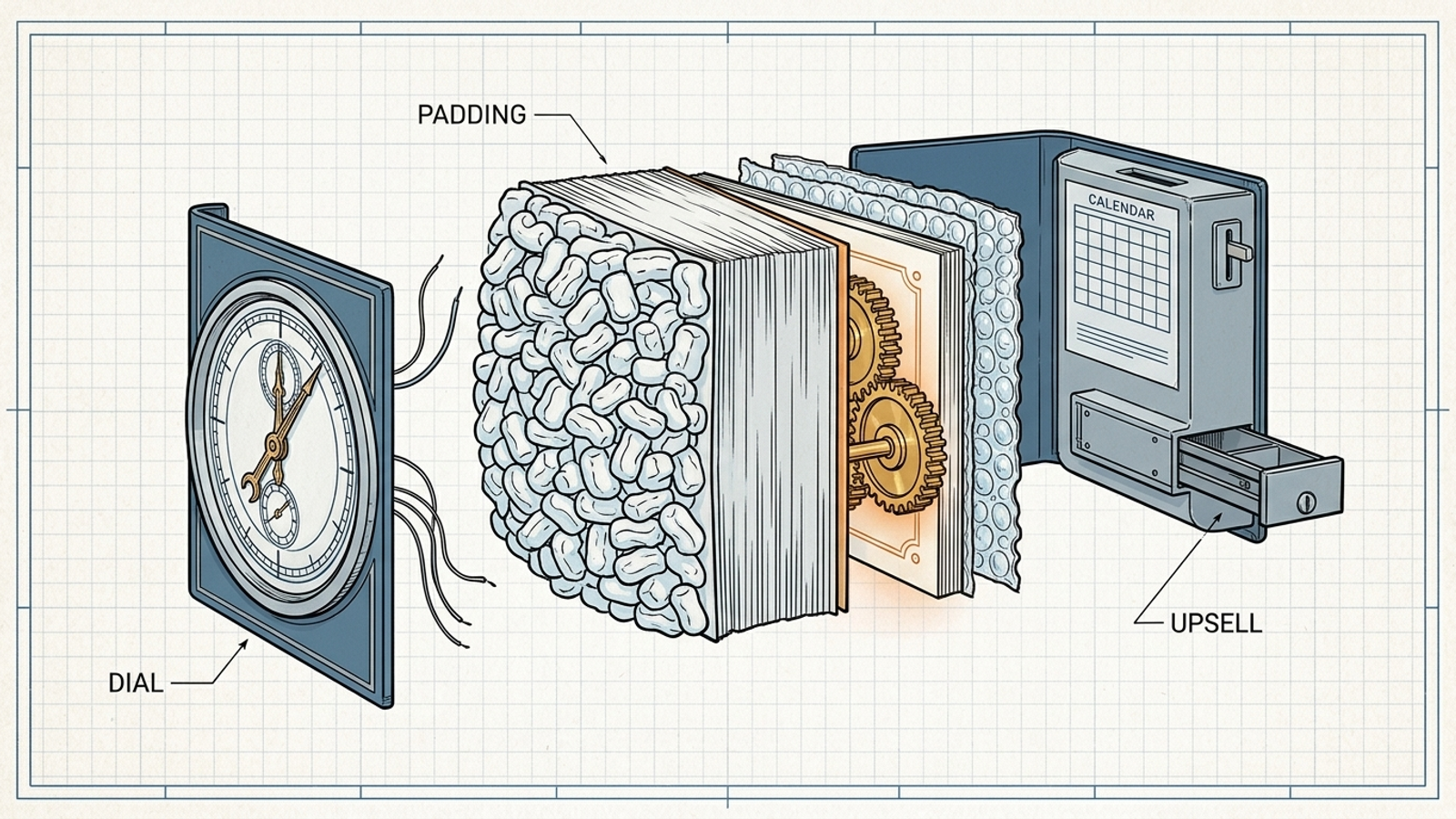
A 28-page AI content gap report can tell you everywhere your brand is missing and still fail to tell you what to fix. I chose a composite of the standard agency deliverable for this teardown because its structure is familiar: a visibility score up front, a mountain of monitoring data in the middle, and a content retainer at the back.
It is often sold under titles like Generative Engine Optimization (GEO) Content Gap Audit or AI Search Visibility Analysis. Across its twenty-odd sections, only a handful point to a page you can write or repair to improve your chances of being cited. I’ll follow the report in the order a buyer reads it and grade each part action, decoration, or upsell. The test is simple: does this slide identify a source, a missing proof point, and a change someone can make?
The cover promises a diagnosis; the pages promise a lot of work
The report borrows the look of an enterprise technical SEO audit: a composite score, a traffic-light grid for ChatGPT, Perplexity, and Google AI Overviews, competitor charts, scraped prompts, missing-topic lists, technical flags, and a 90-day calendar full of 2,000-word articles. It feels rigorous because it is heavy.
But monitoring is not a plan. A prompt where your brand is absent tells you what happened in that answer. It does not, by itself, tell you whether to fix a product page, clarify a limitation in your documentation, or pursue an external reference. That distinction is what the deck needs to earn, slide by slide.
Opening slide: the visibility score is decoration
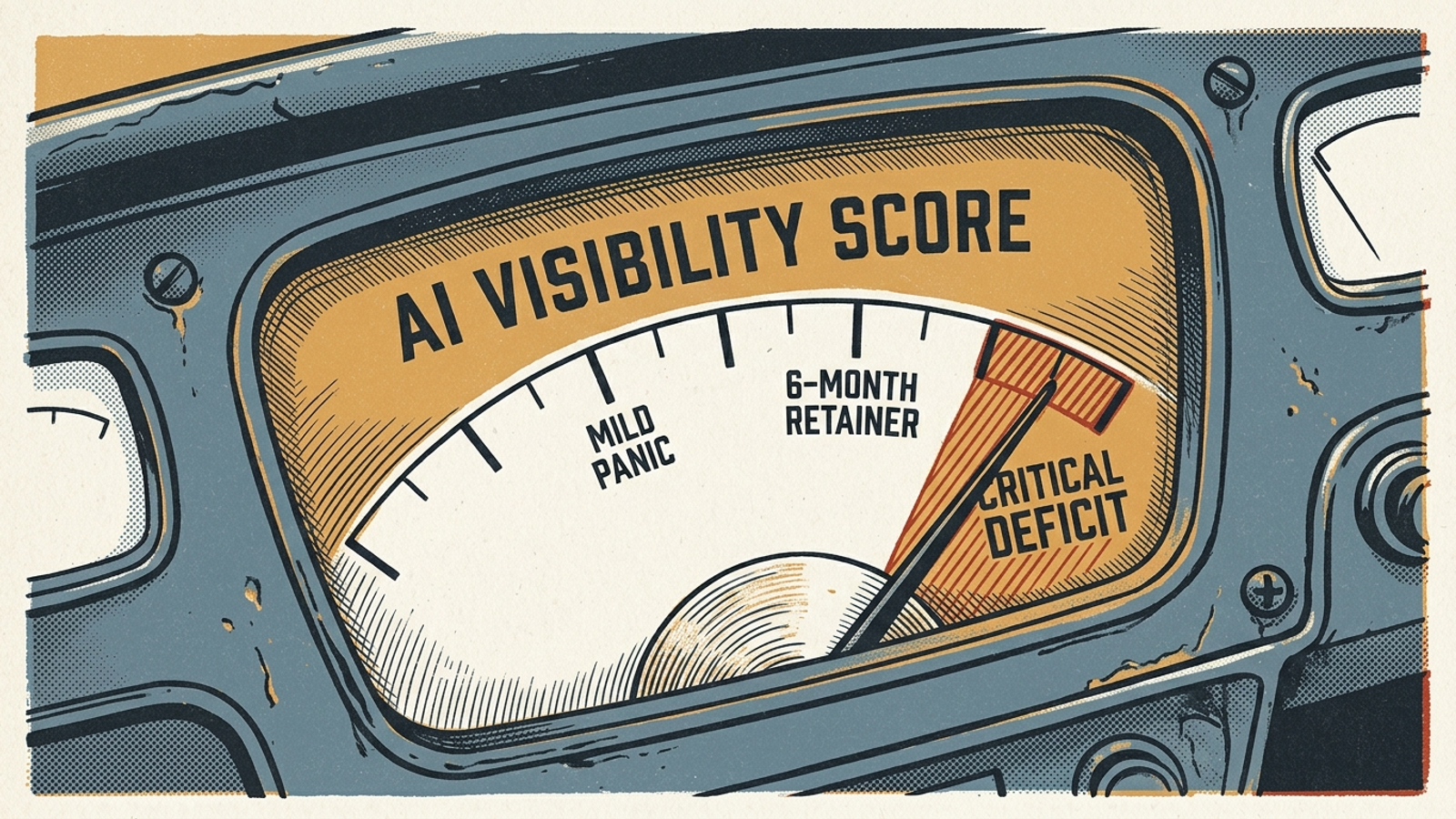
The first number is usually an “AI Engine Visibility Score” or “GEO Readiness Index” out of 100. It has the same job as the automated Google Ads graders agencies used to send small business owners: put an alarming number on the screen before anyone asks how it was calculated.
Take a GEO Health Score of 62 out of 100. Without the tested prompts, sampling method, and a clear connection to buyer intent, that score cannot tell you which page deserves work. An answer can change with prompt phrasing and retrieval conditions; averaging a set of answers into one neat dial conceals those differences. A competitor’s 82 next to your 41 looks decisive. It may only mean the chosen prompts suited the competitor.
Verdict: decoration. Keep the underlying observations if they are available. Do not treat the dial as an operating metric.
Competitor share of voice: action, but only on buyer prompts
A few slides later comes the stacked bar chart showing who gets mentioned or cited. This can be useful. First, look at the prompts underneath it.
Broad category questions such as “best project management software” or “top CRM for startups” tend to put large directories and publishers in the answer. A chart dominated by G2, Forbes Advisor, and TechRadar tells you something about those queries, but little about the pages your buyer needs while choosing between two products. Trying to win every broad category mention is the AI-search version of bidding on the broad-match keyword “shoes.” There is plenty of activity and not much direction.
Now look at narrower evaluation questions: “Brand A vs Brand B pricing,” “reasons teams migrate away from Brand B,” or a specific compliance constraint such as “HIPAA-compliant patient billing software.” If the report shows the URLs cited for those prompts, you can inspect the evidence a prospect might encounter during a purchase decision.
Verdict: action when the prompts reflect your buyers and expose the cited URLs; otherwise decoration. Ask for the prompt set before admiring the bars.
Pages eight through fourteen: missing topics become an upsell
Next comes the long table of “Semantic Theme Deficits” or “Uncovered Prompt Vectors.” Strip away the vocabulary and it resembles a keyword-gap spreadsheet. Competitors appear for prompts about “cloud cost governance tools,” so the report prescribes several introductory articles explaining cloud cost governance.
That recommendation skips the useful question: what did the cited page provide that yours did not? The Princeton GEO benchmark study found visibility gains when pages incorporated verifiable statistics or explicit citations, while keyword stuffing performed poorly in its tests. That does not give every company the same writing formula. It does give the auditor a better place to look than a list of repeated topics.
If a competitor’s cited page contains a specific constraint, comparison, or data point, another generic explainer will not fill that gap. The report should identify what an answer can extract from the competitor’s page, then show whether you have an equivalent source worth improving.
Verdict: upsell when the table turns every absent topic into a new blog assignment. Keep a topic only when the report can name the missing evidence and the page meant to carry it.
The buried cited-source table: action
Around slide twenty-two, the deck finally gets to its best asset: a table of URLs the tested engines linked in their answers. This is the part I would export before closing the PDF.
Retrieval data across 1.4 million ChatGPT prompts suggests that being retrieved and earning an inline citation are different things. An analysis of 15,000 prompts also found limited overlap between cited URLs and Google’s organic top ten for the same query. So a ranking report alone is a poor substitute for inspecting the sources shown in the answer.
The table can reveal a third-party comparison guide, a technical page, or a forum discussion supplying the fact your own material leaves vague. It also gives you something concrete to review: the prompt, the cited URL, the passage that answered it, and the nearest page you already own. Without that last step, even the best table remains a record of what happened rather than a decision about what to do next.
Verdict: action. This is the page to keep, provided you can trace each proposed fix back to a cited source rather than accepting the agency’s interpretation on faith.
Technical flags: one real check inside a padded list
The technical section mixes access problems with an impressively long list of things a crawler can count. Crawler access and rendering belong here. If an important page is blocked from a relevant crawler, or its answer lives in client-side content the crawler does not render, rewriting that answer will not solve the access problem.
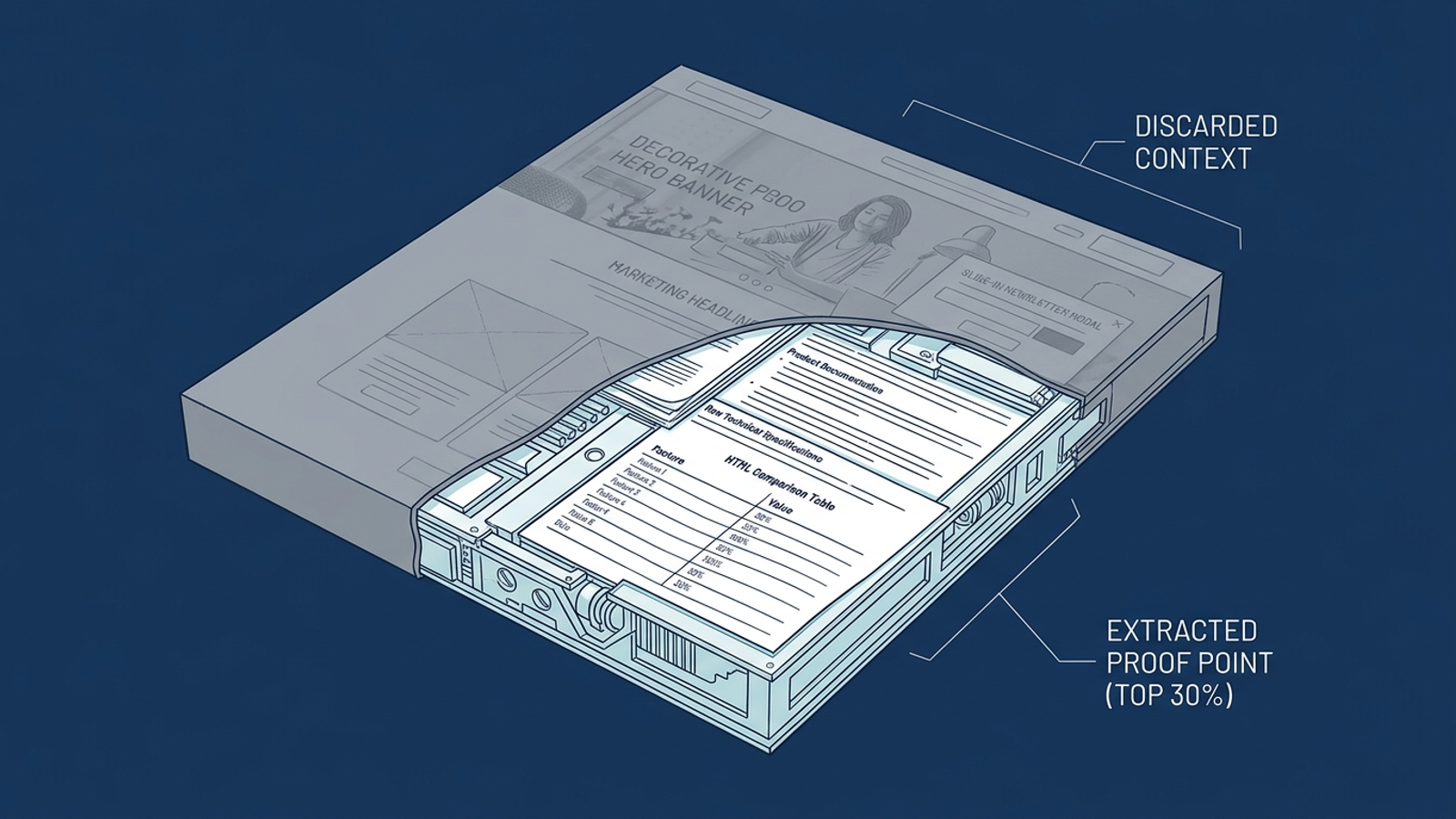
Page structure matters too. Research on AI citations associates citations with descriptive, semantically structured URLs and finds many cited passages early in the page. If your product constraint is buried behind an accordion or absent from rendered HTML, move the answer into clear, accessible page copy before commissioning something new.
Then the section drifts into warnings about every missing JSON-LD property. An extra schema field cannot turn an empty product claim into useful evidence. The report should distinguish a page the engine cannot access from a page it can access but has little reason to cite.
Verdict: action for a demonstrated access or rendering fault; decoration for an undifferentiated list of flags. Fix the obstacle to the answer, not every warning in the export.
Slide twenty-six: the content calendar reveals the sale
Near the end, the diagnosis becomes a ninety-day editorial calendar: twelve 2,000-word blog posts per quarter, often at retainer rates. This is the moment to compare the prescription with the cited-source table. If the winning sources are external review pages, directories, or independent comparisons, why does every proposed fix live on your blog?
One analysis of commercial-intent citations reports that listicles and comparison guides account for a substantial share of cited pages and that many of those guides sit on third-party domains. You do not need to accept a universal rule from that observation. You do need your vendor to explain why an owned article is the right response to an off-site citation gap.
Some owned articles will be worth writing. A calendar that assigns the same format to every problem is not a diagnosis; it is a production schedule looking for a diagnosis.
Verdict: upsell unless each assignment names the buyer prompt, the cited source, and the evidence the proposed page will supply. Decline a twelve-post plan built from topic labels alone.
What the report gets wrong about a “gap”
The deck’s central mistake is treating a missing mention like an unranked keyword. In traditional SEO work, a team might find a query with 2,400 monthly impressions, build an 800-word page, and work on its rankings. In an AI answer, the more immediate question is different: which source supplied the answer’s supporting fact, and what did it make easy to verify?
Say an assistant recommends a competitor for enterprise data migrations. Your missing asset might not be another article defining data migration. The cited source might provide a specific performance benchmark, a migration constraint, or neutral user reviews that your material does not offer. You can only choose a sensible fix after looking at that source and the buyer’s question together.
That is the logic behind earned search execution at groas: turn citation observations into specific proof points, page changes, and off-site targets. A chart can reveal the gap. Someone still has to close it.
Three page types I would investigate before ordering twelve posts
The report’s useful evidence points toward three kinds of pages, not one universal blog template. Which one matters depends on the prompt and the source that currently earns the citation.
1. Documentation that answers the awkward product question
Technical documentation and limitation pages give an assistant something more precise than a slogan. In one analysis of multi-turn buyer evaluation queries, product documentation and help-centre pages accounted for 29% of brand-owned citations, rising to 46% for questions about trade-offs, constraints, or feature limits.
If a buyer asks whether software supports multi-tenant SSO or handles a 50,000-SKU catalogue, an explicit answer in accessible documentation is more useful than “built for scale” on a landing page. Check the relevant help page first. If the answer is missing, buried, or ambiguous, that is a fix with a destination.
2. Comparisons that state the constraints
Head-to-head evaluation pages can address a buyer’s actual choice: where each product fits, where it does not, and which limits matter. A matrix that awards your product a checkmark in every row reads like promotional copy because it is promotional copy. Pricing tiers, throughput limits, implementation timelines, and API rate caps give the reader—and an answer system—something specific to evaluate.
Publishing constraints does not guarantee a citation. It makes the page more useful for the comparison being asked. If you are trying to work out why ChatGPT does not mention your business, look for unanswered evaluation questions before writing another top-of-funnel introduction.
3. External pages you cannot rewrite like a landing page
Third-party profiles, directories, and community threads are the uncomfortable part of an owned-content plan: they do not live in your CMS. An Indexly study of Perplexity buyer prompts found citations across editorial media, forums, and brand-owned pages, with external domains accounting for much of the cited material.
That does not mean you can order an independent publisher or a forum to say what you want. It means an audit should identify the relevant external source and distinguish what you can update, what you can contribute to appropriately, and what you can only monitor. If the cited comparison is elsewhere, another article on your own blog may leave the buyer’s answer unchanged.
Checklist: the seven lines an actionable gap needs
Before paying for the report’s next phase, I would ask for a short worklist. Each gap should connect a buyer question to a source and an executable change. If the vendor cannot fill these fields, the polished PDF is still a reading assignment.
- Exact buyer prompt: The commercial question tested, with the engine and relevant retrieval conditions.
- Cited URL: The competitor page, documentation, review profile, or forum thread shown in the answer.
- Extractable proof point: The statistic, price, constraint, or direct answer the source supplied.
- Nearest page you own: The existing URL that could answer the question, if one exists; check before ordering a new post.
- Specific page fix: The rewrite, table, or direct-answer block needed, plus any demonstrated access problem.
- Off-site target: The external profile, directory, or discussion that matters when an owned page is not the answer.
- Named execution owner: The person accountable for getting the approved change live.
The last item is the one most likely to disappear between diagnosis and delivery. No execution owner means no dependable path from finding a gap to fixing it. That is how an expensive audit becomes a shared-drive ornament while the same citations keep appearing.
Overall verdict: keep the source table, not the page count
On the next vendor call, I would ask: “When this audit finds a missing citation, who makes the required page or off-site change, and how will I see that it went live?” A monitoring dashboard can show an absence. A calendar can fill a quarter. Neither closes the gap on its own.
The composite report earns its fee only when it turns cited sources into assigned work. I would keep its buyer-level prompts, cited-source table, and any demonstrated technical faults. I would discard the anxiety score, the generic topic backlog, and the twelve-post prescription that arrives before anyone has decided which page needs fixing. The best slide in a 28-page deck is the one that lets you stop buying more slides.