

 LinkedIn
A tracker can tell a small business it is missing from AI answers for $29 a month. Should that business keep AI search visibility in-house, or pay someone to get it featured? Smart people disagree because monitoring has become a scheduled software job, while getting cited still means rewriting pages, clearing technical blockers, and earning mentions week after week. The cost lives in execution hours, not the dashboard.
I have worked on both sides of that handoff. I mined negative keywords at 1am when I managed accounts by hand; now machines do checks I once spent billable hours doing. That makes me reluctant to sell anyone an expensive report. It does not make me think a report fixes a website. I will make the strongest case for each path, put the prices beside the work, and then rule on the one question that matters: can you ship pages and fixes every week?
The in-house case: stop paying a retainer to read a dashboard
I used to tell clients that visibility tracking took real analyst time. I was wrong. An entry dashboard costing $29 to $79 a month can monitor whether your brand appears in AI answers. Otterly Lite is $29 for 15 prompts; Airefs starts around $39, Scrunch around $49, and HubSpot paid monitoring around $50. Most teams land between $49 and $199 a month. The free HubSpot AEO Grader can give you a starting baseline without a card.
That changes what you should pay for. Set up questions worth tracking, check the results each week, and note whether the answers cite you. If you want to monitor 30 or 40 prompts across ChatGPT, Perplexity, and Google AI Overviews, choose a plan that covers that scope rather than assuming a 15-prompt entry tier will do it. Buying enough monitoring is not the same as buying someone to manage it.
You also hold an advantage a vendor cannot download: the phrasing buyers use before they purchase. You hear it on calls, in the shop, and in the inbox. An owner who writes down 25 real questions has a better starting point than a vendor running 200 generic prompts. The useful question is not merely whether an AI answer mentions your brand. It is whether you appear when someone asks about a price, a problem, or which service fits their situation.
The in-house advocate has a blunt answer to the retainer pitch: if the deliverable is a weekly email and a chart, keep the money. Read the report over coffee. Ask the person who talks to buyers whether the prompts sound like buyers. Adjust the list when they do not. I have no patience for dressing that work up as strategic genius and billing for the privilege.
If visibility meant tracking alone, I would tell every small business to keep it in-house. Own the questions and the reading. That is the part software has made cheap.
The done-for-you case: a citation report cannot rewrite your page
Now the strongest case against doing the whole job yourself. Most trackers report citations but do not ship fixes. A category review found tools that track, tools that help optimize content, and few that do both. Picture a weekly email saying you appeared in 11 of 40 prompts, down from 14. Useful information. Then what?
Someone has to work out which page should answer the question, rewrite the passage, deal with a technical blocker, and publish the change. Someone has to return the following week and do it again. The handoff from finding a gap to fixing it is where DIY stalls. A small team can understand the report perfectly and still have nothing new on its site when the next report arrives.
There is a reason this work extends beyond prompt tracking. Over 90% of AI Overview citations pull from pages already ranking in the top 10. A page needs a passage that answers the question cleanly enough to use. Google’s technical rule is plainer still: there is no special markup requirement, but the page must be indexed and eligible for a snippet. Robots.txt, noindex, nosnippet, a bad canonical, a 4xx, or unrendered JavaScript can shut a page out before anyone gets to admire the copy.
And the answers are crowded. In one live test of 300 small-business queries, AI Overviews appeared on 93% of searches and cited 5.4 sources on average. YouTube appeared in 57% and Reddit in 20%. That does not mean every small business needs a video team and a forum strategy. It means the work cannot be reduced to refreshing a website dashboard and hoping the number turns green.
The done-for-you advocate is right about the labor. Content, technical fixes, and useful proof elsewhere need an owner. If yours is already running the business, those tasks compete with jobs that arrive today, not a possible citation later. When you shop, look for help that will get pages featured in Google AI Overviews, not merely count the times they were absent. Pay for work that goes live, not another person to read the chart.
The cost breakdown: the subscription is the small line item
Start with the totals. In-house monitoring runs about $600 to $2,400 a year in software; done-for-you AI search work runs about $12,000 to $60,000 a year for a small business. The detailed 12-month math is in what AI search visibility actually costs. Those ranges do not purchase the same thing. One pays for watching; the other is supposed to pay for execution. Here is the listed bill before anyone counts their own time.
| Path | Line item | Listed cost | Timing | Source |
|---|---|---|---|---|
| In-house | HubSpot AEO Grader baseline | $0, no card | One-off check | AISEOShift tool roundup |
| In-house | Entry tracker, including Otterly Lite, Airefs, and Scrunch | $29 to $79/month | Recurring | AISEOShift tool roundup |
| In-house | Typical team monitoring spend | $49 to $199/month | Recurring | AISEOShift tool roundup |
| In-house | Mid-tier Semrush or Ahrefs bundle | $139 to $199/month | Recurring | AISEOShift tool roundup |
| Done-for-you | Small-business AI SEO retainer, category rate | $2,500 to $5,000/month; 30 to 50% above traditional SEO | Recurring; 6- to 12-month contracts | ForkOff agency cost study |
| Done-for-you | Disclosed local retainers for tree service, landscaping, painting, solar, and pest businesses | $1,042 to $5,000/month | Recurring | ForkOff agency cost study |
The one-off baseline and recurring tracker fees are easy to see. The hidden cost is time. A broader estimate of DIY SEO puts owners at 7 to 10 hours a week. Valued at the cited $75 to $150 hourly contractor rate, that is $525 to $1,500 a week, or $27,300 to $78,000 a year in time. It is an estimate of labor value, not an extra software invoice or guaranteed lost revenue. Your cost depends on what you can do yourself, how much needs fixing, and whether that work displaces something else.
Nor does every retainer buy the same volume of work. Price pages often give a starting figure without making clear whether citation monitoring, technical fixes, and enough content for work across multiple engines are included. Ask what gets published, who clears blockers, and who pays for the tooling. A lower monthly number attached to reports alone is not a bargain against a higher number attached to shipped work.
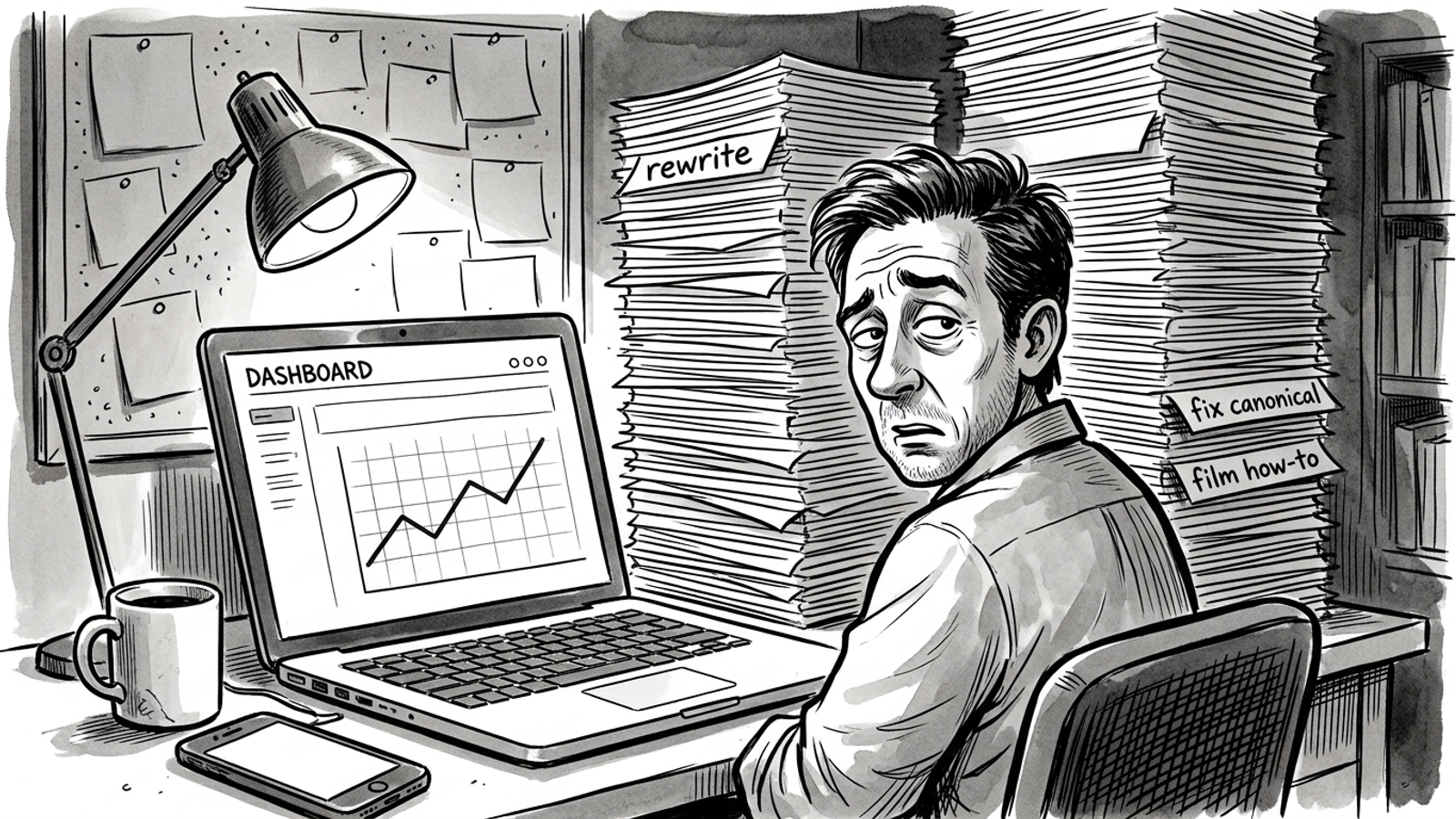
The cheapest mistake is buying a $79 tracker, ignoring it for three months, and wasting $237. The most expensive is signing a $1,042 to $5,000 monthly retainer for 6 to 12 months, waiting through the 3 to 6 months in which results may begin to move, and discovering in month eight that nobody shipped the rewrites. If someone guarantees you a ChatGPT citation, walk away. The invoice is not proof of execution.
A 30-day test before you choose a side
You do not need to settle this from a sales call. Give the in-house case a fair test before signing anything. Pick 30 questions your buyers might ask: service plus city, price, best fit, and the problem they need solved. Use a free grader for an initial baseline, then choose a tracker tier that can cover the prompts you want to follow. Check the same set weekly across ChatGPT, Perplexity, and AI Overviews. In one sheet, record citation share: how many of your 30 prompts cite you.
Next, assign one owner and put two focused hours on the calendar every Friday for 30 days. The work is not to admire the sheet. Each week, try to:
- Rewrite one decision page that already ranks in positions 1 to 10. Put a direct answer in the first 120 words under a question heading.
- Clear one technical blocker that keeps a page out of snippets.
- Publish one useful answer where buyers compare vendors. Where it fits, turn a how-to into a short YouTube version, too.
That is a demanding list for two hours. Good. The point is to learn whether this work gets a protected slot in a real small-business week, not whether it looks tidy in a plan. If you need a simpler starting shape without a subscription, there is a 30-day playbook for one person, two hours a week, and zero software budget. Do not confuse finishing the setup with finishing the job. A prompt list and a baseline are preparation; the page and the fix are output.
Score the month by what shipped. Four weeks and four pages, with blockers cleared and citation share flat or up, make a credible case for staying in-house. If work ships for two or three weeks and then stops when jobs, vacations, or client work intervene, keep ownership of the tracker and consider outside help for content and technical fixes. If you ship nothing, or only one week, stop paying to watch yourself stall. I have seen the Friday block slip three times in a row. It did not recover because the report got prettier.
Citation share is worth watching, but it cannot excuse a month of missing output. A flat result after you ship calls for another look at the questions and pages. A rising result after you ship nothing is not evidence that you have built an execution habit. Judge your ability to do the work before you judge whether to buy help doing it.
My verdict: keep the watching; buy the shipping if it will not happen
I rule for the split for small businesses that cannot publish and fix pages every week. Keep monitoring in-house and buy execution. The single deciding consideration is not the tracker price or the size of the agency pitch. It is whether someone in your business consistently ships the work the tracker points to.
If you already publish, you may be the exception. Keep the questions, the weekly check, and the execution in-house while the schedule holds. I used to tell small clients to outsource all of it on day one. I was wrong for the ones who could write, fix, and publish without waiting for a vendor to turn an observation into a task. Paying a retainer to do what they already do would put the old waste back into a newer dashboard.
If nothing has shipped in the last 60 days, take that answer seriously. I mean pages rewritten, blockers cleared, a how-to filmed, or a useful answer posted where buyers compare vendors. A folder of drafts is not a live site. A weekly tracker can document the distance between them with beautiful charts; it cannot close it. Keep reading the tracker yourself so a vendor cannot hide behind jargon, but give someone else responsibility for getting the fixes live.
Before you sign, demand a technical baseline, a competitor benchmark, and a citation baseline before content starts. Those were part of the disclosed local engagements in the $1,042 to $5,000 monthly range. Then ask what will actually ship. If the answer returns to prompts and reporting, you are buying the dashboard again at a markup.
Monitoring got cheap when software learned to run prompts on a schedule. Getting featured still depends on pages that rank, answer cleanly, remain eligible for snippets, and carry useful proof beyond your site. None of that ships from a dashboard. Keep the cheap job. Pay for the shipping job only when your calendar proves you will not do it. The report never earned anyone a citation.