


Business owners keep asking me the same questions they asked about Google Ads a decade ago: Can I buy my way in, how do I measure the return, and which tool does the work? This time, you cannot buy your way into the answer, and that changes how you budget for it.
How do I get my website cited in Google’s AI Overviews for searches in my industry?
Start by dropping the assumption that a top-three organic ranking automatically wins you a place in the AI summary. Ranking helps, but it does not settle the matter. According to BrightEdge’s longitudinal research on AI search, the overlap between AI Overview citations and organic top-10 rankings rose from 32.3% to 54.5% between May 2024 and September 2025. That relationship also varies by industry. In healthcare, education and B2B software, organic-rank correlation sits above 70%. In ecommerce, overlap drops to 22.9%: the summary may bypass a top-ranking product catalogue to cite buying guides, comparison blogs or discussion forums.
The part nobody can promise you
A ranking is not a citation reservation. Up to 88% of citations in AI answers point to third-party domains rather than a brand’s own site. An Ahrefs study of 75,000 brands found that unlinked brand mentions across the web correlated more strongly with AI Overview appearances (0.664) than traditional backlinks (0.218). Inflating word count had a negligible 0.04 correlation. Publishing 50 shallow articles on your blog will not manufacture a reputation elsewhere.
That is the work I would inspect first: where independent review directories, comparison pages and industry forums discuss the category, and whether they mention your business accurately. You cannot order those sites to cite you. You can identify the places a buyer might encounter you before an answer engine does.
Do this: Audit the external review sites and forums that mention your top three competitors. Prioritise accurate coverage on relevant sources before rewriting your entire blog.
Can’t I just run AI Overview ads instead?
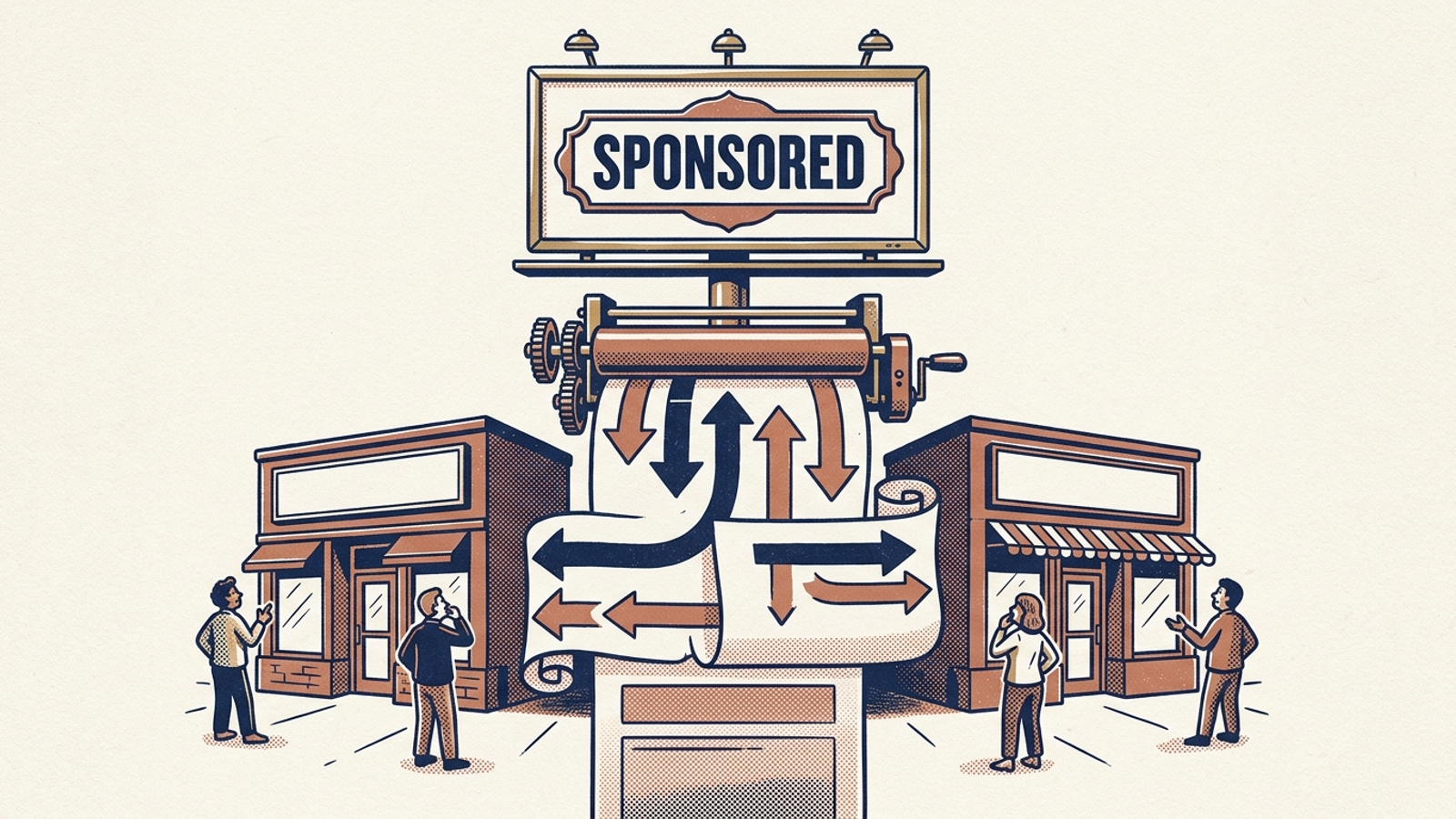
This is the first question a performance marketer asks when organic traffic wobbles. The old playbook was straightforward: if an algorithm update cut organic visits, raise bids on high-intent terms and buy back some visibility. An ad can capture demand; it cannot buy your brand into the AI answer.
What the ad placement actually buys
You cannot open Google Ads and tick a box to place your ad inside an AI Overview. According to Google’s Ads documentation, those ads are pulled automatically from existing Search, Shopping and Performance Max campaigns when broad-match or keywordless inventory is enabled. Sensitive categories such as healthcare, finance and alcohol are excluded from in-overview placements. And as JumpFly’s placement analysis notes, impressions and clicks are folded into standard “Top Ads” reporting rather than a separate segment you can use to isolate conversion rates. There is no clean placement switch you can flip without affecting your core campaigns.
Then there is the awkward possibility that the answer beneath your ad disagrees with your sales pitch. Search Engine Land documented a case in which an emergency contractor paid for the top ad position while the AI Overview below it recommended two local competitors and omitted the sponsor. You can pay a premium for the click and still have the page make somebody else look like the obvious choice.
Do this: Keep Search and Performance Max working for direct demand capture. Treat AI Overview ad appearances as a byproduct of those campaigns, not insurance against being left out of the answer.
How can my business measure brand visibility across ChatGPT, Gemini and Google AI Overviews?
A screenshot of your competitor in a ChatGPT answer is not a measurement plan. I keep seeing the same pitch: someone types one flattering prompt on a screen share, circles a competitor’s name and offers a monthly retainer to make the problem go away. One run of one prompt tells you almost nothing about your share of relevant answers.
Practitioner testing across B2B brands shows why prompt choice matters. A company may appear in a branded comparison such as “Tool A versus Tool B,” then disappear when a buyer asks an unbranded discovery question such as “software to streamline inventory reconciliation.” You tested whether the model recognises a name, not whether a customer can discover the company.
Engines differ, too. Cross-engine testing reported an 89% divergence between cited sources. ChatGPT draws on Bing’s search index and historical training data; Perplexity uses live, per-query web retrieval; Gemini draws on Google’s index and Knowledge Graph. Consistent visibility on one does not prove visibility on the others.
For a usable baseline, run the same set of prompts on a schedule. Our guide to measuring AI visibility with fixed prompts and repeated runs sets out the mechanics: track at least 30 unbranded category queries across multiple runs each week. Record whether you appear, how you are described and which sources are cited. Repeated runs matter because an appearance rate of eight out of ten on Monday could become two out of ten on Thursday as the sources change. Do not turn either day’s screenshot into a strategy.
Do this: Put 30 customer-problem prompts in a spreadsheet and test them every Tuesday and Friday across two engines. Compare patterns, not anecdotes.

What tools actually help a business get featured, not just monitored?
The software market solved the easiest part first: building dashboards that tell you where you do not appear. Pay for a tracking platform and you may get a clean chart saying your brand was cited in 14% of category queries last week, down 3% from the week before. The chart does not edit your site, improve a slow server response or get an independent source to discuss your product.
I spent years watching clients pay for PPC monitoring suites that sent alerts when an ad group ran out of budget. Useful warning. Not account management. The test is whether the tool ships a fix or merely assigns one to you.
Ask what went live last month
Before signing an annual contract, ask the vendor: What code or content does this platform deploy into production on my behalf? If the answer is “we provide insights for your team to implement,” you are buying diagnostic software. Price it that way. Our breakdown of tools that help you get featured in Google AI Overviews draws that line between passive trackers and execution engines.
When groas manages search, specialized models deploy server-side-rendered structures, address latency bottlenecks and update intent-matched copy around the clock. A named strategist owns the direction and the outcome. That is different from a weekly PDF listing missed citations and leaving your team to do the work.
The hidden cost of an alert tool is the labour behind every alert. If each issue takes four hours of developer time and three hours of copywriting, a $500 monthly subscription can consume closer to $3,000 in diverted payroll. The dashboard price was never the whole price.
Do this: If a visibility tool cannot deploy a code change, publish content or execute an optimisation without your team touching a keyboard, treat it as a diagnostic tool, not a growth engine.
Which tool fixes the technical SEO issues that hurt AI visibility?
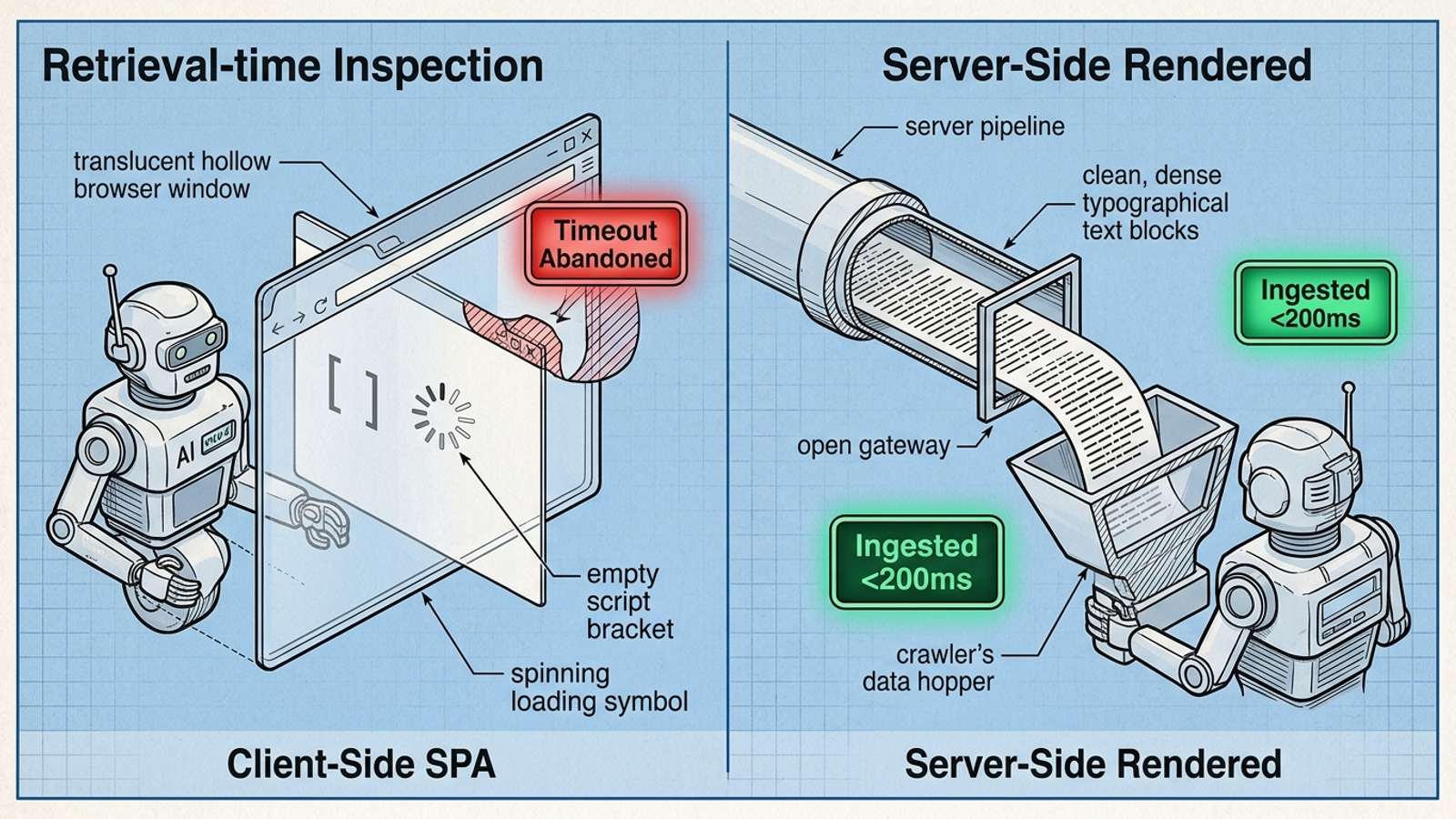
Not every visibility problem is a content problem. Some begin before a crawler can read a sentence: in your rendering pipeline or your server response time. If the initial HTML is empty or arrives too late, better copy may never get a fair look.
The distinction matters for sites built as single-page applications in React, Vue or Angular. Data from more than 500 million GPTBot fetches shows that crawlers such as GPTBot, ClaudeBot and PerplexityBot do not execute JavaScript. Googlebot may render client-side scripts later through a secondary queue, but those other crawlers can take the initial raw HTML and stop there. Without server-side rendering, a page that looks complete to you may offer them little beyond an empty shell.
Speed creates another obstacle. Retrieval systems assembling an answer work under tight latency budgets, and research on server response times in generative search retrieval describes pages with a Time to First Byte above 600 milliseconds being bypassed. That makes caching and response time more useful places to look than a decorative AI-search file. Google’s search relations team has confirmed that Search does not use llms.txt for AI Overviews. Blocking Google-Extended excludes model-training use, not search synthesis. Our guide to fixing technical SEO issues that hurt AI visibility walks through rendering checks and caching configurations.
So which tool fixes it? One that can diagnose the problem and carry the change into production, with the people responsible for your site involved where needed. A scanner that reports an empty HTML response has found work; it has not finished it.
Do this: Check priority landing pages with JavaScript disabled in developer tools, then investigate slow Time to First Byte. Aim to get it below 200 milliseconds before paying for an AI-specific content push.
Is this just SEO with a new invoice?
In a lot of agency pitches, yes. I have seen the same familiar scope—schema markup, keyword-targeted posts and sitemap submissions—relabelled AEO or GEO. Published generative engine optimisation pricing puts small-business retainers between $1,500 and $5,000 a month and describes a 20% to 30% markup on the underlying work. New initials are not a new service.
But the entire problem is not just old SEO, either. Traditional SEO concentrates on pages you own and the rankings they earn. Generative visibility also depends on consistent evidence about your business across sources you do not own: community discussions, independent directories and comparison hubs. Editing your blog alone cannot create that external consensus, however immaculate the schema looks.
I would read the scope before arguing about the label. Does the agency identify relevant third-party sources and a credible way to improve your presence there? Does it handle technical access as well as on-page copy? Or does the proposal only touch the HTML on your existing blog? If it is the last one, you are buying traditional SEO in a more expensive jacket.
Do this: Check whether at least half the proposed effort addresses third-party citation sources and external consensus, rather than just another batch of on-page posts.
What should I spend on this, and when do I stop?
Paid search gives you a relatively direct spending test. If $10,000 in ad spend produces $40,000 in attributable margin, you can maintain or raise the budget until returns weaken. Generative-search visibility does not give you that same lever or that same arithmetic. You are trying to influence an answer you cannot reserve, often on a page where fewer people click at all.
According to Seer Interactive’s CTR benchmark data, average informational click-through rate falls from 1.76% to 0.61% when an AI Overview appears. A cited brand reaches 0.70%, compared with 0.52% for an uncited competitor. A citation is not a promise of a traffic surge. At those rates, paying $5,000 a month in consulting hours solely to chase an 18-basis-point informational CTR difference is a bad bet for a mid-market company.
This is why groas puts paid demand capture and organic search execution under a flat monthly fee instead of billing advisory hours to analyse missed citations. Specialized models handle technical hygiene, server rendering and ad bidding continuously; a named strategist is accountable for the revenue picture. The point is not to make a prettier visibility chart. It is to connect search work to qualified pipeline.
I would stop increasing a standalone AI-visibility budget when the work cannot show attributable pipeline, or when maintaining external citations costs more than the gross margin of the sales they influence. That is a harder conversation than “our mentions went up.” It is also the one that protects your budget.
Do this: Cap standalone organic AI testing at 10% to 15% of your total search budget. Expand only when you can connect cited brand mentions to qualified pipeline.
What question do you wish more owners asked?
Not “How do I guarantee a spot inside ChatGPT?” Nobody can sell you a permanent editorial citation in an answer that may change when its retrieval sources change. And not “Which dashboard shows the most prompts?” A dashboard will not rescue an offer that does not convert.
AI search is one more touchpoint in a messy buying cycle, not an independent kingdom. You can pay $4,000 a month to monitor 30 prompts while your core ad campaigns leak budget on irrelevant searches and slow landing pages. I would rather see the budget protect the basics, support execution across paid and organic search, and answer the question that decides whether any of it deserves another month’s spend:
How much attributable revenue did our total search footprint generate this month, and who is accountable when that number drops?