

 LinkedIn
The number in your Google Ads contract decides what your account manager tries to win. Pick the wrong one, and you can hit the target while missing the outcome you wanted: attributable revenue that exceeds what you spent to acquire it.
Most businesses treat ROAS vs CPA as a choice in campaign settings. I would settle it earlier. The metric you write into the mandate shapes what your team reports, what Smart Bidding pursues, and which losses can hide behind a good-looking dashboard.
A CPA target rewards conversions at or below a stated cost. A ROAS target rewards reported revenue relative to ad spend. Neither tells the whole story on its own. Choose the number that tracks your economics, then define exactly what counts toward it.
If conversion value is fairly flat and the result arrives quickly, CPA is usually the cleaner judge. If order values vary and accurate revenue reaches Google Ads quickly, ROAS gives bidding useful information that CPA ignores. If deals close offline months later, judge performance on qualified pipeline and treat both platform metrics as proxies. That is the decision. The rest is making it hard to game.
What do ROAS and CPA actually measure?
Strip away the dashboard labels and both metrics describe ad spend through different lenses:
- CPA (Cost Per Acquisition) is ad spend divided by the number of counted conversions. Spend $1,000 on 20 purchases and CPA is $50. It does not care whether a purchase is worth $10 or $1,000.
- ROAS (Return on Ad Spend) is reported revenue divided by ad spend. Spend $1,000 to generate $4,000 in reported sales and ROAS is 400%, or 4.0x. It captures order value but does not, by itself, tell you how many orders you won or what it cost to fulfill them.
The phrase counted conversion is doing a lot of work here. If your primary conversion is a completed purchase, CPA measures cost per purchase. If it is a form fill, CPA measures cost per form fill, whether or not anyone on that form ever buys. Likewise, ROAS can only judge the revenue that makes it into the measurement system you use.
How does average order value connect them?
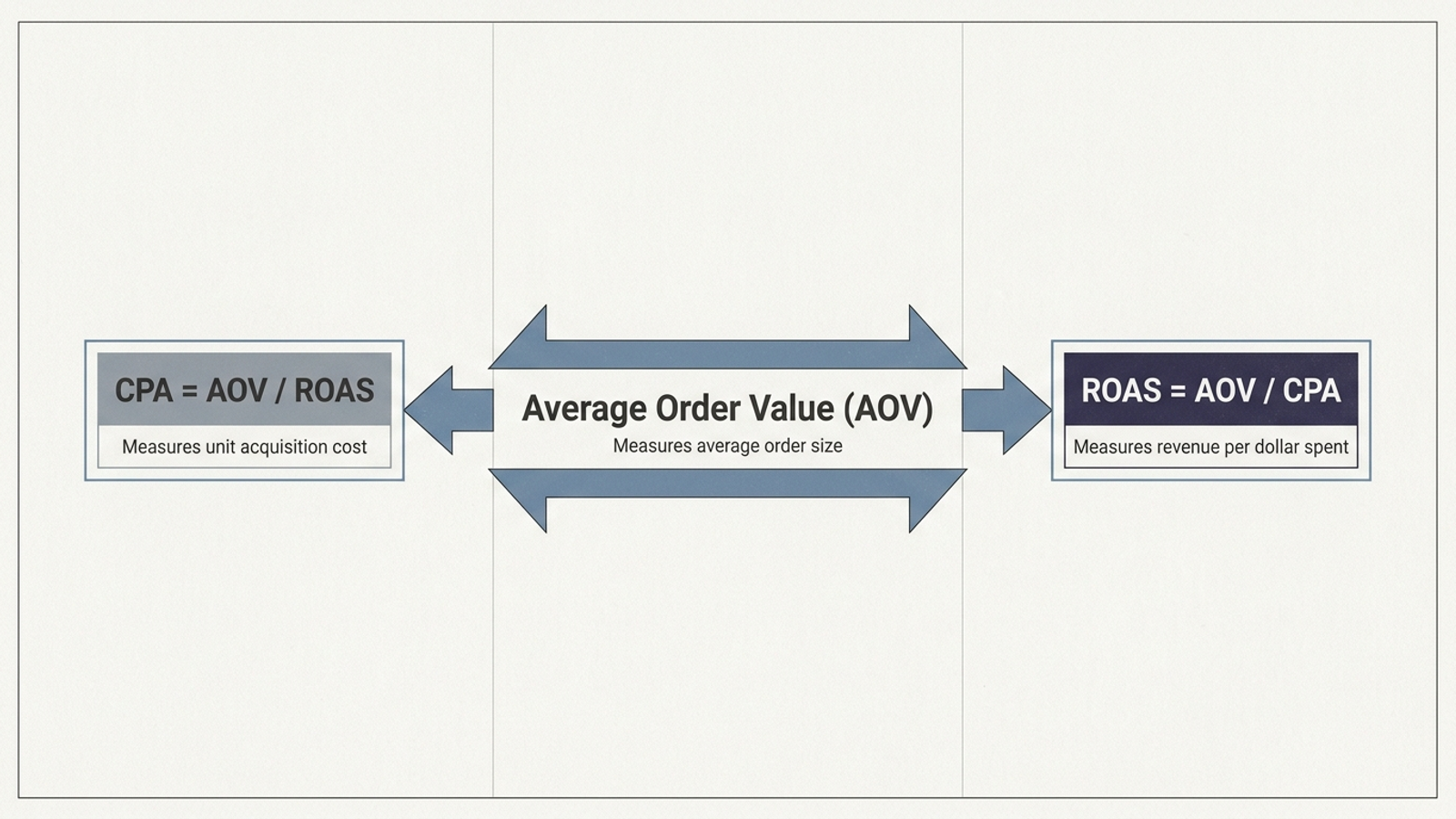
CPA and ROAS are linked through average order value (AOV) when you measure the same purchases over the same period:
- CPA = AOV / ROAS
- ROAS = AOV / CPA
Use ROAS as a ratio in that math: 400% is 4.0, not 400. If every checkout is $100, a 400% ROAS corresponds to a $25 CPA ($100 / 4.0). At a $25 CPA, those same $100 orders produce 400% ROAS. With one fixed order value, the two metrics describe the same spend from different sides.
Now put $15 replacement parts and $750 equipment in the same catalog. One CPA target can distort what bidding pursues: a cheap accessory purchase counts as one conversion, just like an equipment order. Target CPA can meet its cost goal by finding more low-value orders. The account may look efficient on a cost-per-purchase report while revenue suffers.
ROAS gives those two purchases different values. It still needs an honest revenue feed and a target grounded in margins. The practical takeaway: before choosing a bidding strategy, check whether the conversions it counts are worth roughly the same amount.
When should you put CPA in the agreement?
Use CPA when the financial value of each counted conversion is predictable, and you can tell quickly whether you got one. Think of a single-tier subscription, a standardized fixed-fee service, or a service business with a consistent ticket and a reliable intake process. In those cases, revenue per conversion may add little useful direction to bidding. What matters is the cost of acquiring the action you defined.
Target CPA prioritizes conversion volume against a cost target. If every successful sale brings in about the same amount, that can be a sensible instruction. But the target belongs in your commercial agreement only after you answer two questions: What is the conversion, and how often does it become revenue?
Say a service business receives calls, books appointments, and completes paid jobs later. A cost per call may be easy to measure, but it is not a cost per customer. If callers rarely book, a cheap call is not cheap acquisition. Choose the furthest reliable event you can track promptly, then check it against completed jobs in the business’s own records. If that relationship changes, revisit the target.
Skip CPA as the sole judge when order values swing widely or when your primary conversion is merely a lead. A $40 cost per form fill tells you little if half the forms are junk. Put the quality definition in writing before anyone gets paid for lowering the number.
When does ROAS earn the top spot?
ROAS is the better primary judge when purchase values vary and the store sends accurate transaction revenue back promptly. An ecommerce apparel brand or industrial supply catalog can sell a small replacement item and a much larger bundle through the same account. A blanket CPA treats those purchases equally. ROAS gives bidding a reason to distinguish the $12 order from the $850 one.
The mechanism matters. Target ROAS uses reported conversion values alongside auction signals to pursue revenue relative to spend. It can bid differently when signals point toward higher-value checkouts. That is useful only if checkout values arrive correctly and the revenue figure means something to your business. An inflated, duplicated, or incomplete feed gives the system a precise target built on bad data.
You also need a margin floor. One way to calculate a break-even ROAS target is 1 / Gross Margin, using the margin available to pay for ads after the costs included in your calculation. At a 33% margin, that puts the threshold at roughly 300%, or 3.0x. A 300% ROAS is not automatically a healthy business: the calculation does not pay costs you left out, and a blended margin can hide differences between products. It gives you a starting boundary, not a victory lap.
Skip ROAS as your contractual scorecard if revenue reaches Google Ads late, inaccurately, or not at all. A platform cannot optimize toward sales it cannot see. And even with clean ecommerce data, reconcile reported revenue against orders, cancellations, and refunds before declaring the target met.
What if sales close offline months later?
This is where the neat CPA-versus-ROAS debate stops being neat. In B2B SaaS, corporate consulting, commercial insurance, and other high-touch sales, the landing-page conversion is the beginning of a sales process. Someone fills out a form, speaks to a rep, attends demonstrations, and may sign a contract months after the click.

Judge that account on front-end CPA alone and you reward cheap forms. Students downloading a whitepaper, job seekers submitting résumés, and prospects who cannot buy can all make the dashboard look busy. Your sales team gets the bill for sorting them.
A closed-won ROAS target sounds better, but it may give bidding too little usable feedback. Offline conversion imports have time limits; long sales cycles can leave eventual revenue outside the window the platform can use. Even when you can connect a deal to a click, waiting months for a small number of outcomes makes day-to-day bidding harder to steer.
Judge this business on qualified pipeline in the CRM. Then use validated intermediate milestones to give Google Ads earlier signals. A milestone valuation ladder might assign illustrative values of $50 to a marketing-qualified contact, $500 to a completed discovery call, and $2,500 to a verified pipeline opportunity. Those figures are not prices to copy into your account. Set values from your own funnel economics and require each milestone to mean something a sales rep would recognize.
Importing those stages can create a useful pipeline ROAS proxy. It does not turn estimated pipeline value into booked revenue. Keep the written scorecard tied to qualified opportunities and, eventually, closed contracts. For an example of this shift away from vanity forms, see our teardown of a B2B SaaS team’s pipeline attribution.
How can a manager hit the target and still lose you money?
A metric is an incentive. An agency, an internal team, or an automated system will work toward the version it can measure. Leave the definitions loose and the easy version tends to win.
CPA can be gamed through conversion inflation. If PDF downloads, brief site visits, duplicate tags, or chat opens count as primary conversions, low-intent actions can make CPA look better without producing more customers. Bidding follows the counted events. A lower number on the weekly report can arrive alongside a worse morning for the sales team.
ROAS can be flattered by existing demand. Brand traffic and returning customers can lift aggregate reported ROAS while new-customer acquisition struggles. Someone searching for your company by name is not the same prospect as someone who has never heard of you. Blend both into one number, and a strong return from existing demand can conceal weak non-brand performance. A rising ROAS can also accompany shrinking prospecting activity if the account concentrates spend on easier conversions.

I would not accept either headline metric without asking what produced it. Which conversion actions count? How much of the result came from brand terms or returning customers? Did qualified pipeline or reconciled orders improve? If the supporting business outcome did not move, the prettier dashboard is not the win.
What should the written target say before you spend?
A verbal agreement to achieve 400% ROAS or an $80 CPA leaves too much room for interpretation. The target needs definitions: which system settles the result, which actions count, how you separate existing demand from acquisition, and what performance looked like before the work began. Those structural terms matter in performance agreements because an attractive number is easy to produce when nobody agrees on its boundaries.
Before launch or handover, I would put these four decisions in order:
- Name the system of record. For ecommerce, reconcile reported revenue against backend orders, cancellations, and refunds. For lead generation or SaaS, use CRM stages and closed contracts to judge commercial quality. Google Ads can guide bidding without being the only authority on whether the business made money.
- Separate brand from acquisition. Keep branded search visible as its own line of performance, and use brand exclusions where appropriate so prospecting results do not borrow credit from people already looking for you. Evaluate non-brand CPA or ROAS on its own merits.
- Choose primary conversions deliberately. Audit conversion actions under Goals in Google Ads. Completed checkouts and genuinely qualified lead actions belong in a different category from page-depth events, PDF downloads, and preliminary chat clicks. Keep soft actions available for observation rather than letting them steer bids as if they were sales.
- Record the pre-launch baseline. Save the trailing 30 to 60 days of performance before changing the account or hiring someone to manage it. That gives you a reference point when brand demand or seasonality makes a later report look impressive.
Do not bury those rules in a slide deck. They determine what your CPA or ROAS target means. They also demand ongoing checks of search-query drift, bidding behavior, conversion data, and brand spend, not just a polished weekly report.
That is the operating model behind groas: autonomous execution across bidding, targeting, and budgets, with written commercial guardrails, action logs, and a dedicated human strategist accountable for direction. The point is not to replace one dashboard number with another. It is to keep execution tied to the outcome the agreement actually names.
What is the first thing to do today?
Do not start by changing bid strategies. Open Google Ads, go to Goals > Conversions > Summary, and inspect every primary conversion action feeding Smart Bidding.
If you sell products with varying cart values, check whether purchase revenue is accurate before considering a ROAS target. If you sell through calls or forms, check whether the primary action represents a qualified prospect rather than an easy click. If sales close offline, compare what Google Ads counts with the pipeline stages your CRM can verify.
Find the event your account is being rewarded for. Then decide whether CPA, ROAS, or qualified pipeline is the number you are willing to put in writing.