

 LinkedIn
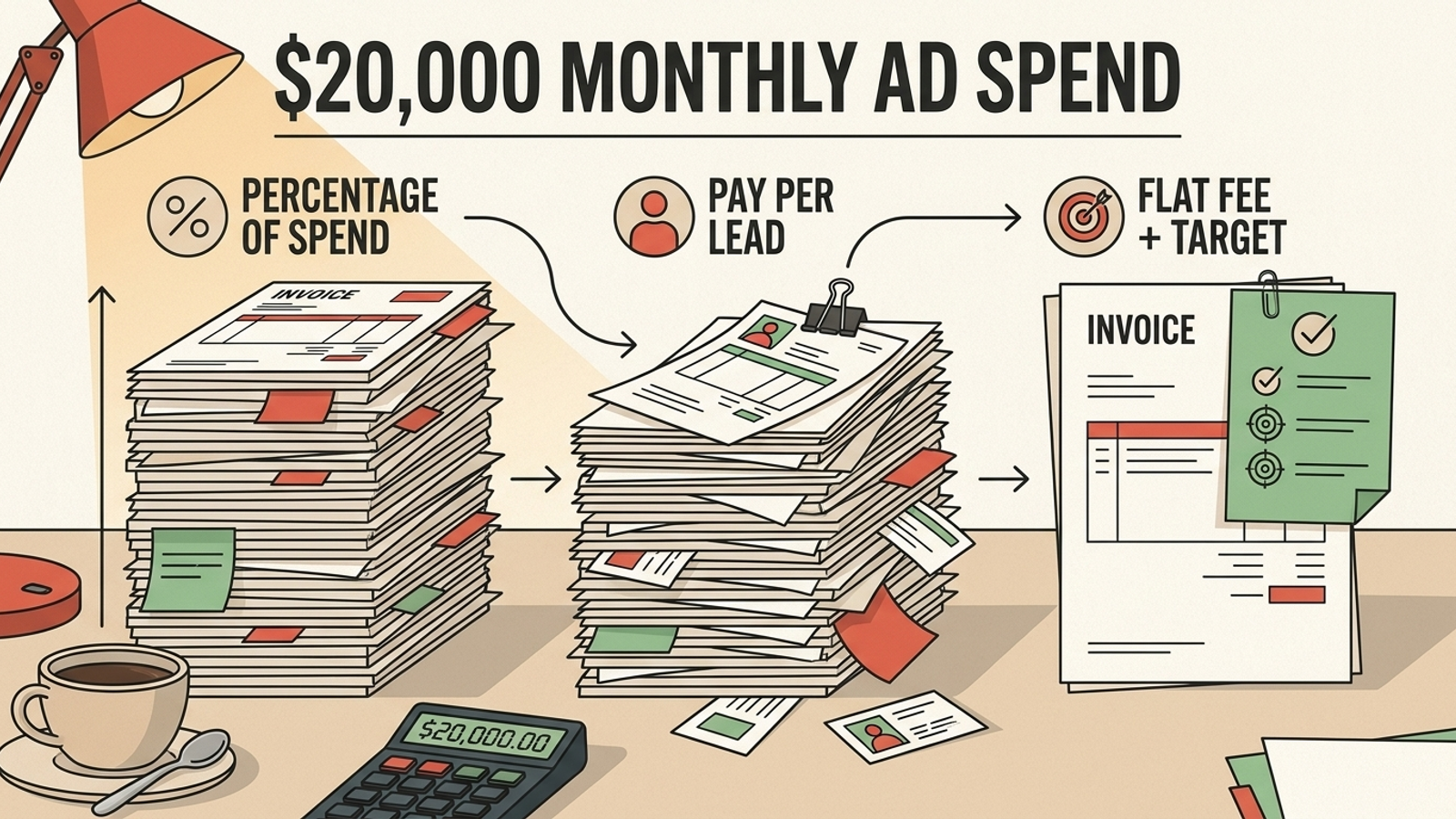
A $20k Google Ads budget can carry a $3,000 management fee, a $15,000 lead fee, or a flat fee agreed before work starts. If you are the founder or marketing lead paying the first invoice and considering the second as your escape route, this is your head-to-head: percentage of spend, pay-per-acquisition, and a flat fee tied to a written revenue or pipeline target.
My claim is blunt. Percentage of spend rewards a bigger budget. Pay-per-lead rewards a bigger lead count, including cheap leads sales cannot use. A flat fee with a written target gives the manager no extra fee for either move. If missing the target means working for free until it is hit, the manager has a reason to make your existing spend work harder. Here is what that distinction costs on the same account.
The $20k account: total cost before the sales pitch
Assume $20,000 a month in media and, for the lead-fee example, 100 billable leads. A 10–20% spend fee puts the listed monthly total at $22,000–$24,000, including media. At the cited $50–$500 per-lead range, that same lead count puts the total at $25,000–$70,000. A flat-fee total is $20,000 plus the fixed price you agree to; the draft has no published flat price to substitute for your quote. These are comparisons, not promises that the account will produce 100 leads or $100,000 in revenue.
| Recurring line item | Management fee in this example | Media plus management | Basis for the figure |
|---|---|---|---|
| Google Ads media | — | $20,000 before fees | Same illustrative budget for every model |
| Percentage of spend | $2,000–$4,000 | $22,000–$24,000 | 10–20% agency range applied to $20,000 |
| Pay-per-lead | $5,000–$50,000 for 100 billable leads | $25,000–$70,000 | $50–$500 per-lead range applied to 100 leads |
| Revenue share | $8,000 | $28,000 | 8% on $100,000 in attributed revenue |
| Flat fee with written target | Fixed amount agreed before work starts | $20,000 plus that fee | Contract price; no flat-fee amount assumed |
Those are recurring listed costs, not a complete contract price. A vendor may quote one-off setup separately for tracking, account architecture, and feeds. The cited small-account setup range is €200–€500. Minimum fees can also override the headline percentage: at 15% with a $1,000 minimum, a $3,000 media budget still incurs a $1,000 fee, an effective rate of 33.3%. Exit terms and account ownership do not fit neatly in a monthly total. They can still make a cheap quote costly to leave.
If a vendor blends media and management into one number, ask for two lines. You cannot compare these models while the invoice hides what Google receives.
The three contenders, as they actually bill
Percentage of spend is familiar for a reason. The agency takes 10–20% of media, often with a $1,000–$3,000 monthly minimum. At 15%, management is $3,000 on $20k, $750 on $5k before any minimum, and $15,000 on $100k. I used to sell this structure. The argument is that management work grows with account complexity. Sometimes it does. The invoice also grows when the extra spend accomplishes nothing.
Pay-per-acquisition changes what triggers the bill. You might pay per raw lead, qualified lead, new customer, or a share of attributed revenue. The cited benchmarks span $50–$500 per lead and 5–15% of attributed revenue. Those are different contracts wearing the same performance-pricing label. Pay for form fills and you get an incentive to produce form fills. Pay for qualified leads and you must agree on qualified. Pay for customers or revenue and you must agree on attribution. The conflict has not disappeared. It has changed counters.
Flat fee with a written target and free-work clause is the contender I would choose for most readers spending $20k a month. Set the fee, define the target before work starts, and state what happens if the manager misses it. The target might be qualified pipeline, sales, ROAS, or cost per acquisition. groas offers 40% more sales from ads or 40% more visibility in search in 90 days, or it works for free. That is not an extra bonus for success: the fee stays flat. The consequence of a miss is more work without another fee. I used to assume flat fees meant less attention. With a target and that consequence in writing, I no longer think the invoice alone tells you how hard a manager will work.
Axis 1: what does the manager get paid to improve?
Follow the fee, not the pitch deck. With percentage billing, the fee rises with spend whether the added budget pays off or not. More spend can create real work: more queries, negatives, and feed decisions. I know that work well. But the manager gets the increase before proving that the new budget earned its keep. The reward follows budget, not return.
A raw lead fee moves the pressure from budget to conversion count. Broader terms, looser intent, and a softer form can raise that count without giving sales more buyers. Tying payment to qualified leads or customers improves the signal, but then definitions and attribution become the fight. I have seen lead volume climb while close rates fell. A report can call that growth. Sales will use a different word. For more on the incentive problem, see how each pricing model creates misaligned incentives.
A flat fee removes the extra payment for bigger spend or more raw leads. The written target and free-work clause supply the pressure that a bare flat retainer lacks. Neither can make a manager control your sales team or pricing, but together they put the fee at risk when the agreed result does not arrive. Do not buy the word flat without the target beside it.
Axis 2: which results make the invoice move?
At $150 for each of 100 accepted leads, management costs $15,000. The decisive word is accepted. If it means every submitted form, lowering the bar can raise the invoice. Put the definition in the contract, not in a reassuring conversation.
One qualified-lead contract example requires all five conditions: contactable, budget-matched, a timeline under six months, within the service area, and not a duplicate. It also provides free replacement if a lead is flagged within seven days, with media paid directly to Google. You may need a different definition. You still need one that sales and the manager can apply to the same lead without an argument every Friday.
Revenue share avoids paying for a pile of raw forms, but attribution and efficiency still matter. At 8% of $100,000 in attributed revenue, the fee is $8,000. An account spending $20,000 to produce that revenue and one spending $40,000 to produce it pay the same revenue-share fee, despite 5.0x versus 2.5x ROAS. Write down which revenue counts and how much spend it took to produce it. Otherwise performance fee may describe the invoice better than the performance.
Axis 3: who pays when performance misses?
Under percentage of spend, you carry the performance risk. If CPA doubles, the media spends and the percentage still bills. Under raw pay-per-lead, the manager carries lead-volume risk while you carry lead-quality risk. A revenue-share contract puts more outcome risk on the manager, until the parties disagree about which sale the ads produced.
The case for hybrid base-plus-bonus pricing is that a manager does not control everything between a click and a sale. The manager controls bids and targeting; you control pricing, sales response, fulfillment, and retention. A flat fee with a written target does not erase that division. It makes both parties define the result and the remedy before the account misses. Put risk beside the lever each party controls.
The side-by-side math at $20k, then $50k
The monthly totals above are only the first invoice. Keep spend and billable volume steady for a year, and the management-fee difference becomes harder to wave away. This table excludes the $20,000 monthly media budget, which is the same starting assumption for each row.
| Model | Monthly management fee at $20k spend | Year-one management fees if unchanged | Basis |
|---|---|---|---|
| 10% of spend | $2,000 | $24,000 | Percentage-pricing example; calculated over 12 months |
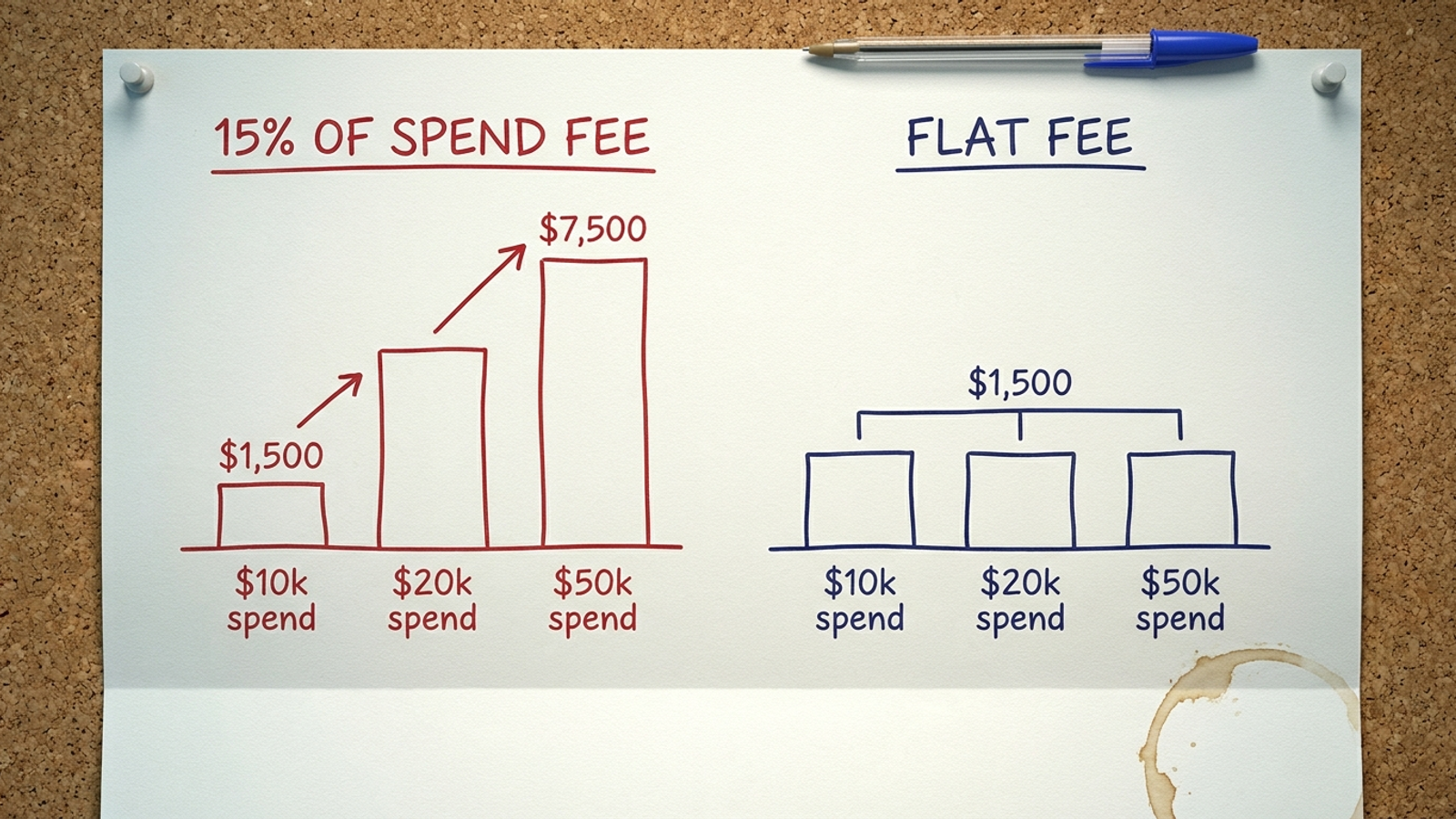
| 15% of spend | $3,000 | $36,000 | 15% on $20k; calculated over 12 months |
| 20% of spend | $4,000 | $48,000 | Percentage-pricing example; calculated over 12 months |
| $150 per accepted lead | $15,000 at 100 leads | $180,000 | $150-per-lead example; calculated over 12 months |
| 8% revenue share | $8,000 on $100k attributed revenue | $96,000 | Revenue-share example; calculated over 12 months |
| Flat fee with written target | Agreed fixed fee | 12 times that fee, subject to the contract | No price assumed; does not rise with budget or lead count |
Now raise media from $20k to $50k. At 15%, management jumps from $3,000 to $7,500 a month, or $90,000 over a year at the new spend level. More budget can mean more work; it does not automatically mean 2.5 times more work. The fee, however, is 2.5 times higher. If billable leads double from 100 to 200 at $150 each, the lead fee doubles from $15,000 to $30,000 even if the new leads are poor. Both models can bill more before qualified pipeline improves.
The breakeven calculation for a comparable flat retainer is simple: divide the retainer by the percentage rate. A $3,500 retainer divided by 12% is about $29,167 in monthly spend. Below that, the percentage fee is cheaper at the same scope and without a binding minimum. Above it, the flat fee is cheaper. That is a price comparison, not proof that either manager will perform better.
Lead quality can make the other invoice worse without any budget increase. Say your $20k month produces 100 billable leads at $150 each, but only 30 qualify. The $15,000 management fee per qualified lead is $500; media is additional. Next month, looser targeting and a softer form produce 150 billable leads, while qualified leads stay at 30. Management rises to $22,500, or $750 per qualified lead. You pay $7,500 more for the same 30 usable opportunities. Under percentage billing, the $3,000 fee stays put, but sales still sorts the extra 50 leads. Under a flat fee, the manager cannot raise the invoice by producing them, and a written pipeline target gives them a reason not to.
Where the losing models still earn a place
Percentage of spend can be the cheaper choice for a small, stable test budget. At $5k in media, 15% is $750 before a minimum. Check the minimum first: it can wipe out that advantage. Then revisit the contract as spend rises rather than letting the same rate follow you indefinitely.
Pay-per-acquisition has a narrower fit. If you control qualification, keep media in your own account, and have a written rule for rejecting and replacing junk leads, paying per accepted lead can put useful volume pressure on a manager. Skip raw form-fill pricing. At $20k in spend, I would still choose a flat fee with a written pipeline or revenue target over a contract that makes every disputed lead another item on the invoice. For a closer look at the alternative, see who charges on CPA instead of a percentage.
| Decision axis | Percentage of spend | Pay-per-acquisition | Flat fee with written target |
|---|---|---|---|
| What raises the fee? | More media spend | More billable leads or attributed revenue | Nothing during the agreed term |
| What needs defining? | Scope and minimum | Qualification or attribution | Target, measurement, and remedy |
| What happens on a miss? | Fee still bills | Depends on what qualifies for payment | Free work if the contract says so |
| Best fit here | Small, stable budget where the minimum does not bite | Buyer can enforce a strict accepted-lead rule | $20k+ buyer accountable for pipeline |
Verdict: write the target before you sign
For the $20k buyer answering to pipeline, pick the flat fee with a written revenue or pipeline target and a free-work clause. Choose percentage of spend for a smaller, stable budget only when its actual fee, including the minimum, beats the flat quote. Choose pay-per-acquisition only when the contract pays for leads you can genuinely accept, not counters the manager can inflate.
Get four lines on paper: the exact target, the definition of qualified, the management fee separate from media, and what happens at no additional fee when the target is missed. Keep the Ads account in your name, with media billed directly and fees visible separately; the account and fee-disclosure guidance is a useful check before signing.
I stayed comfortable with percentage billing longer than I should have. When spend rose, the invoice rose, and it was easy to call that growth. Pay-per-lead moves the same temptation to a different counter. The cheapest mistake is paying a setup fee twice. The expensive one is spending a year rewarding the wrong result.