

If you have $2,000 to spend on getting cited by ChatGPT and Perplexity, should it go to answer pages on your own site or to mentions on someone else’s? Smart practitioners split on this because both approaches work, just not for the same questions. Fact-seeking prompts need a primary source. Recommendation prompts need an outside witness. Put your first dollar behind the wrong one and you can improve your visibility without appearing in the answer your buyer actually wanted.
I used to default to owned pages. The logic was hard to argue with: state your price, explain your process, answer the question plainly, and give the model something it can quote. But that logic does not settle a prompt like “best CRM for contractors.” A vendor can document its own product. It cannot provide independent agreement that the product is the best pick. That is the debate: which kind of answer are you trying to enter?
Position A: Own the answer buyers came to verify
The owned camp has the cleaner mechanism. AI answers depend on retrievable sources. Google’s version fans a question out into 8 to 12 sub-queries and can only cite pages it can retrieve. Perplexity’s extractor looks for a direct answer in the first 150 words, clear H2s, facts and fresh dates. If your page states the price, the spec, the steps and the date plainly, the model does not have to piece your answer together from a stray mention and an outdated roundup. You have already done the assembly.
The evidence for this camp is substantial. Yext pulled 6.8 million citations from 1.6 million location-intent queries and found 44% came from first-party websites and 42% from claimable listings: 86% from brand-managed sources. Orbit’s practitioner tracker found a similar tilt in a different setting: ChatGPT averaged 4.5 sources per answer and skewed toward primary sources such as pricing and help docs.
Think about the question from the model’s side. If a buyer asks “what does X cost,” the company’s current pricing page is a better place to look than a forum post repeating a price someone remembers. If the buyer asks “how do I set up Y,” the company’s instructions can supply the steps. For facts a business can state directly, its own site should make the answer easy to find and quote. That is the owned camp’s strongest case, and I would not spend on outreach while those basic answers are missing.
Position B: Earn the recommendation you cannot give yourself
The earned camp starts with a different question. When a buyer asks for the best option, the assistant needs more than a vendor’s description of itself. It looks for outside judgments: reviews, roundups, comparison pages and discussions where people name a product because it fits the job. A recommendation needs credibility beyond the company making the claim. A beautifully structured “best tools” page on your own site cannot create that credibility just by being easy to retrieve.
Muck Rack’s Generative Pulse looked at more than 25 million links cited by ChatGPT, Claude and Gemini and found 82% to 89% came from earned media, with paid and advertorial at just 0.3%. On recommendation questions, one B2B pull found 85.6% of citations landed on roundup or comparison URLs. Semrush’s sweep of around 150,000 citations across ChatGPT, Perplexity, Gemini and AI Overviews put Reddit in about 40% of cited sources, Wikipedia around 26% and YouTube around 24%, with no other domain above 5%.
The engines do not all draw from the same mix. Perplexity, in Orbit’s tracker, averaged 19.2 sources per answer and skewed toward LinkedIn, YouTube and Reddit. Still, the practical argument is clear. If the pages answering “best X for Y” keep discussing your competitors and not you, another page declaring yourself the winner will not put you into that conversation. You have to earn your way into the sources the answer uses.
Where each case stops working
Owned pages can be cited without winning the pick
Here is the part I had to change my mind about: being a source is not the same as being recommended. Lily Ray tested 100 B2B “best [category] software” prompts in AI Overviews. Eighty triggered answers in which self-promotional listicles were cited 323 times, yet the brand behind the listicle was left out of the recommendation in 224 cases, or 69%. The page appeared in the evidence. A competitor appeared in the pick.
That distinction matters when you decide what to measure. A ghost citation quotes a site without naming its brand as the pick; one cited estimate puts those citations at 62%. I would rather know that my brand was recommended than celebrate a citation to my self-serving roundup while a competitor gets the buyer’s attention. For a “best” prompt, do not count a footnote as a win.
Earned mentions cannot publish your facts for you
Now the limit on the other side. A review or a Reddit thread can make a business look like a strong option for contractors. When the follow-up is “what does it cost” or “how does onboarding work,” the answer still needs a retrievable source for the detail. Without a citable owned page, earned mentions have nowhere to ground pricing, how-to or spec claims. You can become the pick while leaving the factual explanation to someone else’s page. That is not a position I would volunteer for.
Ahrefs tracked 75,000 brands and found branded web mentions correlated with AI Overview visibility at 0.664, versus 0.218 for backlinks, roughly three times as strongly. Top-quartile mention brands averaged 169 appearances against 14 for the next quartile. Those numbers give the earned camp a serious case for visibility. They do not turn third-party chatter into your pricing page. Earned gets you voted for. Owned gives the vote something to quote.
My verdict: the prompt type decides
I take the owned side first for businesses losing informational and factual prompts. When someone asks how a thing works, what it costs, whether it integrates or how to set it up, the shortest path to a verifiable answer is usually the business’s own page. Put the answer in the first 150 words under a clear H2, give the fact a date, and cut the throat-clearing. If that page does not exist, fix it before paying to get people talking about a detail they cannot verify on your site. For “how do I” and “what does X cost,” start with the source you control.
For businesses losing comparison and “best-for” prompts, I take the earned side first. A buyer asking for the best CRM for contractors or the top invoicing tool for electricians is asking for judgment, not a vendor’s spec sheet. The same goes for a comparison such as ChatGPT versus Perplexity for research: the buyer wants an outside view of the choices. If the relevant roundups, reviews and practitioner discussions leave you out, publishing one more answer page about yourself will not fix the missing witness.

I tell clients losing best-for prompts to stop publishing and start earning for one quarter: bring review profiles current, pursue listicle inclusions where they genuinely belong, and participate in useful community discussions rather than dropping promotional replies. Not every mention becomes a citation, and not every citation becomes a recommendation. But this work addresses the gap the prompt actually exposes.
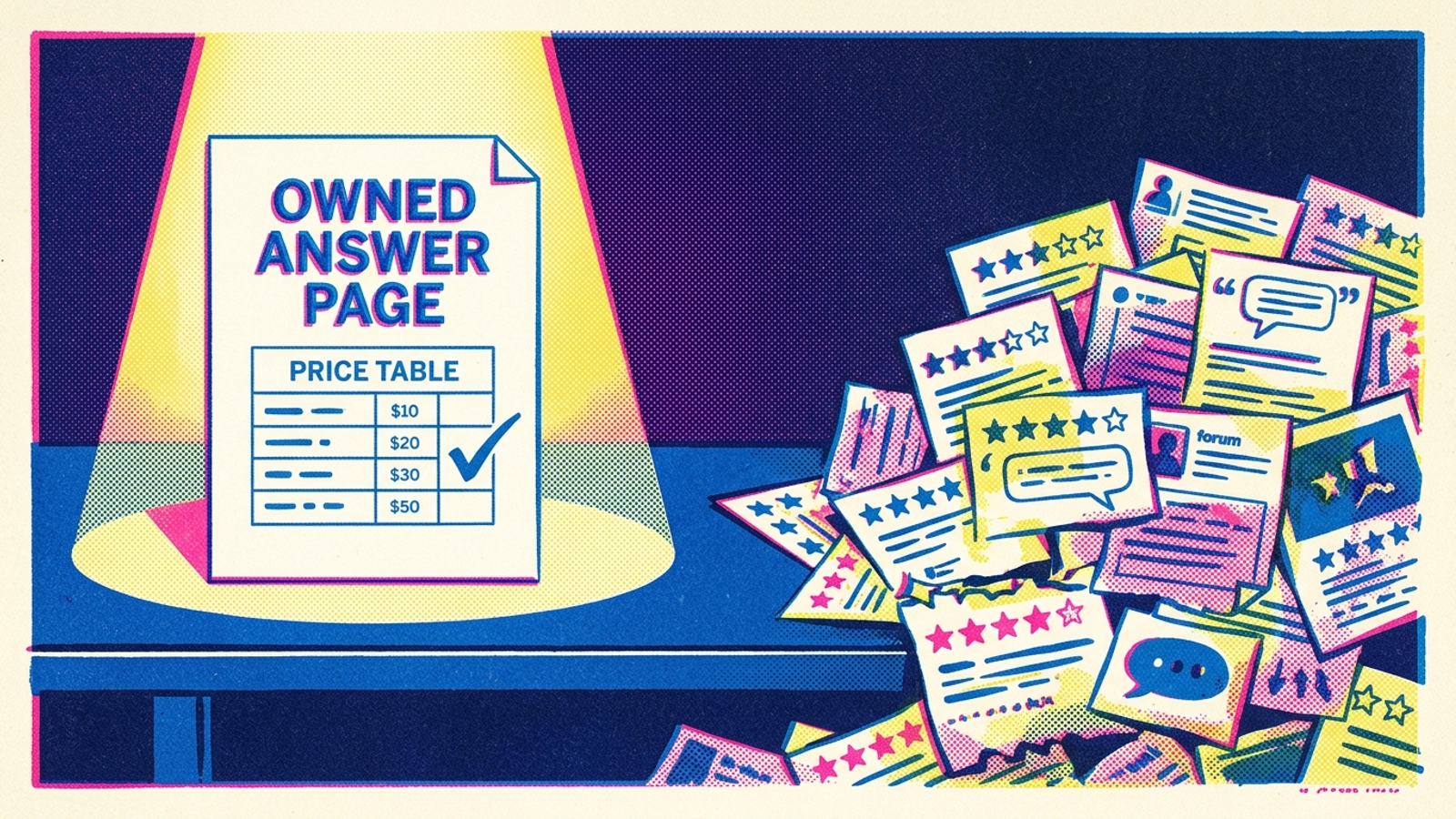
The single consideration that decides my first dollar is whether the buyer wants a fact or a pick. A fact about your price, process or integration needs your own clear source. A pick needs someone other than you to make the case. The same business may need both approaches, but it does not need to spend its first $2,000 pretending the two questions are interchangeable.
Run the test on your own gaps
Question for the notebook: Are you missing from buyers’ answers because you have no citable page, or because no outside source recommends you? Set the test up before changing anything. My expectation is that owned fixes will move fact prompts first and earned work will matter more on best-for prompts. The mechanism is retrieval for the first group, outside judgment for the second. An expectation is not a result, so keep the controls.
- Write the prompt list. Collect 30 buyer prompts in the words a buyer would use: 10 how-to and pricing questions, 10 comparison and best-for questions, and 10 branded or competitor-comparison questions. Run each once in ChatGPT and once in Perplexity. Paste the citations into a sheet and mark every prompt where a competitor gets cited and you do not. That is the baseline, not a verdict. If you want a fuller way to build and tag the list, use this buyer-prompts-you-lose routine.

-
Tag what is missing. Mark a gap owned-content when the answer needs a fact only you can state and you have no clean page for it: pricing, limits, integrations, process or turnaround time. Mark it authority when the answer needs an outside witness and the relevant reviews, best-for lists, threads or comparison tables omit you. Do not tag a prompt authority merely because it contains a competitor’s name. Read what the buyer is asking. A comparison can expose a missing product fact as easily as a missing recommendation.
-
Choose fixes and controls. Select 10 owned-content gaps and 10 authority gaps to work on. Leave 10 comparable misses untouched as controls; keep fact-seeking and recommendation prompts represented among the controls where your list allows it. For each owned fix, make a page that answers the prompt in its first 150 words, with a clear H2 and a dated fact block. For each authority fix, pursue a relevant inclusion: update a review profile, pitch a listicle with real numbers, or give a helpful answer in a community thread. An earned mention has to be earned. Posting “we’re great” underneath a question is not a test of reputation.
-
Re-sample for six weeks. Run all 30 prompts five times per week, using the same wording and a fresh session each time. Record two outcomes separately: were you cited, and were you named as the pick? Single answers lie. When Orbit re-ran the same 72 buyer prompts two days apart, only 30% of URLs survived on Claude, 38% of domains on Gemini, and 65% on Perplexity. One answer is weather. Thirty samples per prompt over six weeks give you a better view of the climate.
-
Compare each treatment with its controls. Calculate citation rate as appearances divided by total runs, then check recommendation rate separately. If your 10 owned-fix prompts move from 10% to 50% while comparable untouched fact prompts sit at 10%, that points toward the pages helping. If earned-fix prompts move while comparable untouched recommendation prompts do not, outside authority looks more likely to be the bottleneck. If everything moves together, controls included, do not take credit for your fixes. If one engine moves and the other stays flat, keep that difference in the result instead of averaging it away.
The engine split is not a technicality. Orbit found that all four models agreed on the same domain for the same question only 1.7% of the time, while ChatGPT and Perplexity shared only about 11% of cited domains. That is why I would log the source and the pick for each engine, not just put a cheerful tick beside “AI visibility.” This prompt-trigger check offers another way to separate a repeatable gain from a lucky Tuesday.
I expect owned fixes to show up on ChatGPT fact prompts first, often in weeks three to four once a page is recrawled. I expect earned fixes to take longer on Perplexity best-for prompts, often weeks four to six, because third-party pages need to be recrawled and weighed alongside other sources. That is the proposed mechanism, not a promise about your results. If the test runs the other way, change the spending order. The point is to find out which gap your buyers’ prompts reveal, not to defend my preferred diagram.
What to do Monday morning
Pull the 30 prompts before you spend anything. If most of your losses sit in how-to, pricing, spec and integration questions, write the owned answers first. Put the answer near the top, date the fact, and give each page a heading a person would recognize. Do not make a buyer read four paragraphs of “our mission” to find a price.
If most losses sit in best-for and versus questions, start the earned work first. Fix review profiles. Pitch two listicles where you belong, with real customer numbers. Answer one thread per week like an operator instead of a marketer. If you are a small team without a tracking budget, use this two-hours-a-week routine and a spreadsheet.
The prompt type decides. Spend the first dollar where the buyer’s question actually gets answered.