

 LinkedIn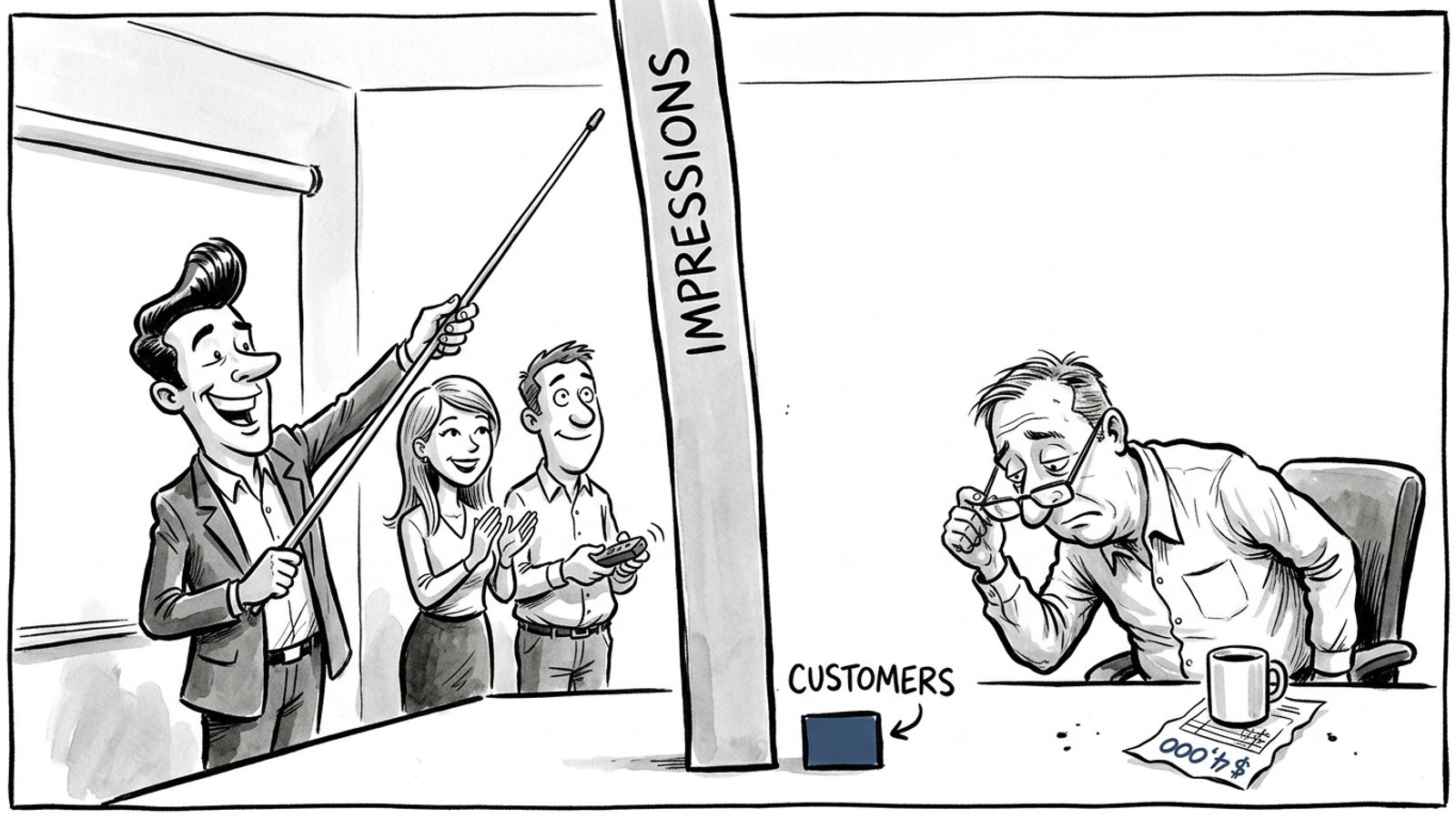
Your Google Ads account spends $20,000 a month, acquisition costs have climbed since month two, and the month-six review deck says “Consolidating Wins & Accelerating Scale.” The PDF arrives seventeen minutes before the Zoom call. Your agency’s $4,000 monthly management bill arrived on time, too.
Cover slide: Momentum, synergy, and the road ahead
Apex Digital Growth Partners
Q2 Performance Review & Strategic Roadmap
Prepared for: Client Leadership Team
Theme: Consolidating Foundations for Accelerated Scale
Before opening the attachment, check the attendee list. The business development director who sold you the contract is here. So is the client success manager who forwards your Slack messages, plus a media buyer assigned to the account three Tuesdays ago. Together, they will read twenty-four Canva slides aloud while you look for the one number your sales team needs.
I have annotated the deck in the margins. Keep the invoice handy. It becomes relevant around slide nine.
Executive summary: impressions up, acquisitions flat
- Impressions: +41% quarter over quarter (Expanded Reach & Brand Presence)
- Click volume: +18% (Strong Top-of-Funnel Resonance)
- Average CPC: down 6% ($2.84 versus $3.02)
- Total qualified conversions: flat (42 versus 43)
- Cost per qualified conversion: up 12% ($465 versus $418)
- Attributable pipeline revenue: “Directionally stable within expected macro seasonality”
Margin note: read the bottom half first
More impressions may mean more reach. They do not tell you whether that reach produced buyers. More clicks can arrive alongside fewer qualified conversions; a cheaper click can still lead to a more expensive customer. That is why the executive summary leads with the numbers climbing toward the ceiling and puts acquisition cost near the floor.
There is a respectable place for awareness metrics in a review. WordStream’s QBR discussion includes high-level measures among the numbers an agency might present. But this account is spending $20,000 a month to acquire customers, not to win a chart-making contest. If qualified conversions have barely moved and each one costs more, “expanded reach” is a description of where the money went, not a commercial result.
Ask for the acquisition number before anyone advances the slide. “Directionally stable” can wait until after someone explains what happened to the pipeline.
Slide 4: The learning phase, again
Campaign Maturation & Algorithmic Calibration
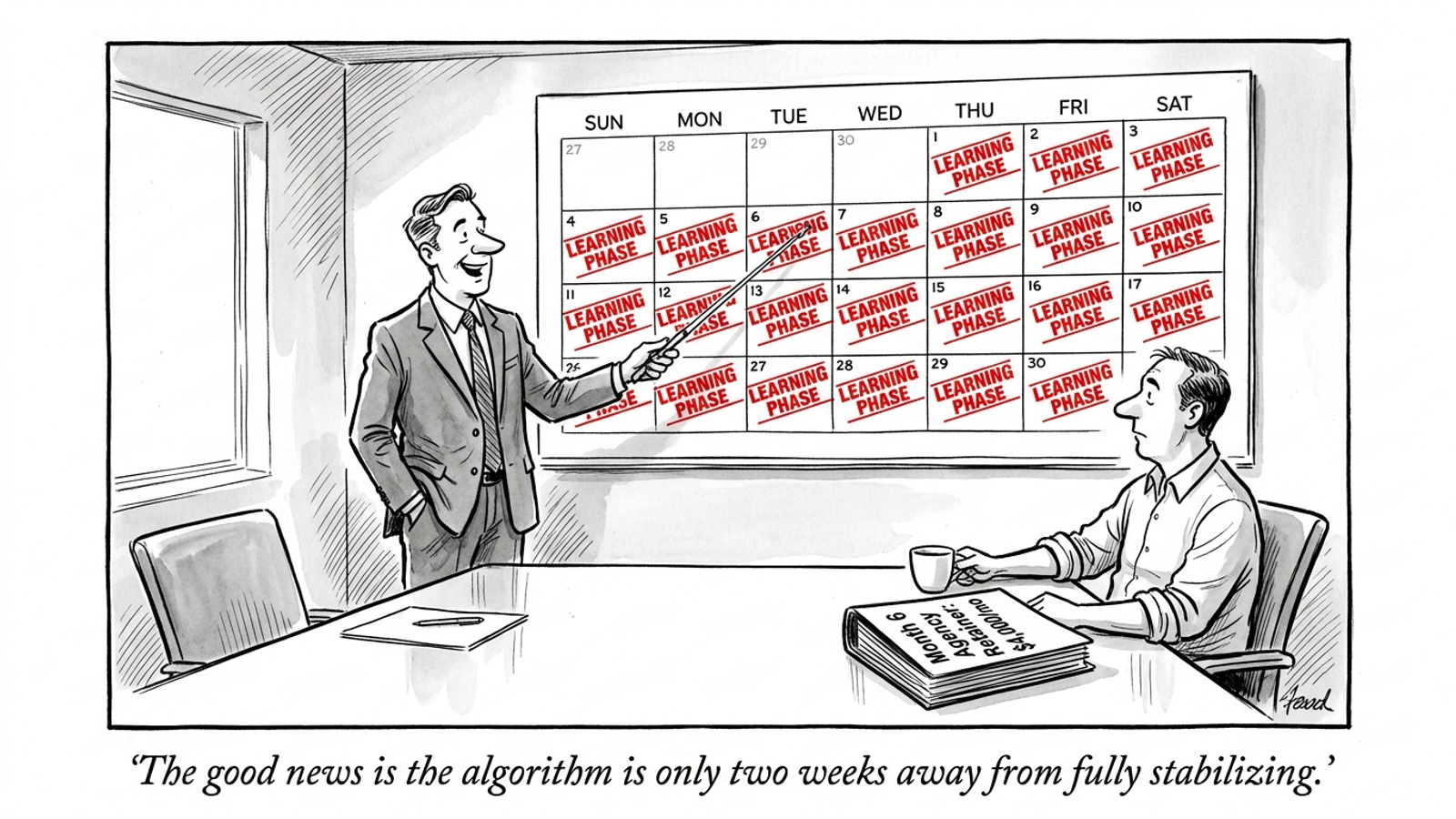
“Following our strategic transition to Value-Based Smart Bidding in late Month 4, the account entered an anticipated machine-learning calibration cycle. Performance metrics in Q2 reflect the stabilization corridor typical of complex auction environments. Early leading indicators suggest the underlying models are successfully building historical conversion equity.”
Margin note: learning is real; a rolling exemption is not
Smart Bidding needs time and conversion data to adjust. Google’s Smart Bidding guidance gives you a reason to ask what changed and when, not a reason to suspend judgment indefinitely. A bid-strategy change late in month four might explain a period of unstable performance. It cannot, by itself, account for every disappointing week since month two.
This is where I would ask the media buyer to put the account’s change history beside the performance chart. Which changes were made? What was each one supposed to improve? What happened afterward? A $5 Target CPA adjustment, three swapped ad assets, and an ad-group restructure are not interchangeable events, and not every edit wipes bidding history. Calling all of them calibration makes the word do more work than the campaign manager.
The slide offers no date when the explanation expires. Put a date on the test and a result beside it. Otherwise, next month’s report can begin in the learning phase too.
Slide 7: Seasonality enters the meeting
Market Dynamics & Macro Headwinds
“While month-over-month volume experienced minor compression (-4%), this aligns closely with observed macro shifts across the broader vertical. Post-spring demand consolidation, combined with lengthening B2B evaluation cycles and summer buyer distraction, created temporary friction in the conversion funnel. We anticipate natural seasonal tailwinds to re-engage in early Q3.”
Seasonality is real for patio furniture and ski resorts. It might matter for your business, too. The slide’s problem is that it has not shown you how much search demand changed, let alone whether that change explains your account’s results. “Summer buyer distraction” is unusually difficult to argue with because it is not presented as anything you can measure.
Pull up your own search-demand trend and the year-over-year organic impressions in Search Console. If demand fell, say so and work out what that accounts for. If it held steady while the ad account’s conversion rate fell, examine the account before blaming the calendar. I have watched perfectly fixable campaign problems acquire impressive macroeconomic names by the time they reach a client deck.
A headwind needs a measurement. Without one, this slide is weather reporting from inside a conference room.
Slide 9: The recommendation is to spend 30% more
Unlocking Scale: Strategic Budget Expansion Framework
“Our modeling indicates that current campaigns are running into impression share budget ceilings (Lost IS Budget: 34.2%). To exit the current efficiency bottleneck and enable Smart Bidding to capture high-intent incremental volume, we recommend a 30% expansion in monthly ad spend ($20,000 → $26,000 / month). This will unlock critical auction headroom and lower blended CPA through statistical scale.”
Margin note: the budget ceiling is not a sales forecast
The account is losing impression share to budget. That is useful information: the campaigns could enter more auctions if you gave them more money. It does not establish that the additional auctions would produce qualified customers at an acceptable cost. The slide moves from “we could spend another $6,000” to “blended CPA will fall” without showing the bridge between those claims.
I would ask which campaigns are constrained, what they currently pay per qualified acquisition, and what evidence suggests the next tranche of spend performs better. If the account cannot acquire customers economically at $20,000, a $26,000 budget does not repair it. It gives the same setup more room to run. More budget may be the right call after the account has a credible target and a plan for the incremental spend. Here it appears before either.
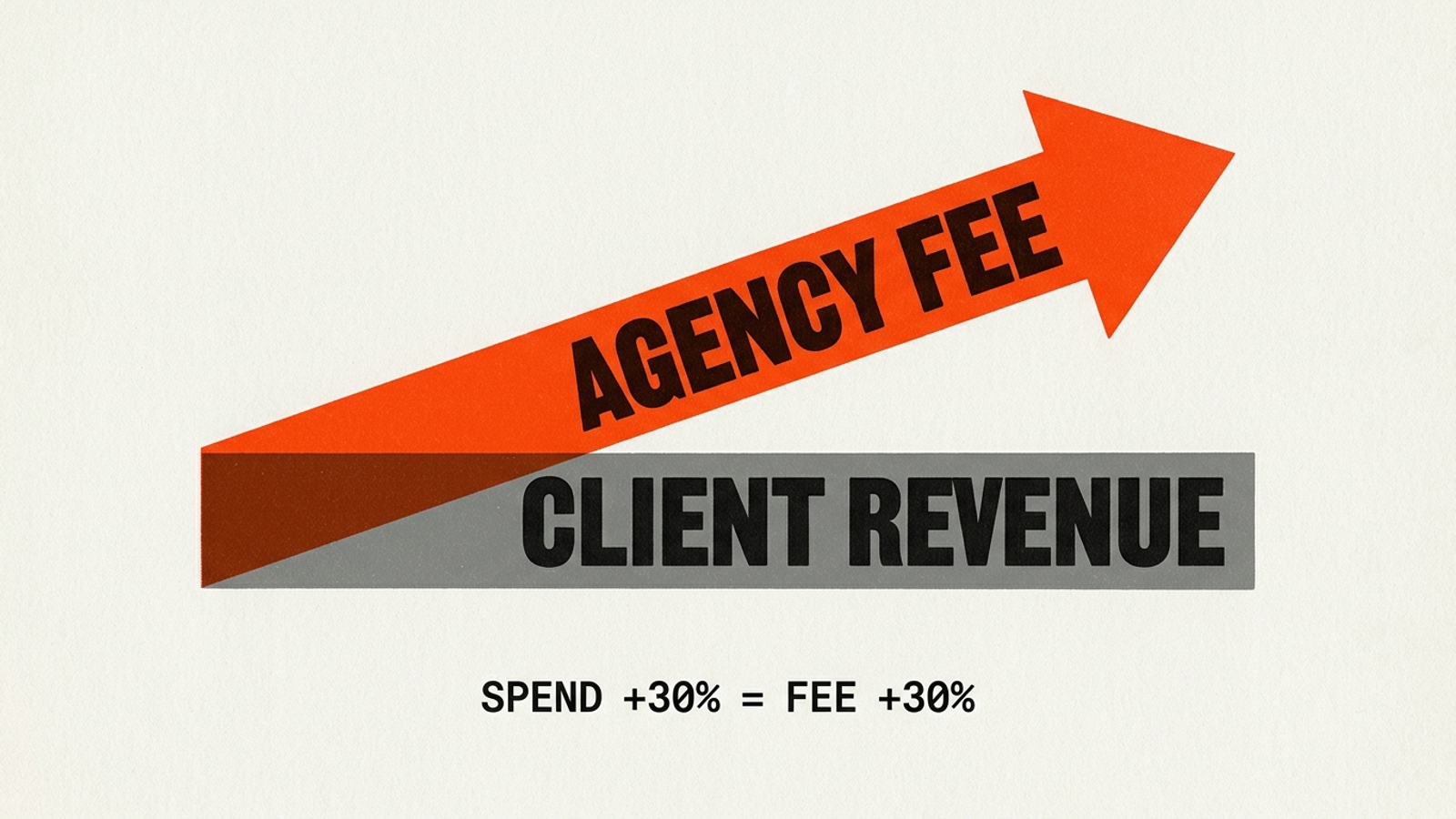
Then comes the fee calculation the slide left out. Under a 15% percentage-of-spend fee, a $20,000 ad budget produces a $3,000 monthly management fee. Raise the budget to $26,000 and that fee becomes $3,900: $900 more per month before one additional customer arrives. That is the incentive built into the percentage-of-spend model. It does not prove every budget recommendation is bad. It tells you exactly why a recommendation to spend more deserves scrutiny when sales have stalled.
Our fictional client currently pays a fixed $4,000 retainer, so this particular increase would not automatically add $900 to that bill. A fixed fee avoids that specific ratchet unless the agreement has spend-based tiers. It does not make weak performance worth $4,000. Nor does a percentage fee become harmless because the agency has a polished retainer explanation. Read the contract, work out who earns more when the budget rises, and ask what you earn if it does.
The $4,000 bill also buys calls, coordination, reporting, and work inside the account. Those are not all worthless. I have spent enough late nights in search-term reports to know good management takes time. But a twenty-four-slide deck is not a substitute for showing which decisions reduced wasted spend or brought in qualified pipeline. Approve the extra $6,000 only if the agency can make that case, not because a column says the budget could be bigger.
Slide 12: Next steps, copied from last quarter
Q3 Strategic Roadmap & Tactical Levers
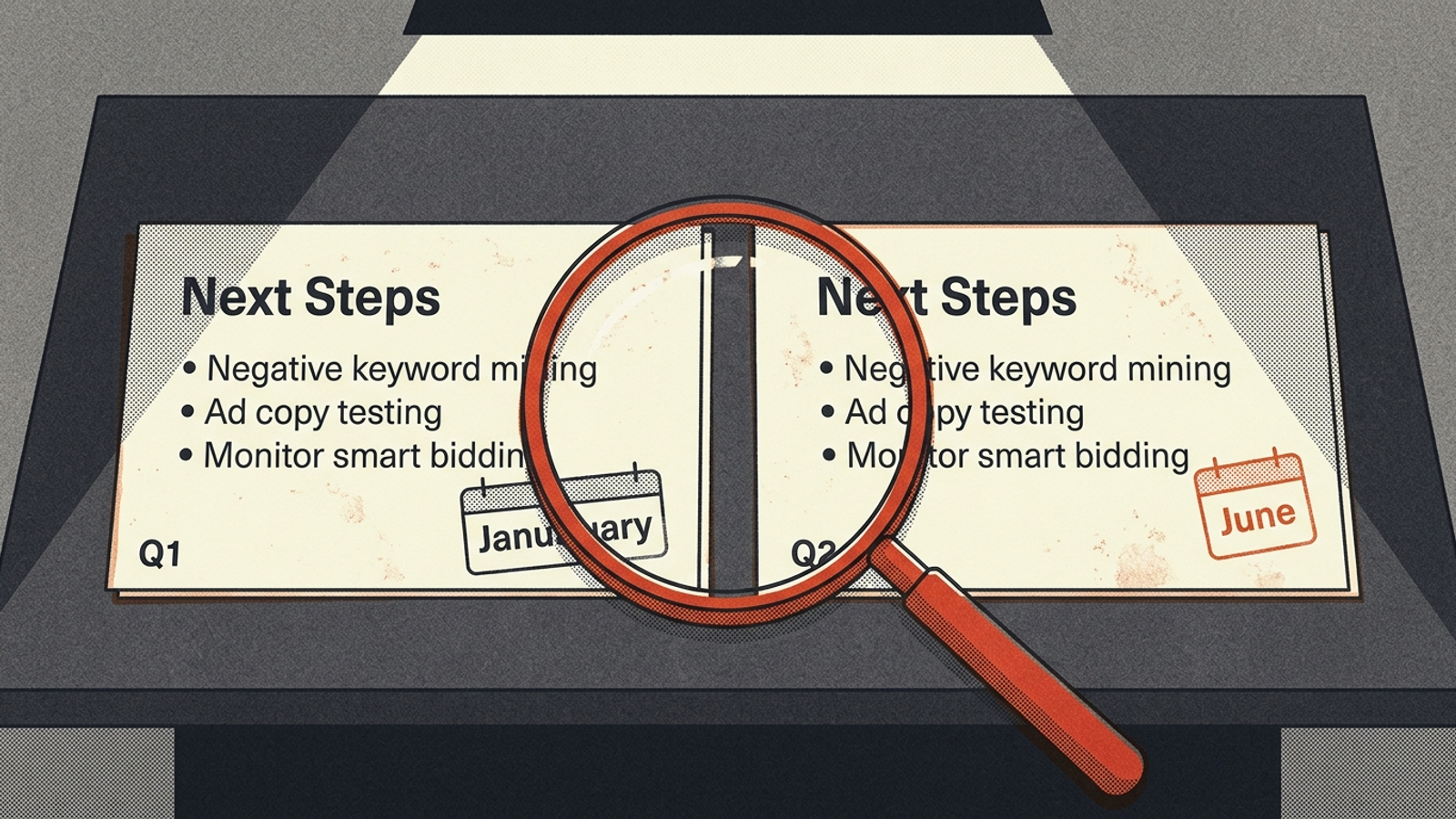
- Continue proactive negative keyword mining and search term hygiene
- Deploy revised Responsive Search Ad headline variations for creative testing
- Explore Demand Gen expansion and top-of-funnel audience testing
- Bi-weekly alignment syncs to monitor Smart Bidding health
Pull up the month-three deck. The bullets are identical. Negative-keyword work and ad testing are legitimate tasks; in fact, I would worry if nobody were doing them. But after another quarter, the roadmap should say what the team found, what it changed, and what it will do differently as a result. “Continue proactive” tells you none of that.
The third bullet proposes another campaign type while the existing campaigns have yet to meet a stated acquisition target. The fourth books another meeting to discuss bidding health. Somewhere between those two bullets, the account’s commercial problem disappears. In its place is an administrative loop: run a test, hold a sync, assemble a deck, repeat the same roadmap. The slides change colour. The plan stays put.
Ask which next step was completed last quarter and what it produced. If the answer is another version of the same bullet, you have found the loop.
The memo the agency did not send
Internal note: month-seven renewal
The client’s acquisition cost is rising. We have not agreed on a written target for qualified acquisitions or attributable revenue, so the review will open with reach and click growth. We can describe the bidding change as calibration, the conversion dip as seasonality, and the available impression share as room to scale. Under a percentage-of-spend agreement, a larger budget would also increase our fee. Under this client’s fixed retainer, the fee continues whether the pipeline improves or not. Schedule the next sync.
That memo would fit on an index card. I would rather receive it than another page of pastel arrows. It identifies the issue that the presentation keeps walking around: the agency gets paid on the terms of the agreement, not on the results implied by its slide titles. A percentage-of-spend fee makes the budget recommendation especially interesting because more spend means more fee revenue. A fixed retainer removes that automatic increase but still needs accountability.
This is a problem with the operating model, not proof that every person at an agency is incompetent. Good people can do good work inside a bad incentive structure. I have made my share of careful account decisions, and I know a spreadsheet does not prune its own search terms. But the client should not have to infer the target from a QBR or discover the commercial incentives halfway through a budget pitch. The broader structural critique of agency models starts there: what is the work meant to produce, and who is answerable when it does not?
Final slide: three questions before month seven
Before accepting slide twelve and renewing the retainer, put these in the meeting chat. Ask them in order; each answer gives the next question somewhere to land.
- What is our target cost per qualified acquisition for the next ninety days? Get a number tied to qualified pipeline or closed revenue, not impressions, click-through rate, or impression share. If the agency wants a higher budget, ask how that budget is expected to affect the target.
- Where is that target written down? A number mentioned on a call and forgotten by the next QBR is not much of a target. Put it in the working plan and the commercial agreement so both sides know what success means before another month is billed.
- What happens if we miss it? The answer might involve changes to the account, the budget, or the management arrangement. “We will review leading indicators at the next bi-weekly sync” is not an answer to what happens to your money.
The alternative is not a more elaborate presentation. It is an operating model that does the repetitive account work continuously while a strategist owns the direction and explains the commercial result. That is the case for a flat-fee option such as groas, or for a structured 90-day search sprint with a target agreed in writing before management fees change hands. Neither removes the need to inspect results. Both make for a better conversation than applauding impressions while acquisition costs climb.
If month six brings 41% more impressions, essentially flat qualified conversions, and a request for 30% more budget, close the PDF before agreeing to slide nine. The fix is a target written down before money changes hands, not a better deck.