

 LinkedIn
PromptMeter Pro is now generally available. Your agency asked for AI visibility; we built a meter that charges you to watch it.
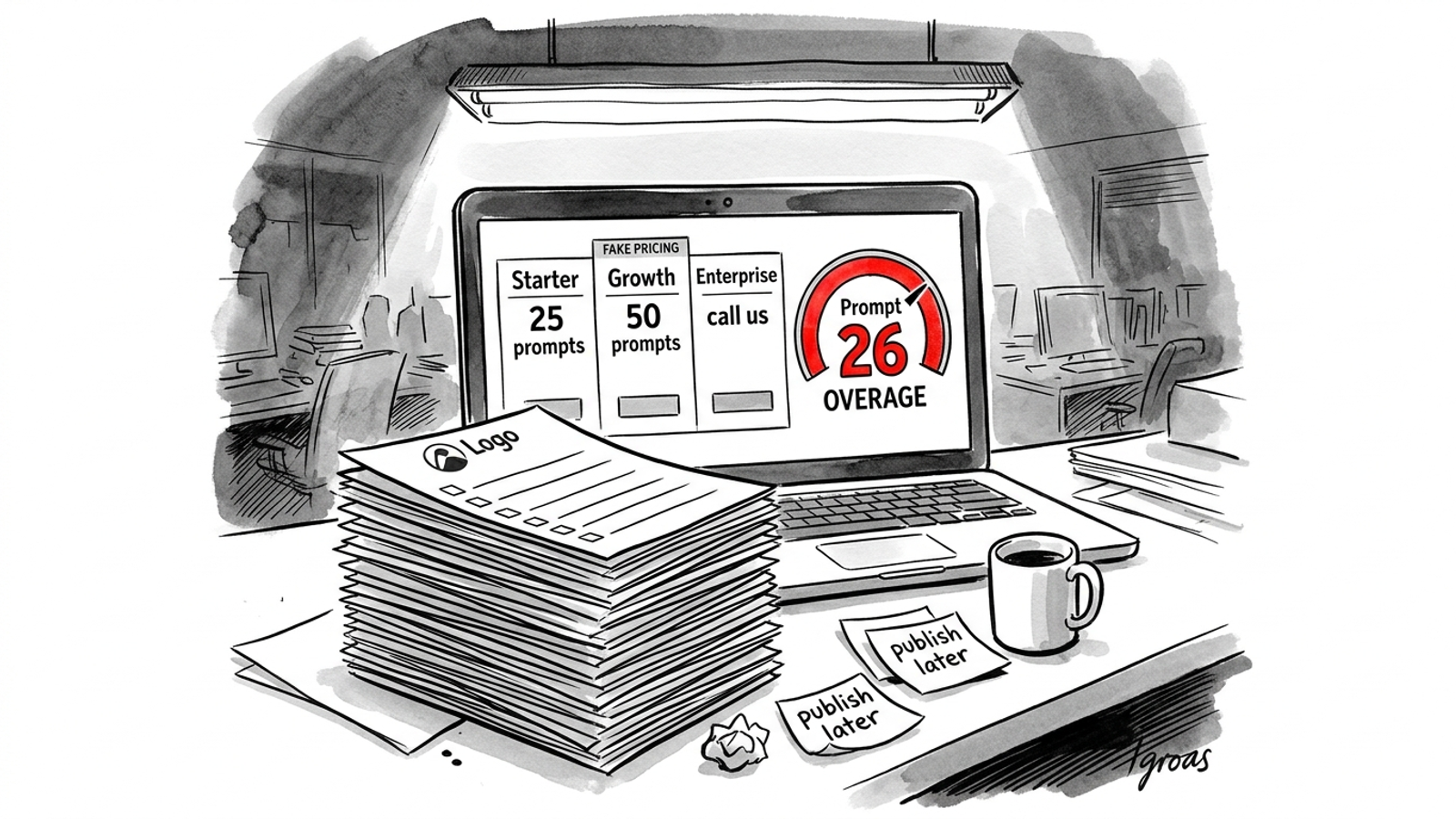
Starter tracks 25 prompts. Growth tracks 50. Enterprise includes a sales call where we pick a number together. Every plan grades your visibility hourly and puts the work your team still has to do into a white-label PDF. If you need prompt 26 on Starter or prompt 51 on Growth, our meter catches that before our crawler does. That is the product.
PromptMeter Pro: Now With 40% More Dashboards
Our pricing: Starter, Growth, and a number we choose together
I used to tell clients that tracking 25 prompts was a starter sample. I was wrong. At PromptMeter Pro, 25 prompts is a pricing tier. Starter spreads those prompts across three engines. Growth doubles the allowance to 50, so your team can decide which questions matter before it learns which questions customers actually ask.
The meter is not a technical limit; it is a familiar business model. Peec offers 50 prompts for $95 a month and 150 for $245. Otterly starts at 15 prompts for $29 before overage math enters the room. HubSpot documents the same tier-and-expansion-pack structure. We copied the part that gives your agency an upgrade decision every time it finds another question worth tracking.
When prompt 26 trends, you will know exactly what you are missing. The chart will show it hourly, in four colors. Upgrading is one click. Covering prompt 26 is your problem. We sell the count, not the fix.
Per-domain? Per-seat? Per-prompt? Yes.
PromptMeter Pro bills the way agencies bill clients, in every direction at once. The base platform covers three client projects, because we read the same arbitrage post you did: charge each client $500 to $1,500, pay us $149, keep the difference. That arithmetic looks lovely until client four needs a domain, another engine, and enough prompts to cover the questions in the kickoff document.
Engines beyond ChatGPT and AI Overviews are $29 a month per engine per client. Prompt Packs are $15 a month for 10 more prompts, per pack, per client. White-label reporting is $299 a month, because your clients should not see our logo on the to-do list we sold you. Extra seats are metered. Extra domains are metered. Gemini and AI Mode are add-ons, priced at $9 to $149.
Say you run 10 clients with 100 prompts each and four engines. Your spreadsheet now has more tabs than your visibility report. Before you can price the retainer, you must work out which clients need which engines, how many Prompt Packs they will consume, and whether the person who fixes the page also needs a seat. That is intentional. Confusion about the bill reads as sophistication of the product.
Features Your Clients Will Love Looking At
The AI Visibility Score: recalculated hourly, actionable never
Our proprietary AI Visibility Score blends mentions, citations, sentiment, and share of answer into one number your client can argue about on a call. It refreshes hourly, which means it moves a lot. It moves when a prompt reruns, when the model temperature shifts, when a competitor publishes a listicle. Movement reads as monitoring. Monitoring reads as work.
A category roundup describes Otterly as monitoring-focused without built-in optimization guidance and quotes a practitioner saying most tools stop at “here’s what changed.” We built PromptMeter Pro to live inside that observation and charge rent. Your team can explain why the score changed, investigate whether it matters, and decide what to do about it. We will refresh the score while you do.
The hourly chart also gives every client call a dependable opening: Tuesday was down four points. That sounds urgent even if nobody has yet identified a page to change. Your score dropped four points Tuesday. Our invoice did not.
White-label task lists, so your team can do the work we don’t
Every plan ships with multi-brand workspaces, bulk prompt management, and white-label reporting. Those are the features agency roundups tell buyers to demand, alongside API access. Open the portal and you get the deliverable: a prioritized list of 47 recommendations. Add FAQ schema. Fix entity gaps. Build citations. Rewrite the comparison page.
Your logo sits top right. Our engine sits idle bottom left.
A monitoring package can run $500 to $800 a month per client while the tool costs $79 to $250. The margin survives if your headcount does not eat it. A fuller program with content fixes and schema runs $1,500 to $3,000. That gap between software and delivery is where your junior hire lives. We have thoughtfully left it open for them.
The PDF makes the arrangement easy to present. It does not tell the client who writes the page, who gets approval, or who checks that the fix went live. You can put your logo on that problem, too. The report is white-label; the labor is yours.
The Execution Add-On: sold separately, priced like a junior hire
For agencies that ask when PromptMeter Pro will publish something, we offer Execution. It publishes content, ships technical fixes, and builds citations: the work that might give the score something useful to measure. Execution costs extra because selling the alert is cheaper than staffing the fix.
Entry AEO retainers run $1,000 to $2,500 a month for monitoring and foundations; mid-market programs run $2,000 to $10,000. Cheaper $99 to $499 tool-led plans can leave agencies with recycled posts and FAQ schema that AI engines do not cite. We read that breakdown and kept the inexpensive part as our default offer.
Execution starts at $1,800 a month per domain. Onboarding takes six weeks, and cancellations are honored quarterly. The dashboard remains real time. The work remains someday. If a client asks why the score has moved but the comparison page has not, show them the activity graph. It has plenty of activity. That delay is not a bug. It is someone else’s utilization rate.
Testimonials From Agencies Who Renewed Out of Fear
“Cost per daily tracked prompt looks excellent on paper. Cost per fixed page is harder to find.” This illustrative testimonial borrows its first concern from a comparison of daily tracking costs: $0.48 for Otterly, $0.53 for Peec, $1.50 for Scrunch, and $1.98 for Profound. We recommend presenting the first column to clients and discussing the second only if asked.
“We renewed because canceling meant explaining why the visibility score disappeared.” That one requires no elaborate pricing model. Once reports become part of a client retainer, losing access becomes a conversation the agency would rather postpone. A dashboard can be difficult to leave even when it has not made the work easier to do.
Our preferred renewal question is therefore not “What shipped?” It is “How many clients expect this graph on Monday?” Nobody renews a reporting dependency because the PDF fixed a page.
Fine Print, Translated
What the deck calls insights, I call a to-do list with a logo
Section 4.2: PromptMeter Pro provides visibility insights and optimization guidance. Translation: we show you the prompt, the answer, whether you were cited, and a paragraph starting with “consider.” Consider adding an FAQ. Consider building entity coverage. Consider fixing the template your developer has not touched since 2022.
I ran accounts long enough to know what “consider” costs. Somebody on your team opens the ticket. Somebody else writes the draft. Somebody waits on the client for approval. The dashboard counts one insight delivered; your payroll counts the hours. If the page never goes live, the recommendation can appear again next month, fresh as ever.
Here is the mechanism: the tool watches answers change and logs the difference. Your team supplies the labor that could turn that observation into a better page. The client pays a retainer that bundles the two, then sees the software’s chart when the result changes. What the deck calls synergy, I call two people doing the same job while software watches.

Agency Procurement Checklist: Complete Before Adding a Card
If you are shopping for AEO software for agencies, run the demo through this form before you decide what to put in a retainer. Sample reports belong in the attachment field. Answers belong here.
- Flat monthly price per domain, with no prompt or keyword caps. If tracking stops at 25, 50, or 150 prompts, ask what happens to prompt 51 before signing.
- Published content and shipped technical fixes, not recommendations. Request a shipped URL and a closed ticket instead of another sample report.
- Multi-domain pricing that does not punish client 11. Get the cost for client 10 and client 20 in writing, including engine and prompt add-ons.
- Contract length and access after cancellation. Know what happens to client work and logo-locked reports before they become part of your retainer.
- Margin after your team does the work. This is the item most often skipped: a $79 to $250 tool that leaves your staff to act on 47 recommendations can cost more than its dashboard suggests.
Renewal Terms
For agencies comparing AEO software against retainer economics, I use the same test I use for PPC: show me the work shipped last week. groas offers flat per-domain pricing with content, technical fixes, and citations included, white-label under your name, with actions logged. That is a stronger alternative to paying PromptMeter Pro for a meter and staffing its recommendations yourself. If we cannot show you a shipped URL, you can keep the demo recording and skip our contract.
PromptMeter Pro renews next Tuesday. Your Visibility Score history stays live as long as you pay. Cancel, and the portal, PDFs, and hourly graphs go dark across all 12 clients on the same morning. The rep will show a slide where citations ticked up three points after your team rewrote four pages and fixed schema on two templates. We will call that lift an insight delivered. Your staff did the delivery; our meter billed the observation.
Say you charge $800 for monitoring and pay $250 for software. The $550 left looks like margin until you subtract six hours of analysis, two hours of client explanation, and a revision cycle. At a loaded cost of $125 an hour, the first eight hours alone cost $1,000. You lost money before the client opened the report. This is how a cheap tool becomes an expensive retainer.
On the renewal call, ask us for a prompt you tracked without an extra charge. Then ask for the page we published for it, the technical ticket we closed, and the answer where the citation appears. A crawler can fetch a page; a page with a direct answer in clean HTML gives the model something quotable to cite; tracking records the citation later. We are very good at that last step. For the rest, please consult your task list.
Pay for work shipped, not prompts counted.