

 LinkedIn
Your Google Ads budget doubles. Your agency’s fee doubles with it, even if its workload barely changes. That is the problem with charging 10% to 20% of gross media spend for work that Google has spent a decade automating.
At a 15% rate, a $20,000 monthly budget produces a $3,000 management fee. Raise the budget to $50,000 because the economics justify it, and that fee becomes $7,500. The extra $4,500 might buy valuable work. But the contract does not require any: the increase follows your spend, not a new campaign, a new asset or a better result.
The model was not always ridiculous. Madison Avenue agencies charged a 15% commission on gross spend when buying and trafficking media involved substantial manual work. Paid-search agencies inherited the percentage model during an era when more spend often meant more campaigns, bids and reporting hours. Spend was a rough proxy for labour. The timeline below shows how that proxy lost its footing while the fee stayed put.
2002–2015: When more spend often meant more hands-on work
In the early years of paid search, account management involved a great deal of repetitive labour. Specialists built keyword structures, adjusted bids, wrote ad variations and combed search query reports for negatives. Single Keyword Ad Groups, or SKAGs, were one way to control ad relevance. Device adjustments and campaign reports often passed through spreadsheets before anyone could act on them.
At 15% of a $30,000 monthly media budget, an agency collected $4,500. Using a senior specialist billing range of $100 to $175 per hour, that could represent roughly 25 to 45 hours of work. A larger account might genuinely require more campaigns, more geographic coverage and more manual maintenance. The percentage was crude, but it had an operational explanation.
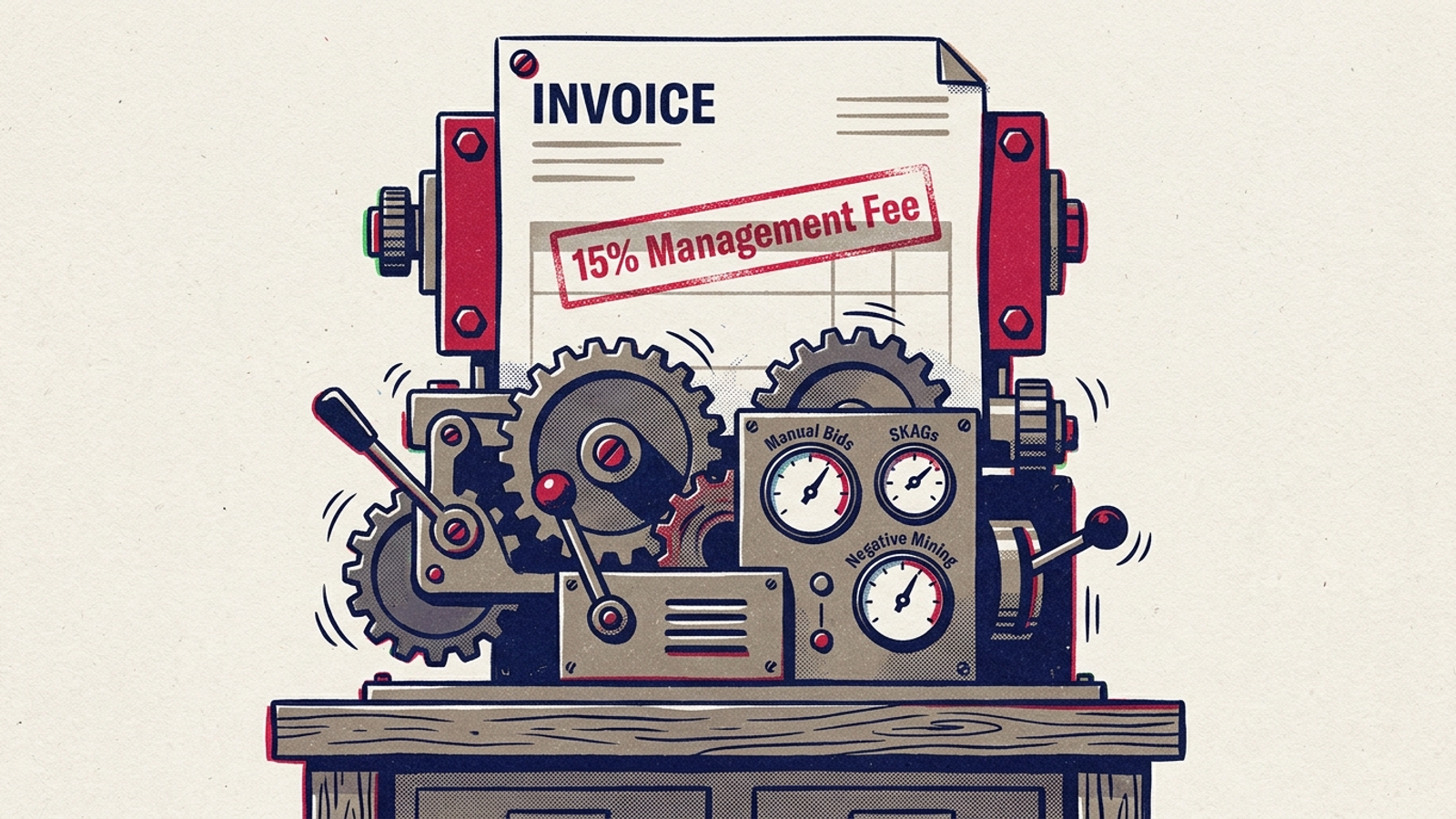
That explanation became a pricing precedent. Small accounts still needed setup and attention, so agencies often protected themselves with minimum retainers of $1,500 to $2,500. On larger accounts, the percentage could rise with spend even when the work did not rise at the same rate. I do not begrudge anyone charging for difficult account management. I do object to treating yesterday’s labour estimate as a permanent claim on tomorrow’s media budget. As I have argued in why paying for time destroys campaign performance, paying for inputs can pull attention away from business yield.
The fee made the most sense when an expanding account also expanded the manual job. The next changes weakened that connection.
2016: Smart Bidding takes over the auction-time calculation
Google’s expansion of Smart Bidding changed what a specialist had to do between setting a goal and entering an auction. Target CPA and Target ROAS strategies could use signals such as device, location, time of day and search behaviour to calculate bids at auction time. An operator’s static maximum CPC and spreadsheet of scheduled adjustments were no longer the only way to respond to those conditions.
That did not make the specialist useless. Someone still had to choose a sensible conversion goal, understand what a customer was worth and notice when the system was optimizing toward the wrong signal. But it did reduce the case for billing as though every additional dollar of spend demanded another round of manual bid changes. A specialist checking bids twice a week could not perform the same auction-time calculation.
Agencies could call the new work “algorithmic oversight” and keep charging 15%. Some oversight was real. It was not the same work as setting bids by hand, and increasing a budget did not automatically multiply it. The practical question changed from “How many bids did you touch?” to “What business target did you give the system, and is it the right one?”
2019–2021: Match types loosen their grip on keyword sculpting
Keyword structure changed next. In early 2019, Google expanded close-variant matching for phrase and broad match modifier keywords. By July 2021, it had phased out Broad Match Modifier, folding its role into expanded phrase match. Syntax and word order gave specialists less control over exactly which queries entered an auction.
That broke part of the old keyword-sculpting routine. Specialists could spend hours routing search terms through tightly separated ad groups and negative lists; semantic matching made that sort of fine-grained routing less reliable. Negative keywords still mattered, especially for excluding waste. They just could not restore the old degree of control by themselves.
For practitioners, the work shifted from maintaining elaborate match-type scaffolding to judging intent and excluding bad traffic. A proposal that promised “active keyword management” needed to explain what those words meant now. Counting keyword edits was a poor substitute for showing that the account attracted better searches at an acceptable cost.
November 2021: Performance Max compresses cross-channel execution
When Google rolled out Performance Max globally in November 2021, it brought Search, YouTube, Display, Discover, Maps and Gmail into one campaign framework. Work that had involved separate targeting, placements, creative assembly and bid decisions could increasingly happen inside one automated system pursuing a conversion goal.
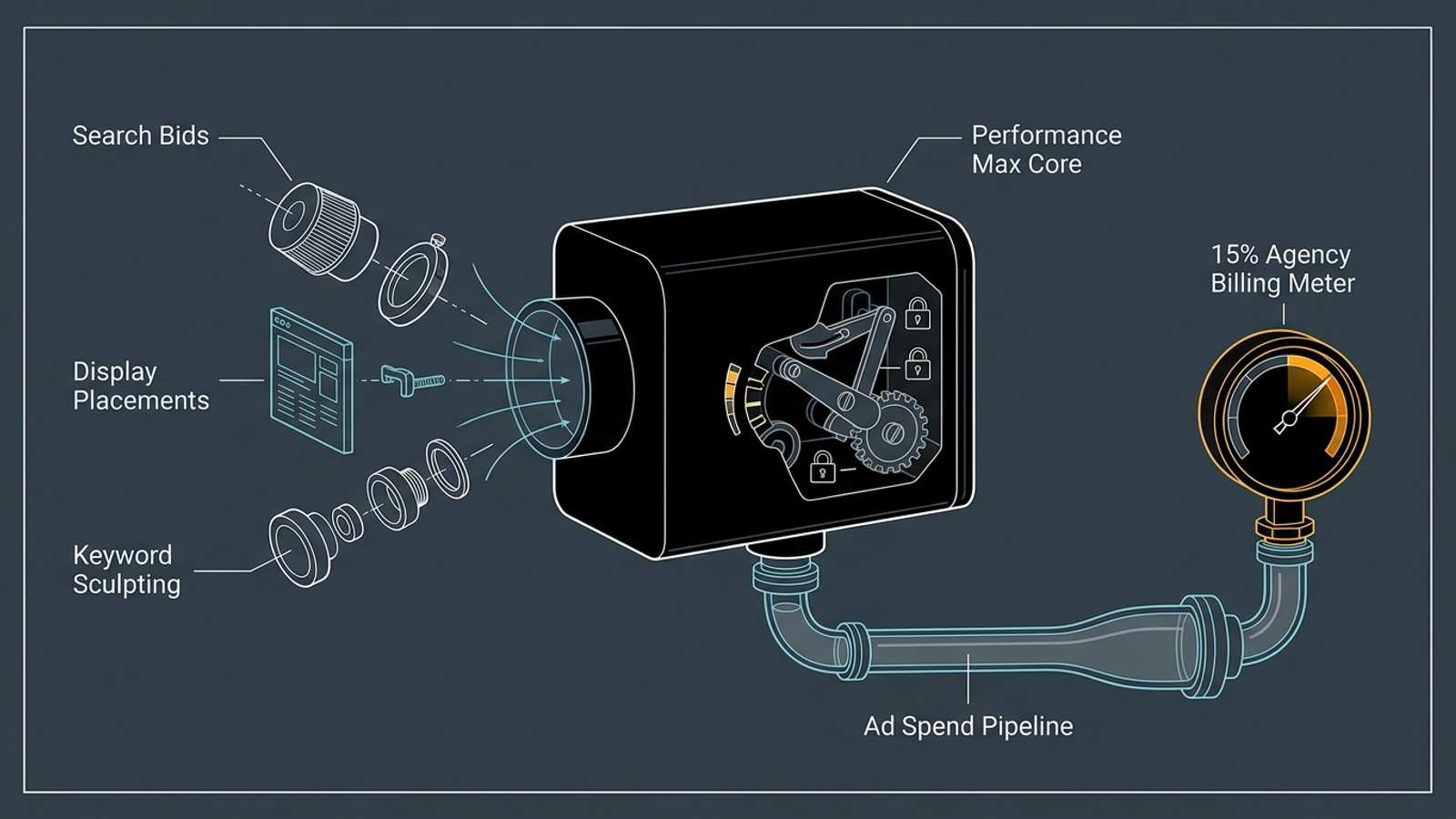
The trade-off was not simply fewer clicks in an agency dashboard. Automation also made it harder to equate platform activity with human value. An advertiser still needed sound goals, useful assets and a way to judge whether additional conversions were worth buying. An agency still had room to challenge a budget increase. But a percentage-based contract rewarded the agency for that increase whether or not the resulting traffic helped the business.
Take an account spending $10,000 a month. At 15%, the management fee is $1,500. Raise the budget to $30,000 to pursue more volume, and the fee becomes $4,500. There may be a good reason to spend the extra $20,000. The extra $3,000 in management fees needs its own reason. If the agency cannot name the additional work or accountability that comes with it, the fee has become a tax on scale.
June 2022: Responsive Search Ads change the creative-testing job
On June 30, 2022, Google sunset Expanded Text Ads, leaving Responsive Search Ads as the standard search ad format. Instead of managing a set of fixed text ads and choosing winners through a familiar split-test routine, advertisers could supply up to 15 headlines and four descriptions for Google to combine in different contexts.
That reduced one kind of manual testing. It did not write strong headlines, decide which claims the business could support or make a weak offer persuasive. Creative judgment survived; the old testing choreography did not. When “ongoing creative split testing” appears in a proposal, ask what the agency will actually write, test and change rather than accepting the phrase as proof of work.
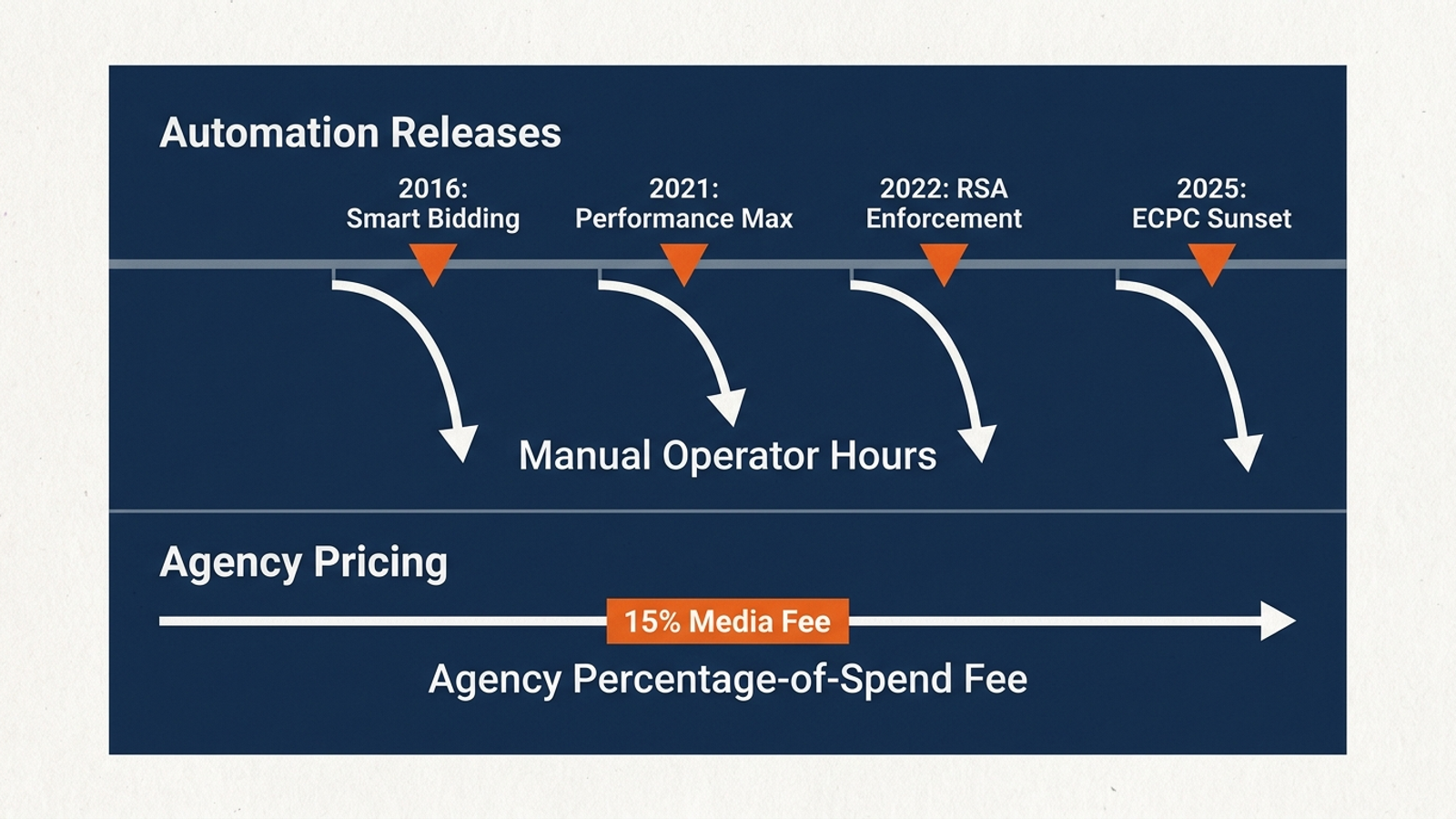
The pattern by this point was hard to miss. Google kept absorbing routine execution while agencies could keep the familiar invoice structure. The important distinction was between work a platform now performed and decisions a practitioner still owned.
March 2025: Enhanced CPC loses its place between manual and automated bidding
Google deprecated Enhanced CPC for Search and Display campaigns in the week of March 31, 2025. ECPC had let advertisers set manual base bids while Google adjusted them for predicted conversion likelihood. Its removal narrowed that middle ground between hands-on bidding and automated bidding strategies.
For an account using Smart Bidding, the valuable human decision was increasingly about the parameters: what counts as a conversion, what target CPA the business can afford or what target ROAS makes sense. Those decisions can be difficult. They can also have expensive consequences when nobody revisits them. But a $50,000 account does not inherently need ten times as much target-setting work as a $5,000 account.
Bid management had become less about changing individual bids and more about setting the conditions for the system to bid well. An agency charging a percentage of spend could still justify its fee through valuable strategic work. It could no longer point to the media budget alone as evidence that the work had grown.
August 2026: Target settings matter more when budgets constrain bidding
Google’s Bidding Target Optimization rollout for budget-limited Target CPA and Target ROAS campaigns, completed on August 17, 2026, put another spotlight on target calibration. A budget limit does not excuse a stale target. If the number in the account no longer reflects what the business can afford, automated bidding has the wrong instruction even when it is operating as designed.
This is where “the machines do it now” becomes a lazy answer. Someone has to connect campaign settings to margins, conversion quality and the terms an advertiser does not want to buy. That calls for ongoing attention, not a ceremonial weekly visit to approve recommendations. It also calls for a fee that does not rise merely because the system is allowed to spend more.
Automation removes repetitive actions; it does not remove accountability for the instructions. The practitioner’s value lies in keeping those instructions tied to the business, not in claiming credit for every auction the platform processes.
2026: Pricing alternatives expose the gap between spend and value
The percentage fee remains common, but it is not the only available structure. The 2026 Agency Pricing Survey reports that 42% of agencies use flat monthly retainers, typically $2,000 to $15,000; 31% use percentage-of-ad-spend pricing, concentrated between 10% and 20%; and 27% use hybrid structures with a baseline retainer and variable percentage tier.
Each model still needs scrutiny. A flat fee can buy thoughtful management or an expensive monthly slide deck. A hybrid contract can preserve the same spend incentive behind a more reassuring label. The useful test is whether the price reflects the work and whether the manager is judged by outcomes that matter: qualified pipeline, acquisition cost and revenue, not simply a larger budget or more clicks.
The arithmetic makes the conflict plain. At a 20% rate, raising monthly media spend from $8,000 to $12,000 adds $800 to the management fee. Perhaps that increase funds new campaigns or genuinely more complex work. If no new work appears, the contract has charged the advertiser for its own growth. Conversely, cutting $3,000 of low-converting traffic cuts a percentage-paid agency’s revenue even when the decision improves the account.
Software buyers should ask the same question of spend-based tiers. A charge that rises automatically with media spend can reproduce the agency incentive, regardless of whether a person or a platform performs the work. The point is not that every flat fee is fair. It is that spend alone no longer measures the labour or the value. That mismatch helps explain why the traditional Google Ads agency model is becoming unnecessary for advertisers who want management tied to business yield rather than a reporting calendar.
2026 and beyond: Put the old fee on trial
The next time a vendor proposes a 10% to 20% management fee, I would ask three questions before discussing the contract:
- What changes if our media budget triples? If spend rises from $15,000 to $45,000, a 15% fee rises from $2,250 to $6,750. Ask what additional work, complexity or accountability earns the $4,500 difference. A budget change by itself is not an answer.
- What happens to your fee if you cut waste? If pruning low-intent traffic lowers spend, will the vendor’s pay fall too? Ask how it stays motivated to make that call when the percentage contract rewards the opposite one.
- What do your people do that the platform does not? Setting business targets, evaluating conversion quality and challenging weak recommendations count. Calling a weekly review of automated settings “hands-on bid management” does not.
That is where the line points next: price search management independently of media spend, then judge it against business outcomes. At groas, specialized models handle bids, negative keywords and campaign guardrails continuously for a flat monthly fee, while a named strategist owns the business direction and accountability. The fee does not climb just because the ad budget does.
The old percentage was a workable approximation for a manual job. It is a poor excuse for charging 2015 prices for work that no longer takes 2015 effort. Pay for accountable decisions and attributable results. Do not give anyone a raise simply because you bought more ads.