

 LinkedIn
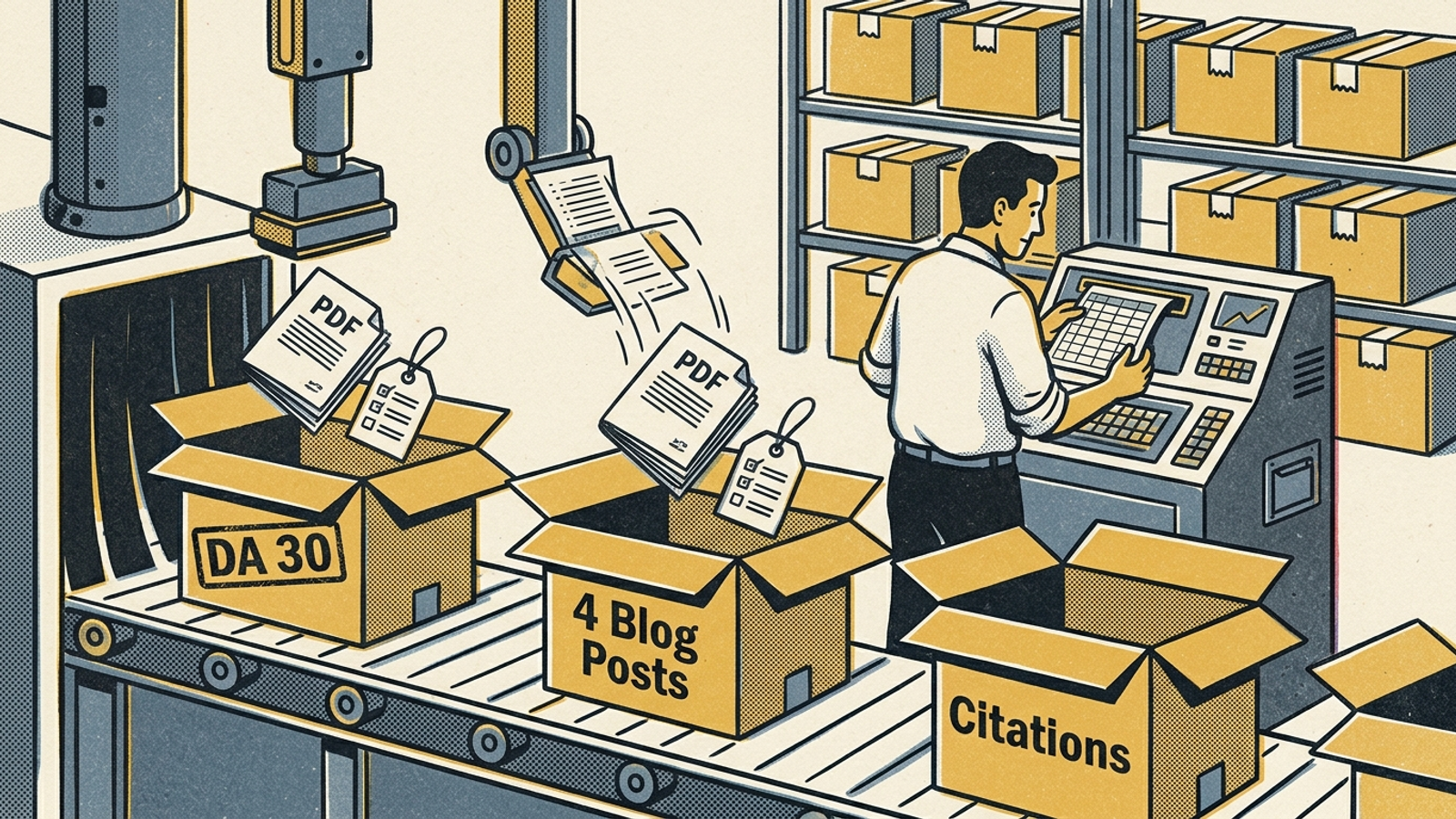
An agency can still buy three links, four blog posts, and a monthly audit, mark them up, and call the package SEO. That is a 2019 delivery model trying to serve an answer-engine market.
The problem is not that links, content, or audits suddenly became worthless. It is that a fixed bundle cannot keep pace with search systems that synthesize answers, cite passages, and sometimes satisfy a query without sending a click. The value has moved from counting deliverables to executing and checking work continuously. Yet many white-label contracts still price the old inventory: a link package for $300, resold for $750, with a report forwarded at month’s end.
That mismatch did not appear overnight. Each turn in search changed what agencies needed to do for clients and what they could reasonably charge for doing it. Follow the timeline, and the case for flat per-domain execution pricing becomes harder to ignore.
2015–2021: White-label SEO becomes a menu of deliverables
In the deliverable era, white-label SEO gave agencies a straightforward way to sell organic search without building an in-house technical team. Wholesale providers such as The HOTH offered guest post links tiered by Domain Authority (DA 10+, DA 20+, DA 30+, DA 40+). Links priced at roughly $100 to $400 each could be marked up and included in a retainer.
A typical package made the arithmetic easy. Wholesale fulfillment of $500 to $1,500 per month bought a fixed scope: say, four 800-word articles, two to five backlinks, and a monthly PDF crawl audit. Agencies billed clients $1,500 to $5,000, supplied a white-label report, and kept the spread. The work had a price, a deadline, and something the client could count.
Local SEO follows the same spreadsheet
Local search reselling used a similar structure. Platforms such as BrightLocal let agencies outsource citation submissions; a roughly $3.20-per-site rate shows how neatly that work fits a unit-cost model. Agencies could pair citations and white-label rank tracking, starting at $39 a month, with Google Business Profile (GBP) maintenance in $500 to $1,500 monthly local retainers.
The client received proof of production: a spreadsheet checking Name, Address, and Phone (NAP) consistency across Yelp, YellowPages, Citysearch, and regional directories, plus scheduled reviews of Google Maps feedback and listing categories. That was useful when inconsistent listings needed fixing. It was less useful as a standing answer to every visibility problem.
The model fixed delivery predictability but encouraged inventory thinking. If traffic stalled, the reflex was to order more posts, links, citations, or audits. Agencies could forecast fulfillment costs with spreadsheet precision; the harder question was whether the next unit would change anything that mattered to the client. Keep the menu for work with a defined end. Do not mistake it for a search strategy.
May 2023: SGE puts an answer above the links
On May 10, 2023, Google unveiled the Search Generative Experience (SGE) in Search Labs. Its AI-generated answer snapshots appeared above traditional organic listings, with conversational follow-up prompts. ChatGPT and Perplexity had already made direct synthesis familiar to early adopters. SGE made the issue concrete for agencies whose reports revolved around positions on Google.
A page could still rank well and have less room to earn a click. More importantly, the answer introduced another question: could Google extract and use a clear, relevant claim from the client’s page? Five guest posts on DA 30 sites did not, by themselves, tell an agency whether the client’s own information was easy to parse, verify, or cite.
SGE did not make rankings irrelevant; it made rankings an incomplete account of visibility. A wholesale supplier built to ship links and a monthly keyword grid had no obvious deliverable for the answer sitting above that grid. For practitioners, the next job was not to rename a link package “AI SEO.” It was to inspect what the client’s pages actually said and how clearly they said it.
May 2024: AI Overviews make the click gap harder to ignore
On May 14, 2024, Google brought AI Overviews to the US public, displaying synthesized answers across roughly 16% of desktop queries and expanding to more than 100 countries by October. What had been a Labs preview became a client-reporting problem.
Third-party clickstream analysis found a 34.5% lower organic click-through rate on informational queries where an AI Overview appeared. That figure does not predict any one client’s traffic. It does show why a ranking report can look healthy while visits disappoint. A client paying $3,000 a month may reasonably ask why position two is not producing the clicks it used to. “The arrow is green” is not an answer.
A rank is no longer a reliable stand-in for a visit. Agencies still need to track traditional search performance, but they also need to see when an answer appears, whether the client is cited, and what happens to qualified inquiries. Otherwise, they are billing for a metric while leaving its business consequence unexplained.
October 2024: ChatGPT Search makes citations a client question
OpenAI launched ChatGPT Search on October 31, 2024 for paid tiers and opened it to all users in December. Real-time web retrieval and clickable inline citations put another search surface in front of clients. The question became awkwardly specific: Why does ChatGPT cite a competitor for a category recommendation but not us?
A reseller portal built to supply ten tracked Google desktop keywords could not answer that question. Buying another blog post might be appropriate if the client lacked useful content. It was not a substitute for checking what an engine retrieved, which claims it could extract, and where the client appeared in the resulting answer.
That is the distinction between monitoring and execution. A dashboard can show an omission. Someone still has to diagnose it, improve the underlying material where possible, and check the output again. Selling citation visibility without a workflow for acting on what you find leaves the agency holding the work. Ask who will make the fix before adding AI visibility to a client retainer.
May 2025: AI Mode complicates the single-keyword report
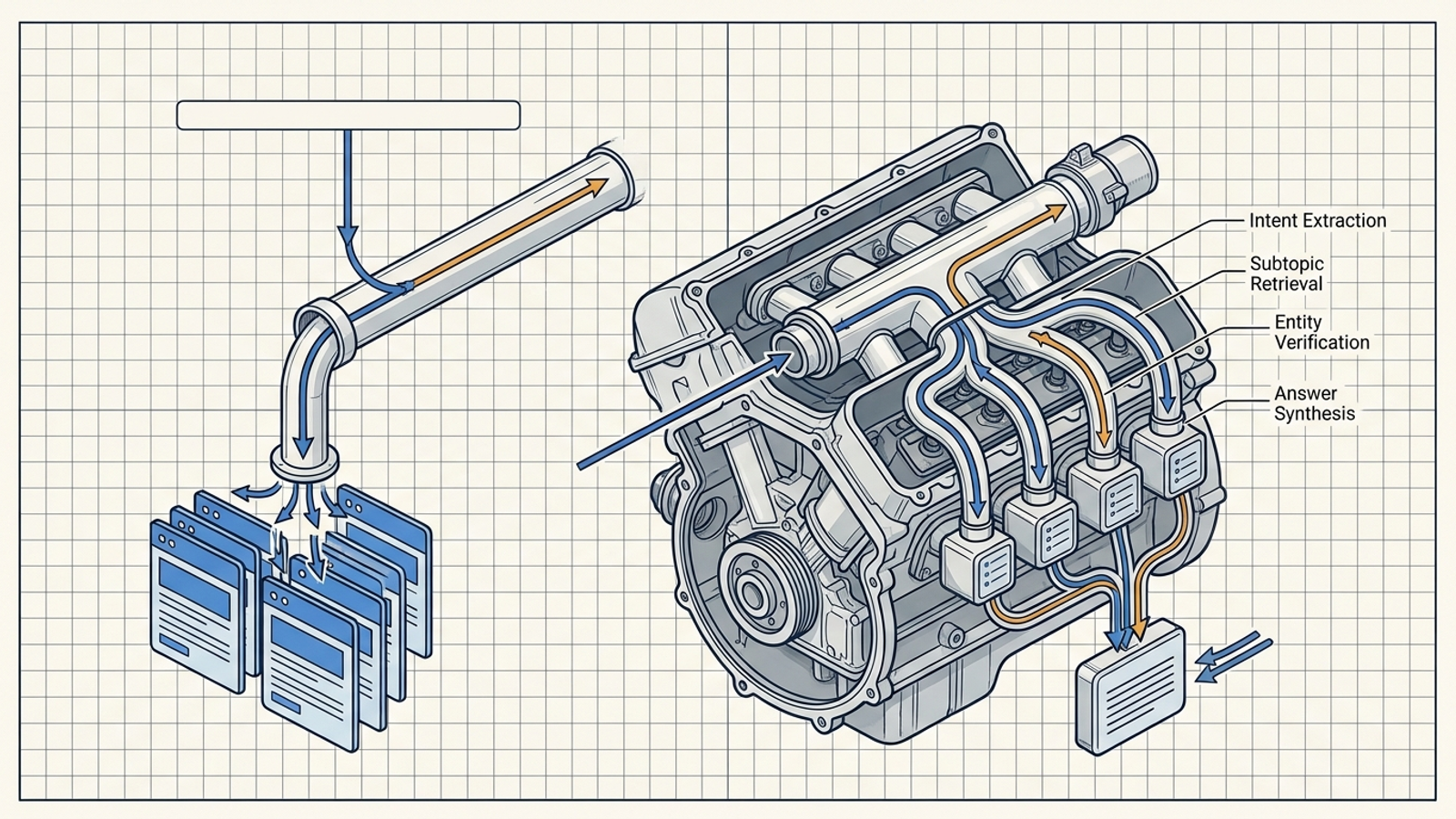
On May 20, 2025, Google rolled out AI Mode across the United States at Google I/O. Its interactive search experience uses query fan-out: a complex prompt can be broken into multiple related searches before the system assembles a response. That is a different operational problem from tracking one fixed phrase and recording its rank.
Semrush clickstream analysis reported 92%–94% zero-click rates for conversational query sessions. I would not turn that into a forecast for every client or query. I would treat it as a warning against selling position three on one keyword as a complete picture of whether a client showed up in a complex search journey.
The work now spans the question a customer asks, the related information an engine seeks, and the claims it chooses to put in its answer. The old reporting grid can still tell you something. It cannot tell you all of that. Track the answer, not just the starting keyword.
2025–Present: The per-domain retainer replaces the bundle
The economics change once the work stops arriving as four posts and three links every month. In the old model, an agency purchased inventory, marked it up, and billed for production. In an answer-engine market, the useful work is a loop: check what search surfaces show, identify what the client’s pages fail to explain or expose, make the relevant content or technical change, and check again. A PDF audit delivered on the first of the month does little if nobody acts on it.
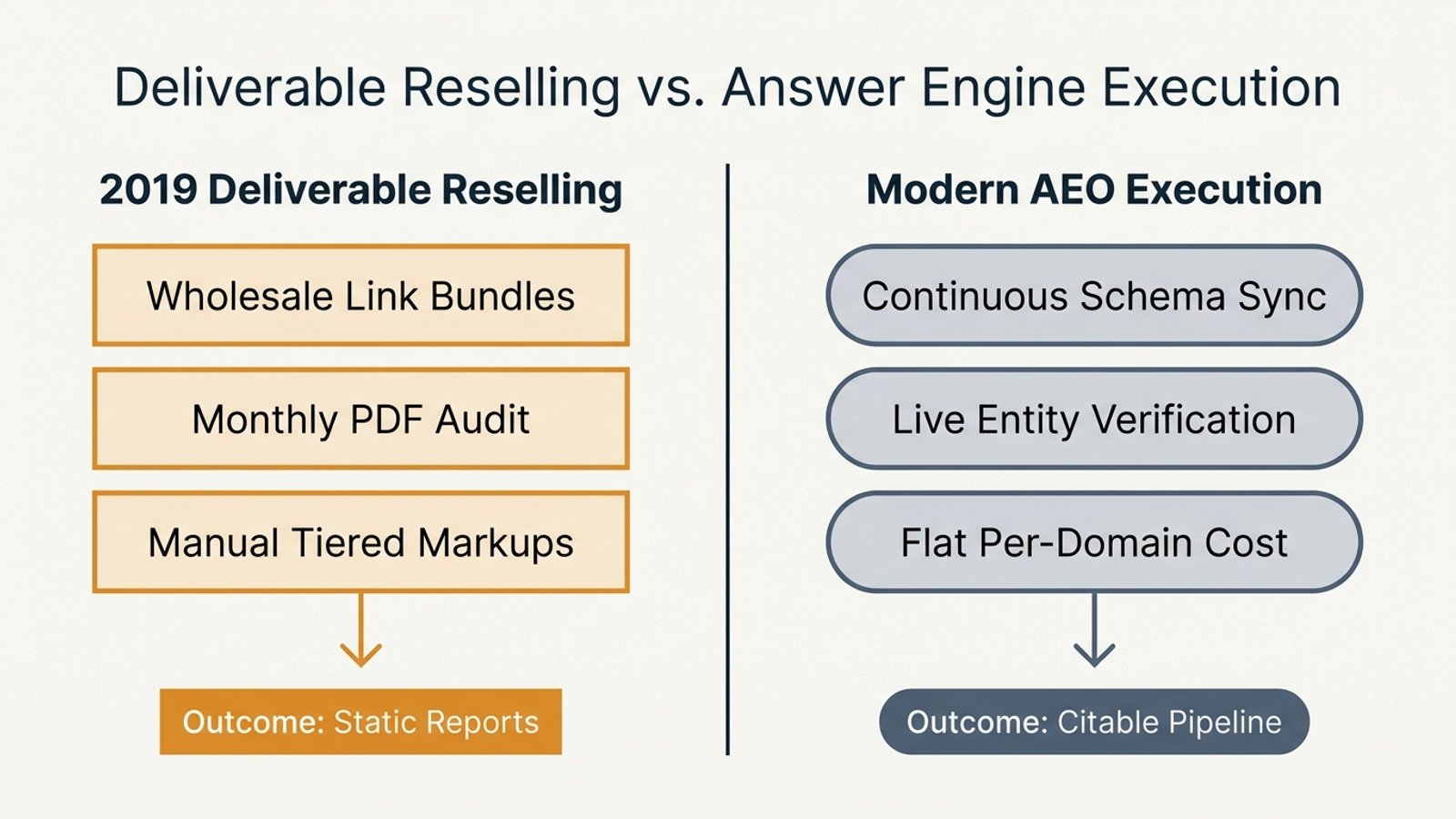
Continuous execution needs predictable costs, not a larger deliverables menu. The tempting alternative is an AEO monitoring subscription layered on top of the existing SEO retainer. Tools priced around prompt caps, credits, or seats can run from $29 to upward of $400 a month for batches of 50 to 250 queries. That can become a margin problem before the agency has changed a page.
Here is the arithmetic. With 20 client domains, 25 commercial prompt variations per client, and four engines to check—Google AI Overviews, AI Mode, ChatGPT Search, and Perplexity—you have 2,000 prompt-engine combinations per run. A metered tool may charge overages to observe those answers. Observation still leaves your team to rewrite passages, fix schema, or deploy changes. Paying for a dashboard and then paying staff to work through its to-do list is how an AEO retainer trap eats the spread.
Price the ongoing job, then show the work
I would not invoice a client for a $2,500 monthly SEO retainer and tack on a separate $750 AEO tracking fee without a clear reason. The client’s objection is fair: if the original retainer covers organic search, why does appearing in search answers require another line item? The technical hygiene, schema markup, and clear claims involved overlap with traditional organic work.
Sell one organic search retainer per domain, not per promised post or prompt check. A $1,500 to $3,500 monthly client retainer can describe an ongoing job rather than a shopping list. Its margin then depends on wholesale delivery that does not multiply manual hours or prompt credits with every client. For comparison, groas for agencies offers white-labeled SEO and AI search execution starting at $199 a month per client domain, including content updates, technical fixes, and multi-engine citation monitoring under the agency’s brand. That is a more workable starting cost for this model than buying a legacy bundle and a separate meter to watch it.
The report must change with the contract. Do not replace a list of backlinks with a prettier list of prompts. Show the client what happened:
- Weekly action logs: Record the code changes, schema fixes, and passage updates actually made.
- Cross-engine citation reporting: Show where the brand appears across AI Overviews, AI Mode, ChatGPT Search, and Perplexity for its core commercial entities.
- Commercial impact: Connect the work to qualified inquiries, booked appointments, and attributable revenue instead of treating Domain Authority as the outcome.
Ask whether the platform fixes anything
Before signing a white-label partner, I would take the AEO dashboard questions into a sales call and ask three things in order:
- Does it deploy content and technical updates, or only flag issues? If it identifies missing structured data but your team must write, test, and add the JSON-LD to the client’s CMS, include that labor in the economics.
- What happens to wholesale cost as you grow from five domains to twenty? Prompt overages and seat licenses can make each new client more expensive to serve. Get a clear per-domain cost before setting your own retainer.
- How does it check more than a sampled answer? A prompt result at 9am tells you what appeared then. Ask how the platform checks whether a search bot fetched the rendered page and whether the client’s claims were available to extract.
My reading of this timeline is simple. Search keeps asking agencies to do more than deliver the next monthly batch, while the old wholesale model keeps paying them to count batches. The next advantage belongs to agencies that can run the work continuously, show what changed, and hold delivery cost steady per domain. The 2019 menu can stay on the shelf.