

 LinkedIn
Monday, 9:12 a.m. The email subject was just “new pricing is live.” I clicked through and found a different product. Same logo, same domain, new headline, new plans, new call to action. The old trial signup I had built every ad group around was gone, replaced by a demo request and a pricing grid I had never seen before.
The campaigns knew nothing about it. They were still bidding, still spending, still sending people toward an offer the client no longer sold. Say we were spending around $20k a month at that point. By 9:30, that spend was buying clicks against yesterday’s pitch. It was the first of four quarterly offer changes. I did not yet know that the first two weeks of each launch would be the hardest to account for.
Week one: the account learns the wrong lesson
By Wednesday, the account looked seasick. CPCs bounced, conversion volume had been cut in half, and the status column showed Learning in the ad groups I had touched. I rebuilt ads to match the new page, paused trial keywords that no longer had anywhere useful to land, and raised the budget on demo terms to get some volume through. Each move had a reason. Together, the changes made it harder to tell which move was responsible for what happened next.
On the Thursday call, the founder asked what was happening. I gave him the line every manager reaches for when the account has no cleaner answer: it’s still learning. Give it a week. That felt honest at the time. The learning phase can last from a week to a month, depending on conversion volume, cycle length, and budget; calibration may take up to around 50 conversion events or three full conversion cycles. But I had changed the budget while rebuilding around a different action. I could not describe the learning phase as something that had merely happened to us.
That Friday, I stayed up with the search terms report. Anyone who has managed SaaS search knows the shape of it: a few clean demo queries carrying the conversions, then pages of drift. Free this, jobs that, how to tutorials, plus GitHub and open-source hunters looking for something that costs nothing. Accounts without maintained negatives can waste 15 to 30% of budget on irrelevant clicks. At our spend, that meant potentially thousands a month buying curiosity instead of pipeline. It also gave the new bidding model more noise to work through.
My workflow was the standard one: open Keywords, then Search terms; sort by cost; block intent mismatches and queries that had spent past target CPA without a conversion. I added free, jobs, salary, tutorial, certification, open source, and a dozen variants, one ad group at a time, watching the clock pass 1 a.m. It helped. It always helps. But with the cursor still blinking in the negative list, I was doing janitorial work on a house scheduled for another remodel next quarter.
The search terms told me where some money had gone. They could not tell me whether this launch was on track. We had changed what counted as a conversion without first writing down what that new conversion could cost. I had a cleanup job and no agreed finish line.
Week two: the page changes again
Two weeks later, the account gave me the morning I still remember by the color of the cells. Core SaaS terms that had sat at 7s, solid and boring the way you want them, were showing 3s across the board. Impression share was slipping. Average CPC was up almost a fifth on the same keywords, with no bid change from me in days. I checked the ads first, then the keywords, then auction insights, the way you check the same locked door three times.
The cause was not in the account. Someone on the client side had pushed a new landing page over the weekend. New headline, longer form, slower load on mobile, and nobody had told me. Quality Score is a 1-to-10 keyword-level diagnostic built from expected CTR, ad relevance, and landing page experience. Google says it is not a KPI or an input into the auction. That distinction matters: the score did not cause the higher CPC. It was a check-engine light pointing me toward something that had changed, not a live gauge telling me precisely when it broke.
I had rebuilt the ads around a page that no longer existed in that form. Now I was inspecting an account for a problem that had arrived through a client-side page change. I used to tell clients Quality Score did not matter much. I was wrong about how useful it could be in a moment like this. It was the receipt for a change I had not known about, delivered after I had already spent time looking elsewhere.
Week four arrived with the call I had been avoiding. The founder opened with the simplest question in advertising: so what did we get for the money? I had numbers. Around $18k spent, 41 demo requests, a CPA I could calculate on a calculator in front of him. What I did not have was a comparison that meant anything. The old offer sold a $49 trial signup. The new offer sold a demo that took three meetings to close. Putting those two CPAs side by side was dishonest, and we both knew it. So I talked about click-through rate and impression share for ten minutes while he waited for a number that told him whether we were winning.
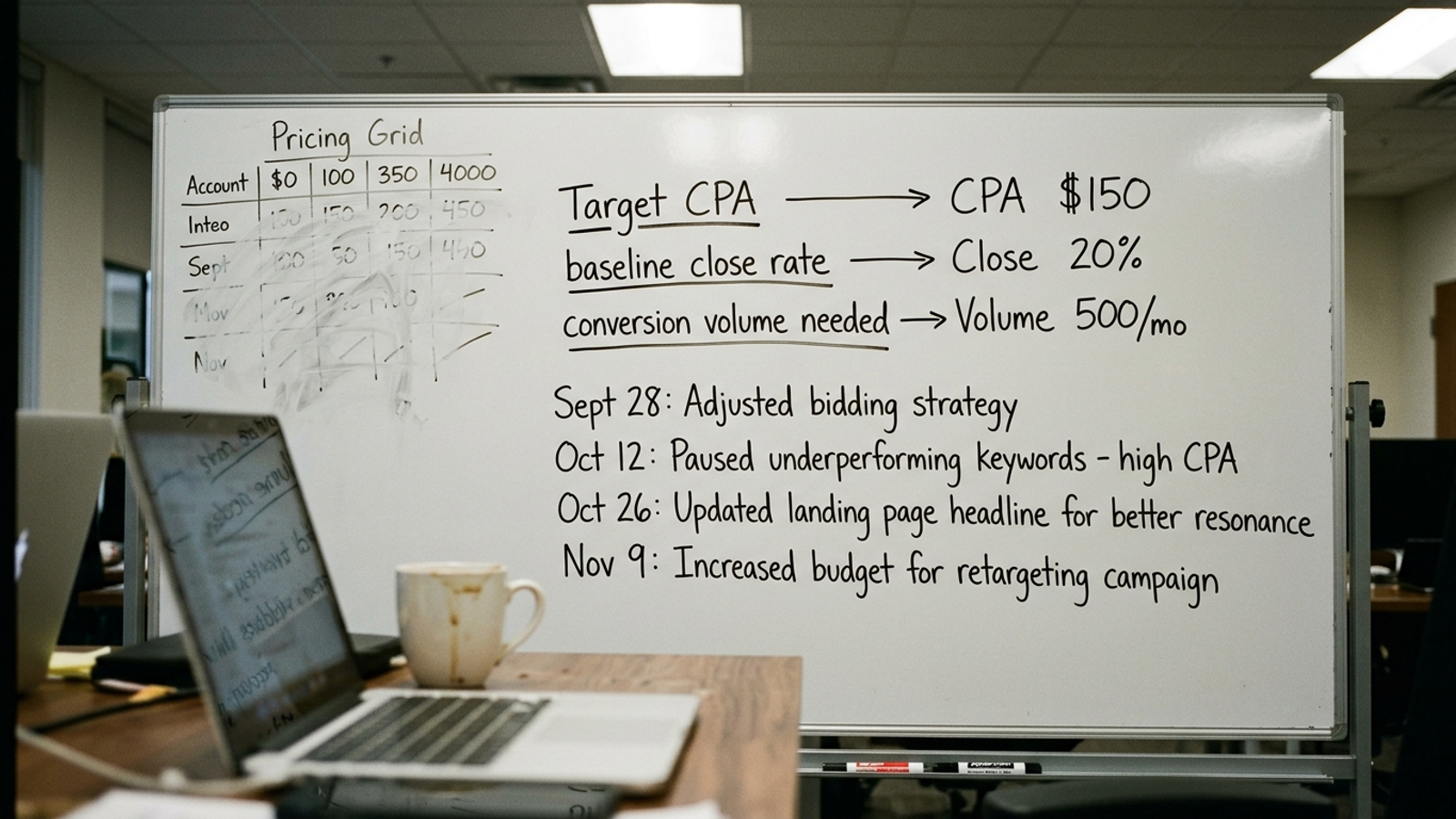
Nobody had written that number down before day one. No target CPA for a demo. No baseline close rate. No agreement on how many conversions the new bidding needed before we judged it. I had leaned on “it’s still learning” because learning was the only explanation the account offered me. Without a written target, there was nothing to miss. Every result could be called early.

The next Monday comes three months later
Three months later, the same Monday arrived with a different subject line. This time it was “v2 positioning,” and the pricing grid I had just finished building ads around was replaced by usage-based plans with names I had to read twice. The demo request survived. The trial signup came back from the dead as a free tier with a different signup flow. I sat with two sets of paused keywords on my screen, one for each dead offer, and felt the account tilt back to week one before I had changed a thing.
I tried to be smarter about the sequence. I kept the campaign shells, rewrote the ads first, and left budgets alone for 48 hours so I would not pile a budget change onto everything else. It barely mattered. We had switched the conversion action from paid trial start to qualified demo, asking the bidding model to calibrate around a different result. Switching conversion actions forces fresh calibration; the old history could not answer every question about the new goal. By Friday, the groups I had been working on were back in Learning.
Four launches a year meant spending a lot of time in the first two weeks. Each time, the visible work was familiar: update the ads, check the terms, watch the status, wait for enough conversions to tell signal from noise. The invisible gap was familiar too. The founder and I could both see spend accumulating. Neither of us had agreed, before it began, what result would count as acceptable for the new offer.
If that founder called me tomorrow about launch five, I would ask for three sentences in writing before touching the account:
- What a demo is allowed to cost.
- What the baseline close rate is on the current flow.
- How many conversions we agree the bidding needs before we judge it.
That is the contract for the first two weeks. Without it, the account keeps resetting its own learning phase, and the week-four meeting becomes a discussion about whether the number is too early to mean anything. Sometimes it is too early. Writing down the target does not make the data arrive faster. It does stop us from changing the definition of success after seeing the bill.
The second thing I would insist on is a log of every change, with the reason beside it. Google’s Change History records account edits with timestamps and users. I still want the human sentence that goes with each entry: what were we trying to fix? During a launch, an empty log gives me little evidence of active management. A crowded log with no reasons makes it hard to separate a deliberate sequence from a pile of reactions.
After the second reset, I made one rule and put it in an email so nobody could forget it: no page goes live without 48 hours’ notice to me. I earned that rule the morning the scores fell to 3s and I spent half a day proving the problem was not an ad edit. Anyone who has lived through a landing page swap that tanked an account knows the sequence. Marketing ships on Friday. Paid search finds out on Monday. By then, the account has already spent money against a page the manager has not checked.
On Fridays, I started sending a log instead of a report:
- Changed the demo headline to match the new pricing page. Reason: hold ad relevance.
- Added 34 negatives from search terms. Reason: $2,100 in free and tutorial queries with zero demos.
- Left budgets untouched. Reason: avoid stacking another change on the conversion-action reset.
The founder never replied, which I took as approval. For the first time, I could point at week four and say what we had done, even when CPA was still ugly. The log did not make an ugly number attractive. It meant I did not have to hide it behind click-through rate while we tried to remember which page had been live on which day.
Performance did not magically improve. The account still needed conversions, and the third relaunch still hurt. What changed was the conversation. There was a target on paper, so a bad week read as a miss instead of a mystery.
I stopped managing that account before the fourth relaunch shipped. The founder hired in-house, which was the right call for a company rewriting its story every ninety days. Last I heard, they were on usage-based pricing v2, or maybe v3. I think about that year whenever someone asks me what the first two weeks of a Google Ads launch should look like. My answer is not a schedule. It is the piece of paper we did not have on that first Monday: a target CPA for the new action, a baseline close rate, a number of conversions before judgment, and a log that says what changed and why.
Somewhere in my archive, there is still that Monday email. Subject line: new pricing is live.