

 LinkedIn
By September 30, 2027, fewer than 25% of new SMB and mid-market search management contracts will charge a percentage of ad spend. The buyer’s question is changing from “Who manages my account?” to “Who will write down a number and carry the risk?”
That is a bad shift for anyone still charging 15% of spend to adjust bids, paste copy variants, and prune search term reports. According to typical agency fee benchmarks, 10% to 20% of monthly ad spend remains a familiar price for that work. The problem is that much of the work now happens inside the platform. Execution is no longer enough to justify the fee.
I spent years doing the manual version of this job. Good account management still requires judgment. But Google’s 2026 updates made the old division of labor harder to defend: AI Max expanded what Search campaigns can assemble, agents moved closer to acting on campaigns, and ads began appearing inside AI answers. When an account stalls, another round of bid nudges may not fix it. Performance plateaus can be structural ceilings rather than tactical problems.
Here are five predictions with deadlines, mechanisms, evidence available today, and conditions under which I will call them wrong. No “the landscape is evolving” escape hatch.
Prediction 1: AI Max takes most standard Search spend by July 2027
By July 1, 2027, more than 70% of standard Google Search spend will run through AI Max configurations. Keyword-only Search campaigns will still exist, but they will no longer be the default way to build for scale.
The mechanism is straightforward. AI Max combines keywordless matching, dynamic asset customization, and final URL expansion inside Search. Instead of asking a manager to map every plausible query to a hand-built ad group and landing page, it uses the site, assets, and conversion signals to make those choices in the auction. Fragmenting queries across dozens of tiny ad groups can leave Smart Bidding with less conversion data to work with. That is a poor trade for the satisfaction of seeing a neat account tree.
Google’s rollout points the same way. It delayed the forced migration of Dynamic Search Ads to AI Max from September 2026 to February 2027, while broad-match campaigns using Automatically Created Assets were upgraded in September 2026 without rollback options. I read the delay as time to handle an operational transition, not a retreat from it.
What proves me wrong: AI Max accounts for 70% or less of standard Search spend on July 1, 2027. A cancelled DSA migration would also undercut the direction I expect. Either way, I would stop calling keyword-only management a legacy setup. For now, I would spend less time perfecting match-type architecture and more time checking the signals and pages the system uses.
Prediction 2: An “AI agent” has to act, not just recommend
By March 31, 2027, a third-party Google Ads tool that only produces recommendations will be a hard sell as a management product. It can still be a reporting product. That is a different invoice.
Consider the current routine: a tool emails 42 suggested negative keywords, flags Campaign 3 for a 15% budget increase, and waits for someone to approve the lot. Google’s Ask Advisor brings a Gemini-powered conversational agent across Google Ads, GA4, and Merchant Center. That can make analysis easier. It does not, by itself, remove the execution queue. A buyer with twenty accounts does not need a more articulate queue.

The dividing line is an action log, not a chat box. Auctions run around the clock; a Tuesday review can arrive after days of budget have already moved. Tools that execute within guardrails can respond continuously. Tools that only suggest changes still depend on someone finding time to make them.
Autonomy has a failure mode, though. As operators discussing agents for paid media have pointed out, direct API access without downstream CRM data can turn a fast agent into a fast buyer of worthless form fills. It needs offline conversions, qualified pipeline stages, and strict guardrails. Otherwise, “always on” just means it can make the wrong decision at 3 a.m. too.
What proves me wrong: Leading third-party PPC management platforms remain read-and-recommend tools through March 2027 and keep customer retention above 80% without automatic API write calls. That would tell me buyers value approval queues more than I expect, or that the risks of autonomous execution have not been contained. Until then, I would ask any agent vendor to show both its guardrails and the changes it actually made.
Prediction 3: AI answer ads take budget from classic Search
By November 30, 2027, more than 30% of paid search spend across competitive commercial categories will flow into ads embedded in AI Overviews and conversational answer modules. I expect that money to come largely from classic top-of-page Search budgets, not a fresh pot of marketing cash.
The mechanism is physical. An expanded answer occupies screen space that once put traditional ads in front of the searcher. If a summary supplies comparisons, prices, and reviews before the user scrolls, fewer people reach the familiar text ad. Attention on the results page does not expand just because Google adds another unit.
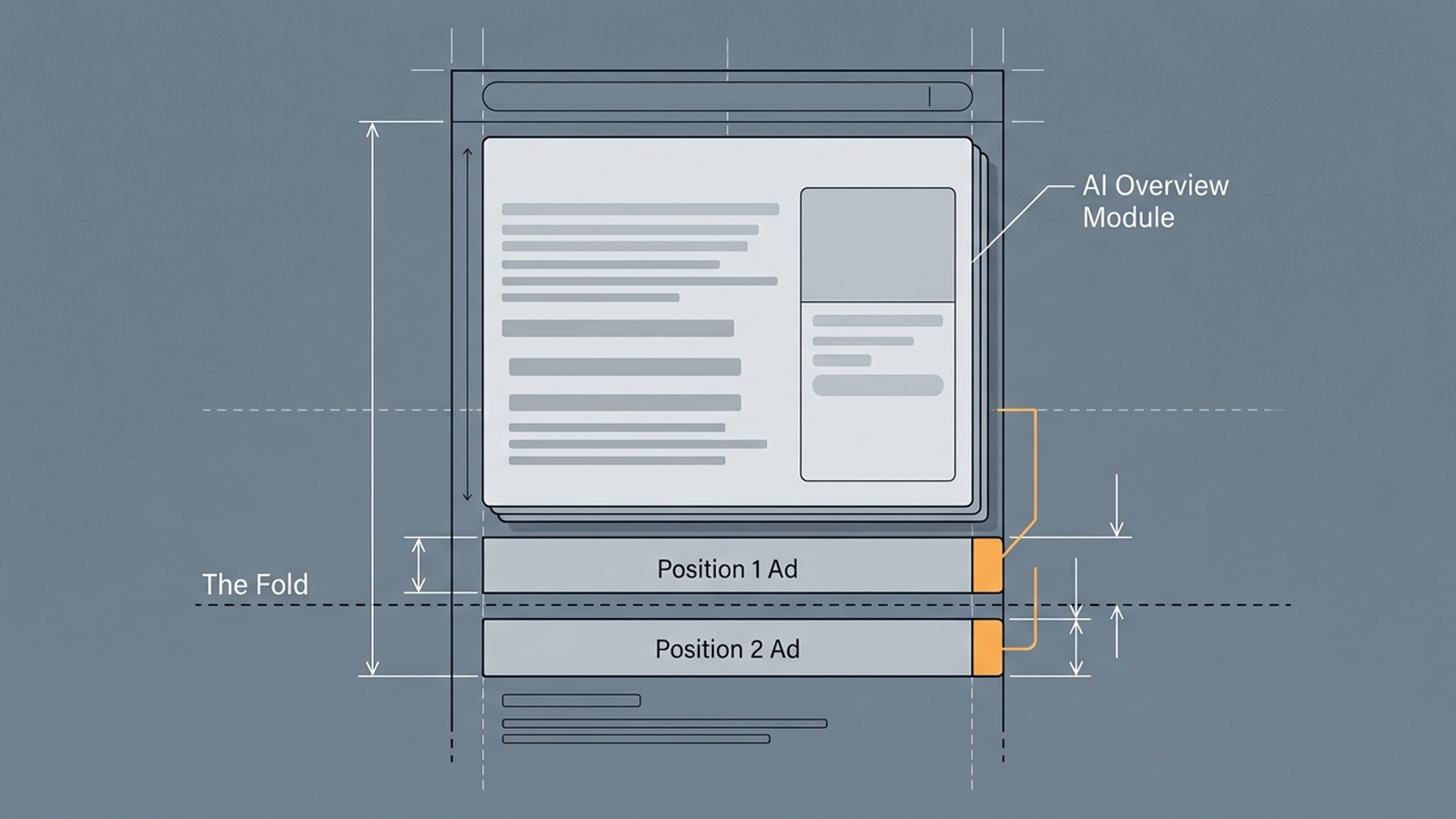
There are signs of that squeeze already. Research on AI search and paid ads reports paid ad CTR falling from 19.70% to 6.34% when an AI Overview appears, alongside high zero-click rates for informational and consideration queries. Adthena’s auction tracking found AI Overviews on 57% of queries in key retail categories, with a 34% drop in ad CTR and a 12% rise in average CPCs. Those figures do not prove where every future ad dollar goes. They do show why buyers will look for placement where attention has moved.
This is not a prediction that every AI answer ad will beat every keyword campaign. It is a prediction about budget allocation when classic placements lose visibility. If the audience moves up the page, the budget follows it.
What proves me wrong: Traditional position-one ad CTR stays above 15% on queries displaying an AI Overview throughout 2027, or commercial advertisers pull spend back because sponsored AI units cost more per acquisition than their keyword campaigns. I would then treat AI answer ads as a side channel, not a replacement for classic Search budget. Watch acquisition cost, not the novelty of the placement.
Prediction 4: Percentage-of-spend fees lose their default status
By September 30, 2027, fewer than 25% of new search management contracts signed by SMBs and mid-market brands will use a variable percentage-of-spend fee.
The old pricing model had an operational story behind it. Scaling spend once meant building more campaigns, testing more copy by hand, and adjusting bids across more keywords. More budget often meant more hours. Now Google handles much of the bidding, asset assembly, and query matching whether an account spends $10,000 or $100,000 a month. Complexity does not vanish at $100,000, but the invoice should not rise automatically just because the media budget does. That is why routine campaign maintenance is a weaker case for a traditional agency.
Google’s August 17, 2026 update to target-based Smart Bidding for campaigns marked “Limited by budget” also makes the incentive problem worth watching. If an advertiser sets a looser CPA target than its margins warrant, bids can move toward that target while the campaign spends its budget. Under a percentage fee, more spend also means a larger management invoice. That does not mean every agency wants a client’s CPA to rise. It means the pricing model does not reward the agency for reducing the bill.
The fee should follow the work and the accountability, not the size of the media line. Flat monthly pricing is one alternative when continuous execution replaces much of the manual routine.
What proves me wrong: New SMB and mid-market contracts using percentage-of-spend fees remain at or above 25% by September 30, 2027. If an independent survey of more than 500 brand marketing leads later finds that over 50% still prefer that structure, the case against its staying power gets weaker still. In the meantime, I would compare any proposed fee increase with the additional work the account actually requires.
Prediction 5: Buyers demand a written performance threshold
By December 31, 2027, more than 50% of new search marketing agreements for companies spending $10,000 to $100,000 a month will include a contractually defined performance threshold.
For years, the standard defense of an open-ended retainer was that an agency sold expert labor, not guaranteed outcomes. When people had to build match-type trees, inspect queries, and adjust bids cell by cell, the labor was visible. As specialized systems take on those mechanical tasks continuously, a list of hours or completed optimizations becomes a less convincing deliverable. Buyers will ask what the work is meant to produce: qualified pipeline, attributable revenue, or an acquisition cost the business can sustain.
That does not make every outcome predictable. It does mean a provider can put the target, measurement method, and accountability in writing. A 90-day performance sprint with written targets is one way to structure that commitment. “We completed the optimizations” is not a substitute for a number the buyer agreed to care about.

What proves me wrong: Half or fewer of those new agreements include a defined performance threshold by December 31, 2027. If fewer than 15% of inbound marketing RFPs in Q4 2027 even ask for performance accountability or clawbacks, I will have overestimated buyer appetite for shifting risk. Until then, I would ask for the target and its measurement rules before signing the retainer.
The scorecard I’ll use at the end of 2027
Forecasts are cheap when nobody comes back to grade them. These are the checks I will use; the deadlines matter more than how persuasive the argument sounds today.
| Prediction | Deadline | I was wrong if… |
|---|---|---|
| AI Max becomes the Search default | July 1, 2027 | AI Max runs 70% or less of standard Search spend, or Google cancels the DSA migration. |
| Agents move from advice to action | March 31, 2027 | Leading read-and-recommend platforms retain more than 80% of customers without automatic API writes. |
| AI answer ads take classic Search budget | November 30, 2027 | Traditional position-one ad CTR stays above 15% on queries with an AI Overview, or buyers move spend back on acquisition cost. |
| Spend-based retainers lose default status | September 30, 2027 | At least 25% of new SMB and mid-market contracts still use a percentage-of-spend fee. |
| Written targets become a buying requirement | December 31, 2027 | Half or fewer of new agreements in the specified spend range include a defined performance threshold. |
What I’d do with my account now
If these predictions are right, the useful work this quarter is not another round of mechanical button-pushing. It is improving what the systems optimize toward, checking where ads appear, and making the person or product managing the account answer for a business result. I would do it in this order:
- Connect closed-won revenue to Google Ads. Stop treating every form fill as equally valuable. If the CRM does not pass offline conversion values back, AI Max and autonomous tools have a thin definition of success. Fix that before giving them more freedom.
- Check AI Overview overlap on the top 20 converting queries. Look at the actual results page. Where an Overview appears above the fold, test the Search assets and content you can control, then measure placement and acquisition cost. Do not assume appearing in a new unit makes it profitable.
- Review campaigns marked “Limited by budget.” Compare the target CPA or ROAS with actual performance and the margin the business needs. If a target is too loose, tighten it deliberately rather than letting a higher CPA become the accepted price of spending the budget.
- Put the management fee beside the work and the result. Calculate the agency fees paid over the last 12 months as a percentage of spend. If they bought a monthly slide deck and weekly negative-keyword reviews, test a continuous autonomous engine on a controlled campaign set. Require strict guardrails, an action log, and a written target you can measure.
I would not hand an agent the keys because it has a convincing chat interface. I would hand it a limited job, clear revenue signals, and a number it has to defend. That is the buying question for 2027.