

 LinkedIn
ChatGPT, Perplexity, and Google AI Overviews are three different citation contests. If you run growth for a business spending real money on search, a pitch promising to get you quoted by all three with one generic content refresh should make you check your wallet. The same page can win a footnote in one engine and disappear in another.
The overlap is small. Foglift’s Q3 2026 benchmark of 75 buyer questions across five AI engines found a mean pairwise citation overlap of 9.4%; seven in ten cited domains appeared on exactly one engine. Research covering nearly 600,000 prompts found that 97.15% of URLs cited by ChatGPT appeared on no other platform. The engines may name the same company, but the clickable sources behind their answers often differ.
That makes this a sequencing decision, not a mandate to publish three times as much. For most small businesses, I would first fix the pages Google AI Overviews and live-fetching assistants can actually read. Clean access and extractable answers give existing Google visibility a better shot at a citation, while making those same pages usable to Perplexity and ChatGPT. Here is where the contests differ, and where that shared work pays off.
Five axes that change the choice
1. Source pools: a Google ranking helps one contender most
An answer engine does not scan the entire internet each time someone asks a question. It draws candidates from its retrieval pipeline, then chooses what to use. Google’s search index gives AI Overviews a different starting shelf from the ones Perplexity and ChatGPT use.
Ahrefs found that 76% of URLs cited in Google AI Overviews rank in Google’s top 10 organic results for the query. Perplexity’s overlap with Google’s top 10 was 28.6%; ChatGPT’s was 8%. An existing Google ranking is your clearest opening for an AI Overview citation, not a ticket to all three. If you have no page-one presence, work on the page and its organic position before treating an overview citation as the immediate payoff. That same Google deficit does not automatically rule out a citation elsewhere.
2. Access: a blocked fetcher cannot quote your page
I would check access before rewriting a sentence. OpenAI uses distinct user agents: GPTBot is associated with training, OAI-SearchBot crawls for ChatGPT Search, and ChatGPT-User can fetch a page in response to a user request. Blocking one is not the same as blocking all three. If you do not want training access, set that permission deliberately; do not accidentally block search and live retrieval along with it. The crawler rules are worth checking before deploying a blanket disallow.
Perplexity also distinguishes its background crawler from its on-demand fetcher: PerplexityBot and Perplexity-User do different jobs. A page that returns a 403, trips a challenge, or depends on slow client-side rendering gives a live fetcher little to work with. I have seen the unglamorous version in server logs: a bot reaches robots.txt, tries a product or pricing page, and gets stopped before the useful content appears. Check what the agents receive, not just what a browser shows you.
3. Freshness: updates do not surface on one timetable
Say you change a pricing schedule this morning. A live fetch may read the new page sooner than a system waiting to recrawl and index it. Perplexity puts particular weight on recent material; ChatGPT Search can draw on its background index or fetch a live page when a prompt triggers that route. Google AI Overviews depends more heavily on Google’s indexed results and the page’s organic standing.
A benchmark cited by Omnibound reports that content updated within 30 days earns 3.2 times more AI citations than stale content across the engines it studied. I would not turn that into a calendar instruction to change a date every month. Update the actual figures, specifications, and availability when they change, and make the update visible on the page. Fresh facts beat a fresh timestamp pasted onto old facts.
4. Structure: give a retriever an answer it can lift
None of these systems reads a sprawling thought-leadership introduction with the patience of its author. They need to identify a passage that answers the question. Perplexity, for example, commonly presents numbered source citations. A short, self-contained definition, a clearly labelled specification, or a readable HTML table gives it a better candidate than a claim scattered across six marketing paragraphs.
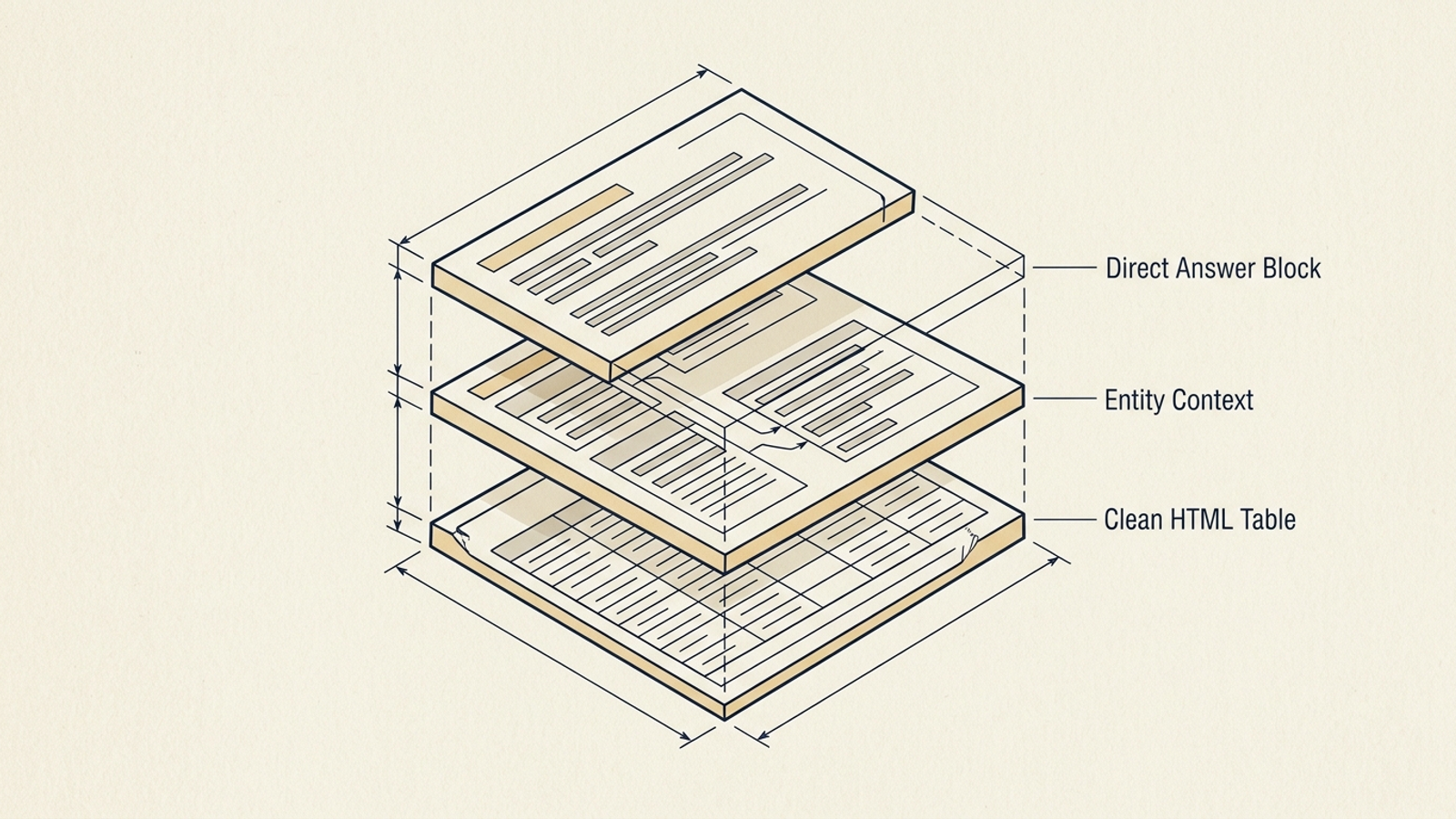
This is not a demand to make every page sound like a parts catalogue. Put a direct answer under the heading that poses the buyer’s question. State what the product is, what a number measures, and any limit needed to understand it. Then use a table when the reader is comparing tiers or parameters, and a numbered list when the order matters. Keep the useful text available without waiting for decorative scripts to assemble it. Make the answer easy for a person to find and hard for a machine to misread.
5. Authority: your own site is not the only candidate
Source selection also changes whose version of your story appears. Omnibound reports that brand-owned websites account for 31% of Google AI Overview citations. Other cited sources include YouTube, Reddit, and Wikipedia. An owned page with organic traction has a credible route into an overview; it does not need to become a third-party article first.
ChatGPT’s cited sources can look different. PingPrime’s tracking found Wikipedia prominent in its reference queries, alongside established media sources. Perplexity also draws heavily on community discussion, including Reddit. So publish accurate specifications on your own site, but do not assume ten self-serving “best alternatives” posts will create outside authority. And do not manufacture forum praise. If buyers discuss your category elsewhere, what they find should agree with what your own pages say. Fix the source you control first; earn outside credibility rather than impersonating it.
| Decision axis | Google AI Overviews | Perplexity | ChatGPT Search |
|---|---|---|---|
| Strongest starting point | Existing Google organic visibility | Accessible, current answers | Accessible answers plus a wider third-party footprint |
| Access to check | Google indexing | PerplexityBot and Perplexity-User | OAI-SearchBot and ChatGPT-User |
| Freshness route | Recrawl and indexed results | Strong emphasis on recent, retrievable material | Background search or an on-demand fetch |
| Useful page shape | Direct answers under clear headings | Precise facts and readable tables | Clear, factual explanations that match the entity being discussed |
| Outside sources | Compete with owned pages for citations | Community discussions can matter | Established reference and media sources can matter |
ChatGPT: win the direct link, not just the name-drop
ChatGPT can mention a business without citing its site. That distinction matters if the goal is a visit from a buyer rather than the small thrill of seeing your name in generated text. Its low overlap with Google’s top results means I would not assume that winning an organic keyword settles the ChatGPT contest.
For a direct citation, give a live fetch something factual and accessible: a technical definition, an explicit product constraint, or a comparison that explains its terms rather than declaring you the winner in every row. Keep it consistent with how your category is described outside your site. A third-party guide may still get the footnote. Do not count a brand mention as an owned-domain citation. Check the actual linked URL before claiming the win.
Perplexity: publish the numbers buyers came for
Perplexity is a poor audience for mystery pricing and vague feature claims. If a buyer asks for a price, specification, or limit and your page says only “Book a demo,” an accessible third-party discussion may give the engine more to cite than you have. That is not an argument for publishing information you cannot disclose. It is an argument for making the concrete facts you can publish easy to retrieve.
Put current parameters in readable text or HTML tables. Label the units. Explain what a tier includes and where a constraint applies. Refresh the page when those facts change, rather than letting a forum thread become the clearest available account of your offer. If you want the citation on your domain, put the answer on your domain.
Google AI Overviews: turn ranking traction into an answer
Google is the contender I would tackle first for an established business with relevant pages already ranking. The 76% top-10 overlap makes organic visibility a practical starting filter. It does not mean every top-10 page earns a citation: a ranking page can still bury its answer beneath an introduction that never quite gets to the point.
Take a page that already attracts the right query. Under a descriptive H2, answer the question in two clear sentences. Follow with the details a buyer needs to assess the answer, using a list or table where that genuinely helps. Keep the rest of the page useful; cutting the windup is not the same as deleting context. Google’s willingness to cite brand-owned pages makes this a more direct owned-site opportunity than trying to manufacture a ChatGPT footnote through another batch of promotional posts. Start with a page Google already has reason to show.
The work I would do once for all three
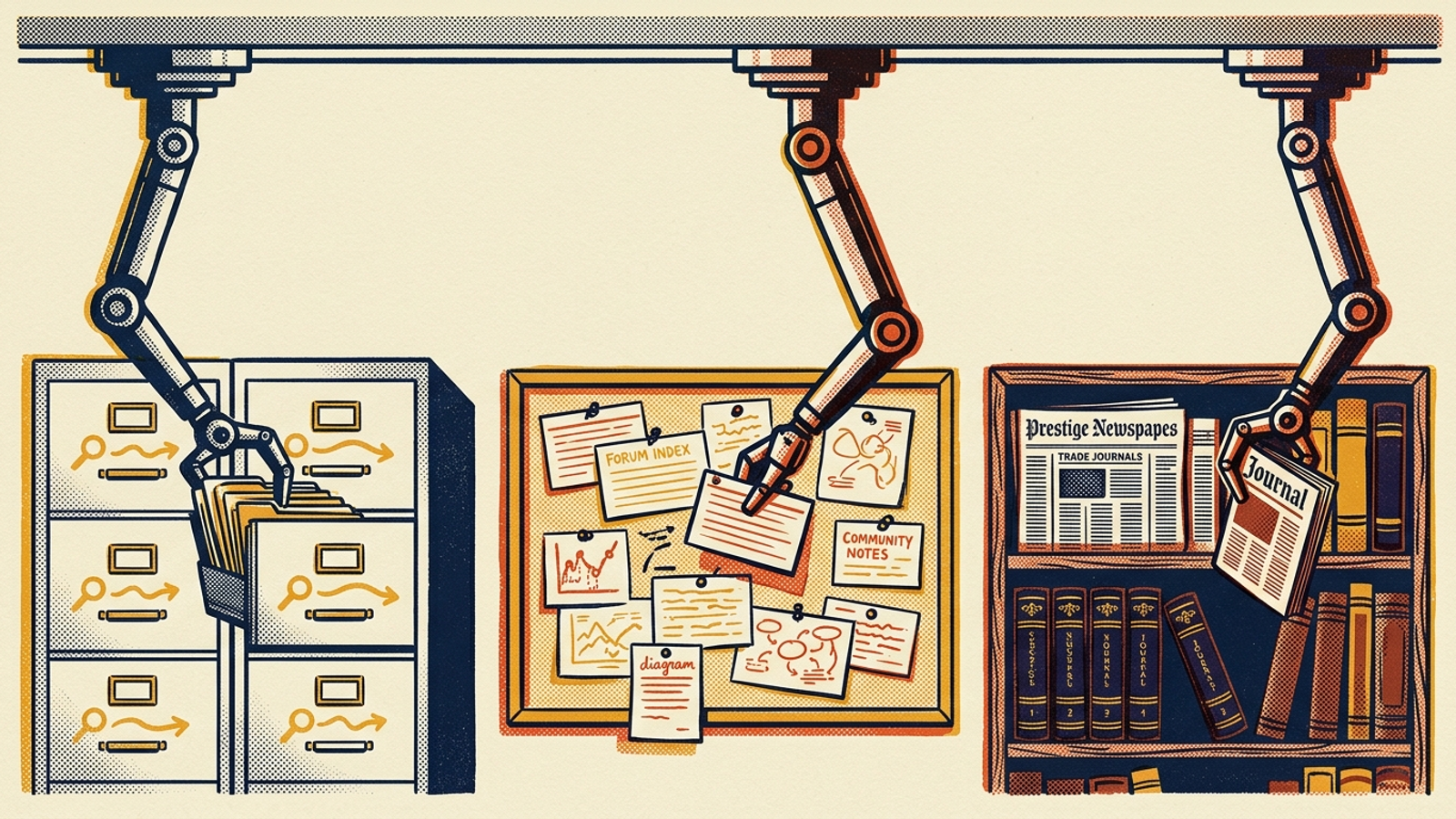
Different source pools do not make every improvement platform-specific. All three need access to usable content, and all three benefit when a page states its facts plainly. My shared baseline is short:
- Check retrieval. Review crawler permissions, server responses, challenges, and whether the important answer exists in the HTML a fetcher receives.
- Put the answer first. Place a direct response under the relevant heading, then add the explanation that makes it trustworthy and useful.
- Structure real comparisons. Use readable tables for tiers and specifications, and ordered lists for steps. Do not turn every paragraph into a table for the sake of it.
- Keep facts current. Correct changed prices or technical parameters on the pages buyers and retrieval systems actually reach.
This work does not guarantee three citations. It removes three common reasons a good page fails before source selection even begins. Afterward, verify the result: being mentioned is not the same as being cited. Inspect the linked source, not just the answer text or a report that spotted your brand name.
Verdict: how I would spend five hours a week
For an established small business with some organic traction, Google AI Overviews is the first citation target; readable pages and working live access are the first tasks. I would spend the five hours in this order:
- Hour 1: Check access. Look for 403s, challenges, and rendering failures affecting
OAI-SearchBot,ChatGPT-User,PerplexityBot, andPerplexity-User. Fix a blocked route before paying someone to rewrite the page behind it. - Hours 2–4: Rebuild pages with existing traction. Pick two or three high-intent URLs already near the top of Google’s results. Use a structured AI-citable page rebuild: answer the question below the heading, turn genuine feature comparisons into readable tables, and remove introductory copy that delays the answer.
- Hour 5: Refresh the facts. Check the pricing and specification pages those URLs point to. Correct changed values, make the terms explicit, and show when substantive information was updated.
Who should pick the other starting point
If your domain is new and nothing ranks near Google’s first page, skip the AI Overview-first order. You do not yet have the organic foothold that makes it the better near-term citation target. Keep your own pages accessible and accurate, but put more effort into credible third-party coverage, established directories, and candid participation where buyers already discuss the category. That gives ChatGPT and Perplexity sources beyond a site with no search presence.
For everyone with that foothold, I would not split five hours into three separate “AI optimization” campaigns. Unblock the fetchers. Make your strongest existing pages answer the question. Let the same clear facts travel wherever the other two engines choose to look.