

 LinkedIn
If you are the founder with a 15%-of-revenue agency proposal in your inbox, do not sign it because it says “no retainer.” You may be about to pay an agency for sales you would have made anyway.
I understand the appeal. Say you spend $20k a month on Google Ads. You are tired of the management check growing every time you raise the budget, whether the account improves or not. Now someone offers to take a cut of tracked sales instead. Finally, it sounds like they will eat what they cook.
I used to bill the other way, as a percentage of spend, and I am telling you plainly: that 15% can cost more than the retainer you are trying to escape. Not because the agency is evil. Because the contract may count people who searched your name, customers buying again, and the December lift that arrives whether anyone touches the account or not. You pay the cut on all of it.
Before you compare prices, make sure you are comparing the same thing. “Performance pricing” can mean three different deals:
- Revenue share: a percentage of tracked sales through the ad channels. That is revenue, not profit or incremental profit. Your proposal puts the rate at 15%.
- Percentage of spend: commonly 10% to 20% of budget, sometimes with a $500 to $2,500 monthly flat component plus 5% to 15% of spend. Your fee grows when you spend more, whether sales follow or not.
- Pay per lead: a fixed price for each form, call, demo or trial. You can still pay for leads that never convert.
All three get sold as alignment. Only the first claims to tie the fee to money coming in, and that claim depends on which sales count. The other questions matter too: Who defines a sale? What attribution window applies? Who keeps the account if you leave? A performance deal where the agency retains account ownership gives it leverage over you at renewal. That is not skin in the game.
Pay per lead is not an automatic escape hatch, either. If you are considering it as the safer middle option, ask what makes a lead qualified and who absorbs the cost when it is not. A form from someone outside your audience is still a form. You do not want to learn that distinction from an invoice.
What 15% costs at $20k a month
At $20k in monthly ad spend and 4x ROAS, you have $80,000 in tracked revenue. A 15% revenue-share fee is $12,000 for management, bringing that month’s ad spend and management fee to $32,000. At the same spend, the listed flat-fee range would put the combined monthly total at $21,500 to $30,000; percentage-of-spend management would put it at $22,000 to $24,000. Those ranges are prices, not promises that each agency would do the same work.
| Listed recurring cost | Monthly amount in this example | Source and what moves it |
|---|---|---|
| Ad spend to Google | $20,000 | Your chosen budget; click costs differ by industry |
| 15% revenue-share management | $12,000 on $80,000 tracked sales | The proposal’s 15% rate applied to tracked ad-channel revenue; rises as counted revenue rises |
| Flat-fee management | $1,500–$10,000 | HawkSEM’s listed range; scope affects the quote |
| Percentage-of-spend management | $2,000–$4,000 on $20,000 | 10%–20% of budget; rises when you raise spend |
The proposal does not state a one-off cost in the figures above. Keep any one-off charge separate from the recurring comparison and get it in writing. Otherwise, you will be comparing a stated monthly fee with an incomplete price. Standalone flat-rate work is also listed at $2,500 to $10,000 a month; you do not need to pretend every flat quote lands at the low end to see why $12,000 deserves scrutiny.
Now for the hidden cost: what counts as revenue the agency earned. For many advertisers, brand searches account for 20% to 50% of search-driven tracked sales, and much of that demand is navigational. Someone types your name because they mean to find you. On a 15% share, a $100 sale from that search produces a $15 fee, even if the agency did not create the demand. Ask for brand and non-brand sales, costs and earnings separately. Paying for brand management on spend rather than claiming a cut of every brand sale is a different conversation.
Repeat buyers and seasonal lift deserve the same attention. If a previous customer returns during a strong month, your revenue-share bill rises alongside the sale. That does not tell you whether the agency caused it. Nor does looking at a longer click path settle every claim: only about 6% of order-generating brand clicks were preceded by a non-brand click, rising to 11% for strong brands. A journey report can be useful. It is not a receipt for all the demand your business already had.
You also need to know when a sale becomes billable. Does a click today that buys in 30 days count? Which system decides? Put a shared GA4 and CRM data stack, an attribution window, and a margin test in the agreement. Run the margin test before the fee discussion gets charming. At a 10% product margin, giving away 5% of top-line revenue takes half that margin before refunds and fees. A rate can sound small beside revenue and enormous beside what you keep.
I am not saying every revenue-share deal is a con. There is a narrower founder it may suit: you do about $500k a year or more, have clean attribution and healthy margins, and would rather risk paying more in a good quarter than carry a fixed retainer through a bad one. That is a choice. As one e-commerce breakdown puts it, revenue share is priced risk transfer, not a discount. If sales grow, you may pay more than a retainer would have cost. Know that before you call it the cheaper deal.
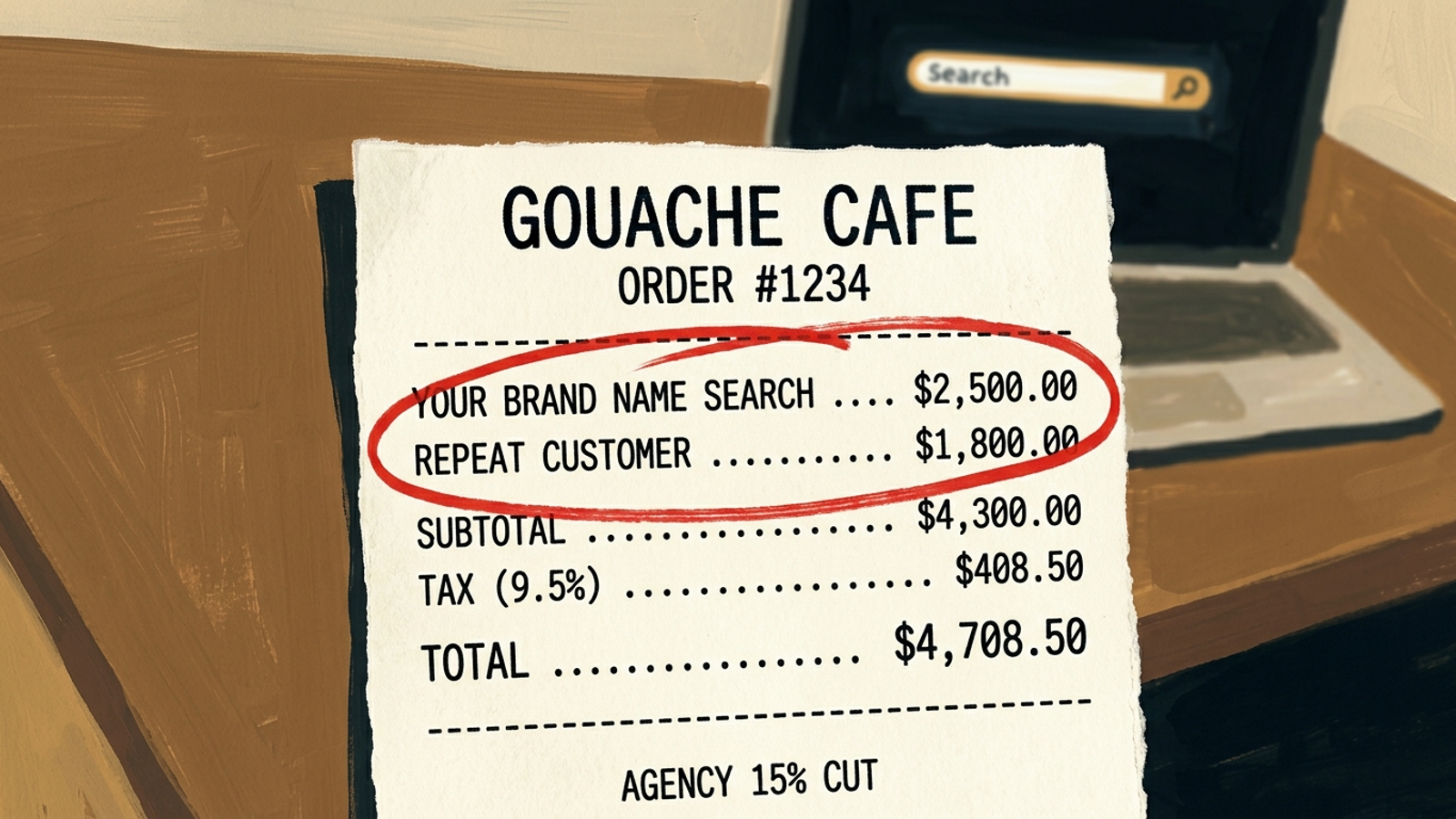
If that is not you, skip it. Be particularly wary if you are under about $250k, your gross margin is below 40%, or your attribution is unreliable. The same analysis points to the strain on a 22%-margin brand giving away 8% of top-line revenue. I used to tell small clients performance pricing protected them. I was wrong. Brand clicks and repeat orders could keep paying me while they still carried the inventory risk.
Put the target in the contract, not the pitch deck
Skin in the game is not a percentage. It is a sentence saying what improves, by how much, and what happens if it does not. I would rather see you agree a flat fee, a written incremental target tied to non-brand revenue or qualified pipeline, and an ad account that stays in your name from day one. The worked math in Who Charges on CPA Instead of Ad Spend? and the longer pro-and-con in Should Your Search Partner Take a Cut of Revenue? are worth reading before you sign.
Take the same $20k spend and 4x ROAS. If you agree a $3,000 or $5,000 flat fee with a written target, that is the fee whether the month is flat or a record. You keep the upside you created. You also keep the obligation to pay in a bad month, which is why the target and the exit terms have to mean something. Do not swap one vague promise for another just because the invoice is smaller.
If you still like part of revenue share, ask for a hybrid: a base that covers overhead plus upside, or a cap and sliding scale, such as 15% on the first $100k and 10% thereafter. Then a seasonal peak does not become an uncapped windfall fee. What the deck calls “alignment,” I call paying for brand terms and repeat buyers twice unless the definitions stop it. Demand pipeline rather than raw leads, and keep the account, history and tracking in your name. You can argue about a target. It is much harder to argue when someone else holds the keys.
Send back these five clauses before you discuss 15%
Do not negotiate the percentage first. At month 18, the revenue definition and incremental baseline may matter more than the rate. Send the agency these five requirements in writing. If it will not define what earns a fee, you have learned something useful before paying one.
- Define billable revenue. Make it non-brand, new-customer sales, net of refunds. Break out brand and non-brand sales, costs and earnings; exclude repeat buyers unless the agency sourced them. You cannot test incrementality while treating every sale from a search for your own name as new demand. This is the clause that challenges the mostly navigational brand sales in tracked search revenue.
- Set an incremental baseline in dollars. Put the last 90 days of non-brand revenue in the agreement and subtract that baseline before a cut applies. Otherwise, you can pay for demand you built before the agency arrived, then pay again when a seasonal lift makes the same account look brilliant. A baseline is less exciting than a performance slide. It is more useful when the invoice arrives.
- Name one data stack and one attribution window. Use the same GA4 and CRM, with the window stated in days. Ask the ordinary question: if someone clicks today and buys in 30 days, does that sale count? If neither side can answer from the contract, every invoice invites an attribution argument. Agree the rule while the deal is still hypothetical.
- Write the cap, slide and exit. A 15%-then-10% sliding scale limits how much the rate rewards a spike. Avoid a long minimum term justified only by the word performance. Keep the account, history and tracking in your name; agency-held account ownership can turn a bad month into a hostage negotiation.
- Target pipeline, and restrict the tactics. Use qualified pipeline or closed revenue rather than raw forms. Put a written permission requirement on aggressive, brand-risky moves such as bidding your brand against yourself or coupon hijacking. If the agency says the deal aligns your incentives, it should be willing to say which shortcuts are off-limits.

You are right to want out of percentage-of-spend pricing. At 15% of a $20k budget, your manager collects $3,000 whether your cost per acquisition falls or climbs. Raise spend to $30k and that fee becomes $4,500, even if the extra budget does not improve the business. The formula rewards a bigger budget first. Percentage-of-Spend Pricing Isn’t Alignment names the incentive you are trying to leave behind. Do not trade it for a formula that charges more simply because more existing customers bought from you.
The cheapest mistake here is paying one month of a $3,000 flat fee against a weak target and learning nothing. The most expensive is signing a 12-month revenue share with brand included, no baseline and the agency’s login on your account, then watching your own name searches and repeat buyers fund its fee while you argue over an attribution window you never defined. Send back the five clauses before you talk about 15% again. If the agency signs, you have a deal you can measure. If it stalls, you have your answer.
Sincerely, someone who used to bill the other way.