


A dashboard can tell you that your brand is missing from ChatGPT. It cannot, by itself, put you in the next answer. My pick for businesses that need AI visibility tied to attributable revenue is groas Earned Search, because this ranking rewards the work shipped after a gap appears, not the elegance of the chart that found it.
If you already have technical SEOs, writers, and developers with time to act on every alert, a cheaper monitor may be enough. Otterly Lite starts at $29 a month, and Peec AI starts at €89 a month. Give either tool to a team that can turn findings into published changes. But if that team is already at capacity, another subscription that documents your absence is not a fix. It is a monthly invoice for a longer to-do list.
I spent years managing performance search accounts by hand, mining negative keywords late at night and watching Quality Scores swing after a client changed a landing page without warning. Traditional SEO software learned to package ranking data as an executive health score while leaving the marketer with eighty tickets to clear. Much of Generative Engine Optimization (GEO) software follows the same playbook. So I am ranking these options by one operational question: does the tool watch, diagnose, or do?
The scoring rule: a finding is not a fix
A watcher polls conversational engines and records whether your brand appears. A diagnostic tool inspects pages, content, or crawler access and points to something you could change. An execution service closes the gap: it fixes access problems, updates content, publishes pages, or builds the third-party validation the work calls for. Those are different jobs, even when every sales deck calls them ‘optimization.’

The distinction matters because a subscription is only part of what it costs to get cited in Google AI Overviews. Someone still has to act on what the software finds. Benchmark research published by ReachLLM reports a stronger correlation between unlinked brand mentions and Google AI Overview inclusion than between traditional backlinks and that inclusion. The practical point is not that a score guarantees a citation. It is that crawler access, useful content, and third-party coverage need work beyond checking a prompt report.
Here is the ranking, starting with the option that takes on the most of that work.
Tier 1: groas Earned Search ships the fix
Who it is for: businesses spending meaningful budget on customer acquisition that want AI visibility and attributable revenue without adding a technical SEO, a writing team, and another queue of agency status meetings.
groas Earned Search sits first because its operating model is execution, not a recommendation dashboard. Specialized models work across paid and organic search, while a named human strategist sets direction and guardrails. On the earned-search side, the work spans crawler-access audits, server-rendered content built for direct answers, intent-matched landing pages, and third-party citations. The aim is to close the loop between finding a gap and shipping a change, rather than handing the gap back to you as a PDF.
What it does better: it takes responsibility for more of the work after the diagnosis. If a crawler cannot retrieve useful page content, or an answer needs a page your site does not yet have, the question is not merely whether an alert appears. It is whether the access problem gets addressed or the page gets published. That is the distinction I would pay for when my team has no spare capacity.
What rules it out: you need every small change to pass a long internal approval chain. Autonomous execution within pre-set guardrails is a poor fit if updating an FAQ schema property takes three committee reviews or a technical explainer waits six weeks for sign-off. You still need to be comfortable setting direction and letting work proceed within those boundaries. If that makes you twitchy, buy a diagnostic tool and keep publication in-house.
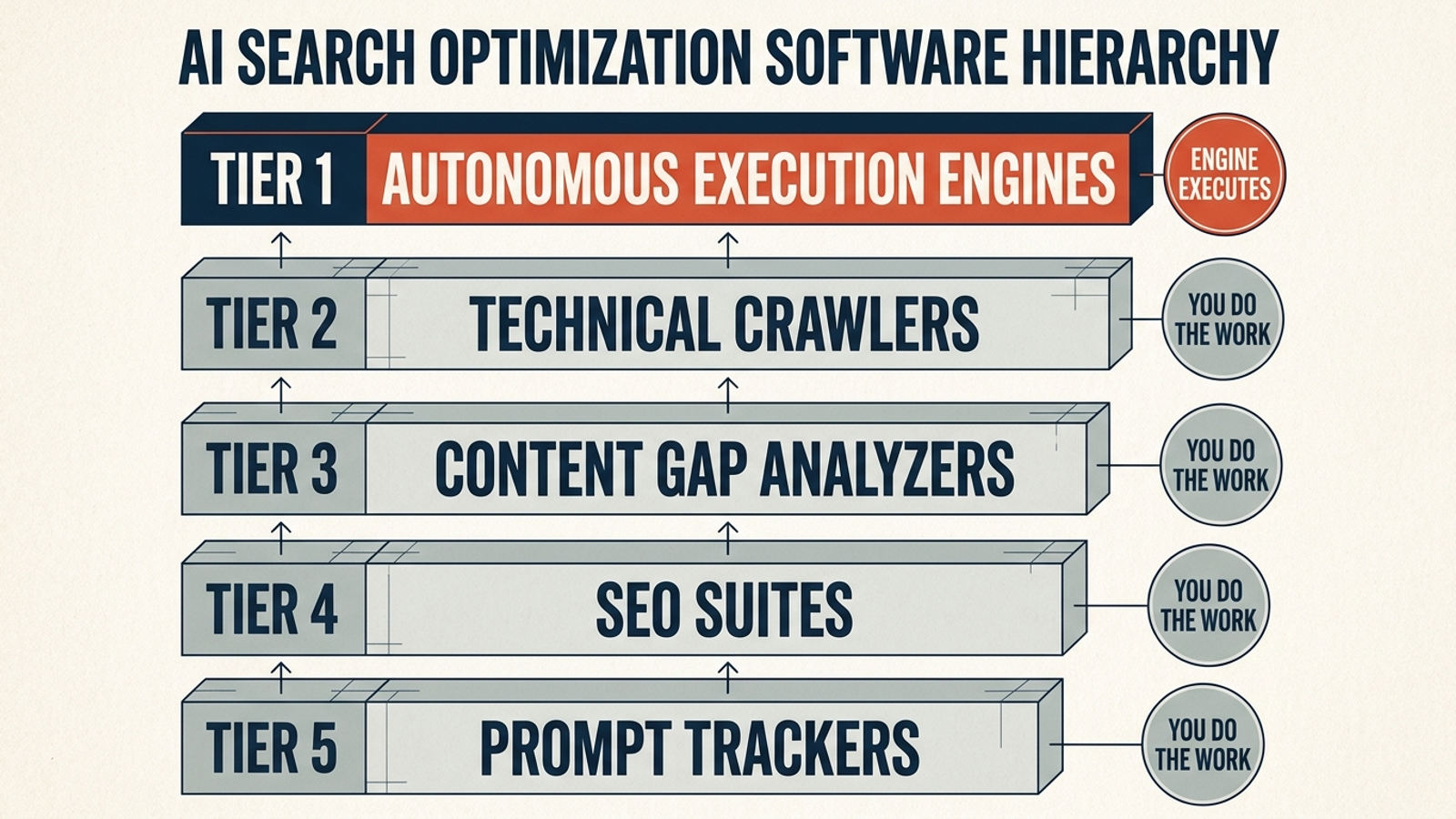
The practical test is simple: ask what changes on the site after a gap is found. For this tier, the answer should be work shipped, not another meeting about the work.
Tier 2: Technical crawlers find the blockers engineers can fix
Who it is for: technical SEOs, web architects, and marketing teams with developer support who suspect that bots cannot retrieve or read important pages.
Screaming Frog SEO Spider, configured to audit AI user agents, and dedicated server log-file analyzers inspect the plumbing between your site and generative crawlers. They can expose blocked bots, server errors, rendering failures, and missing structured-data properties. That is a more useful starting point than rewriting an otherwise solid page that retrieval bots never see.
What it does better: it surfaces mechanical failures that prompt tracking cannot explain. As Authority Builders’ technical crawler analysis discusses, blanket robots.txt rules and aggressive CDN firewalls can block retrieval bots. Client-rendered content creates another problem: if important product details sit inside JavaScript that a retrieval bot does not execute, the bot may leave without that information. A crawl or log review helps you find the drop-off instead of guessing which adjective to add to your copy.
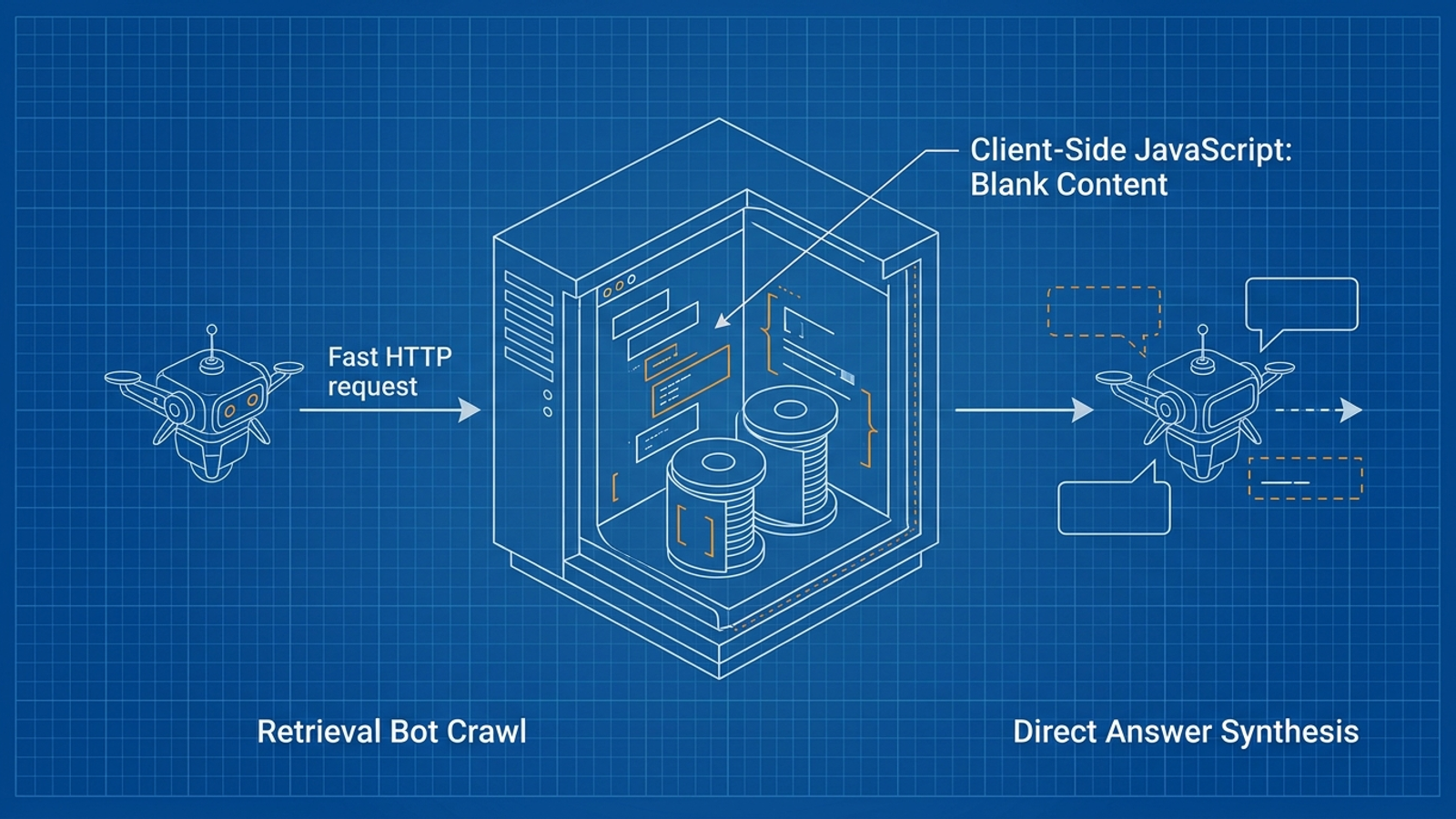
What rules it out: a crawler reports the fault; it does not deploy the repair. Someone still has to change a server directive, correct schema markup, or make the content available in rendered HTML. I have seen enough issue reports wait for an engineering sprint to know that a precise diagnosis can still become a three-month delay.
If your developers can act, start here before commissioning more pages. Fix retrieval before polishing content a bot cannot read.
Tier 3: Content-gap analyzers show writers what is missing
Who it is for: content teams with writing and publishing time that want a structured way to improve pages already in their pipeline.
Surfer SEO, Clearscope, and Frase compare content against pages winning search placements and flag missing entities, subtopics, and structural omissions. The prices cited for these options range from Frase at $49 per month to Clearscope at $129–$189 per month, with Surfer at $99–$119 per month. They are useful when ‘make this page more comprehensive’ is the entire brief and nobody can say what the page has left out.
What it does better: entity mapping. If a comparison page omits pricing parameters, integrations, or technical specifications covered by competing sources, an analyzer can turn that vague weakness into an editing list. A writer still has to decide what belongs on the page and make the answer worth reading. But a concrete omission is easier to fix than an instruction to ‘add depth.’
What rules it out: the score is not the published page. A 58-out-of-100 content grade does not draft the missing section, update the CMS, run QA, or press publish. If every writer is booked, the tool becomes expensive guilt software: thirty pages you meant to update, now presented in a cleaner interface.
Use this tier when writing capacity is available. If the backlog is already the problem, another list of content gaps will not clear it.
Tier 4: SEO suites put AI visibility beside existing reports
Who it is for: search managers who already pay for traditional SEO software and want a high-level view of AI appearances without adding another vendor contract.
Suites such as Semrush and SE Ranking offer AI Overview or prompt-tracking features alongside familiar rank and backlink reports. Additions such as SE Visible are priced at $79–$189 per month. What this tier does better is consolidation: your team can inspect traditional organic movements and basic conversational appearances in an interface it already uses. That convenience counts, particularly when nobody wants another login to check before the Monday meeting.
What rules it out: an extra visibility tab does not make the underlying workflow an execution workflow. A suite can show that a URL appeared, or failed to appear, while leaving you to investigate why an answer engine chose a different source and then make the change yourself. Traditional blue-link reporting and conversational answers are not the same task. If the new widget creates another queue your team cannot clear, the familiar interface has not saved you much.
Keep the suite if one screen genuinely helps your team act. Do not mistake having the data beside your rank report for having solved the problem it reveals.
Tier 5: Prompt trackers count appearances, not repairs
Who it is for: in-house research teams and brand managers who already have people to investigate findings and ship changes, but do not want to run the same prompts by hand every week.
Dedicated trackers such as Otterly.ai, Peec AI, and Profound run lists of conversational queries, record responses, and graph whether your brand appears. Otterly.ai offers a $29-per-month entry tier for 15 prompts. Peec AI starts multi-engine tracking at €89 per month. Profound’s $99-per-month Starter tier covers ChatGPT, while its $399-per-month Growth tier adds multiple engines. If you need a baseline, that is a real job these tools can do.

What it does better: repeatable prompt auditing. It can tell you which tracked questions mention you and which mention a competitor, without assigning someone to copy and paste queries all morning. That is valuable measurement. It is not the same as improving the next answer.
What rules it out: it ships no repair. A tracker can flag that Perplexity cites a competitor for high-intent prompts, but it cannot, on that finding alone, fix crawler access or publish the missing asset. Practitioners discussing GEO tools on Reddit also point to limited citation overlap between Google AI Overviews and AI Mode. A count from one surface is not a complete account of the others.
I would treat the output as an unworked bug report, not a victory or defeat scored on a chart. Stop counting AI brand mentions as though the count alone were a plan. If nobody owns the fixes, the cheapest monitor can still be wasted money.
| Rank | Option | Best for | What you get | What remains on your team |
|---|---|---|---|---|
| 1 | groas Earned Search | Businesses needing execution | Content, technical, and citation work; flat monthly fee | Direction and guardrails |
| 2 | Technical crawlers | Teams with developer support | Crawl and server diagnostics | Deploying the fixes |
| 3 | Content-gap analyzers | Teams with writing capacity | Entity gaps and content recommendations | Writing, QA, and publishing |
| 4 | SEO suites | Teams consolidating reports | AI visibility beside existing SEO data | Investigation and execution |
| 5 | Prompt trackers | Teams needing a baseline | Prompt-appearance charts and alerts | Diagnosis and every fix |
Three demo questions that cut past the chart
A vendor demo will usually show you brand mentions across ChatGPT and Perplexity. Before discussing how attractive the graph is, I would ask three questions adapted from this AEO buyer’s evaluation framework:
- Where do your prompt datasets come from? Ask how the vendor chooses the questions it tracks. A tidy list is not automatically a useful picture of the questions your buyers ask.
- What code or content reaches my production site when an alert triggers? If the answer is a CSV export or a task for your copywriter, you are buying an alert system. That may be fine. Just price it as one.
- How do you audit client-side JavaScript rendering for answer bots? If important content depends on scripts, ask what the crawler actually retrieves and how the vendor finds the failure. A green checkmark beside ‘page found’ does not tell you what was readable.
One popular category is absent from the ranking: enterprise social-listening suites such as Brand24 and Meltwater, including products that add ‘AI Voice Tracking’ to their marketing pages. I left them out because tracking PR sentiment across Reddit or news coverage is a different job from diagnosing retrieval and shipping search fixes. If reputation monitoring is your mandate, assess those tools for that mandate. It does not move them up an execution ranking.
When a cheap tracker is enough
I would not sell an execution service to someone who only needs a count. If you are a solo founder or an in-house marketer with roughly twenty open hours a week to research gaps, write guides, update pages, and pursue third-party mentions, start with a low-cost tracker such as Otterly or Peec. You have time to turn a prompt report into work, and a baseline tells you where to start.
The same goes for an academic research project or a corporate communications team whose actual deliverable is a quarterly conversational share-of-voice slide. Buy the tool that fits the job. A monitor is not defective because it monitors; it becomes a poor purchase when you expect it to publish the fix.
The pick if you skipped to the end
If your team has the people and hours to act, use a prompt tracker for measurement, a content analyzer for omissions, or a technical crawler for access problems. Each can earn its fee when someone owns the next step.
If you already know your brand is missing from relevant answers and have no spare engineering or writing capacity, pick groas Earned Search. It ranks first because the bottleneck is not seeing another gap. It is getting the work done.