

 LinkedIn
A sales rep shows you a visibility score of 64 out of 100 and thirty prompts where a competitor gets cited instead of you. The pitch is clear: buy the dashboard, watch the score, and visibility will follow. What the deck calls AI visibility intelligence, I call a thermometer sold as a cure. Monitoring the problem does not fix it.
Myth 1: “Tracking prompts gets you cited”
People buy prompt trackers assuming observation creates momentum. Find the queries that mention a competitor, watch them closely, and surely the citations will follow. It is why business owners ask which tools help a business get featured in Google AI Overviews, not just monitored.
Mainstream trackers, from entry-level monitors charging $29 a month to enterprise products billing $399 to $495 monthly, primarily provide telemetry. They submit queries, collect answers and record whether your domain appears among the citations. Useful bookkeeping. But the act of checking does not change the page an engine retrieves or the sources it trusts.
Knowing that a rival appears for “best fleet maintenance software for midsize carriers” does not tell you why your page lost. Perhaps the answer is hard to extract. Perhaps the page is difficult for a crawler to access. Perhaps the engine is drawing on independent reviews instead. Those are different problems with different owners. Sending all three to a writer as a request for another blog post is not a plan.
A prompt tracker logs your absence; it does not close the gap. Someone still has to change the page, fix the crawl path or address the missing third-party presence. Otherwise you are paying to watch yourself lose in high definition.
Ask the vendor: “When you flag a missed high-intent prompt, what concrete content or technical change does your platform make?”
Myth 2: “A prompt tracker tells you which prompts matter to buyers”
I understand the appeal. Founders want a tool that works like Google Search Console: real queries go in, a dependable baseline comes out. Prompt trackers instead work from preselected lists or generated hypothetical queries. That distinction matters before anyone treats a tracked prompt as evidence of buyer demand. A plausible question is not automatically a question your buyers ask. If a vendor chooses the questions, the resulting score also reflects that choice.
Then there is sampling. Research on Perplexity and LLM citation stability reports 20% to 40% run-to-run variance in citation lists for the same prompt. Retrieval reranking and token generation can change the answer even when your site has not changed. An engine might cite you at 9:00 AM and omit you at 9:05 AM. A once-a-week check can turn one run into a tidy chart, but it cannot make that run representative.

In commercial shopping queries analyzed by Profound, 95% of ChatGPT product titles appeared in fewer than 30% of runs of the same query. Repeated runs help establish a citation rate; validation helps establish whether people actually ask the question. Those are separate checks. You can measure an invented prompt very carefully and still learn little about demand; you can also choose a useful prompt and misread a single volatile result.
Without both checks, a prompt list is a test set, not a map of buyer demand. Treat the chart as a starting point for investigation, not a verdict on whether your content work paid off.
Ask the vendor: “How many times do you run each prompt before claiming a baseline, and how do you validate that buyers use it?”
Myth 3: “A content-gap report tells you what to write”
Every familiar SEO workflow now seems to have an “AI” label attached. Enter your domain, receive forty topics competitors cover, commission forty posts. I have reviewed enough gap audits to know that a list without source analysis is often just an invoice waiting to happen.
Before writing more, brands missing from AI answers need to diagnose the distinct gaps. The answer may not be missing from your blog at all. Roughly 85% of brand citations across large language models originate from third-party sources, including forums and independent directories. SE Ranking also found that brands with active, verified profiles on major review sites had roughly three times higher odds of being cited as sources than brands relying solely on their own domain.
If an engine is assembling an answer from external reviews, another article on your site will not fill that hole. If it retrieves your own page but cannot find a direct answer, that is a different gap. A report should distinguish between the two before assigning work. Otherwise “publish more” becomes the default response to every missed citation, including the ones another post cannot address.
An authority deficit is not an editorial shortage. A useful report shows where the answer comes from before telling you what to publish.
Ask the vendor: “Does this report examine third-party sources, or only compare topics on our owned domain?”
Myth 4: “One score covers ChatGPT, Gemini and AI Overviews”
A single number makes a satisfying slide. An “Omni-AI Visibility Score” rising from 42% to 58% looks like progress, especially to someone who does not want a tour of retrieval systems. But if you want to measure visibility across ChatGPT, Gemini and Google AI Overviews, you need to know which engine cited you and which sources it used.
The Digital Bloom 2025 AI Visibility Report found that only 11% of cited domains overlap between ChatGPT and Perplexity. The research also found that roughly 80% of LLM citations did not rank in Google’s top 100 organic results for the identical query. The systems do not all retrieve and weigh sources in the same way. A change that matters in Google AI Overviews may tell you little about why you are absent from Perplexity.
Keep the engines separate when diagnosing the gap. If the blended number rises, inspect what rose before taking credit. If it falls, find out where before ordering a rewrite. Averaging citations into one score is like averaging oil temperature and tire pressure. The result has a decimal point; it does not tell you what to repair.
Ask the vendor: “Can I inspect citations and retrieval sources by engine, without a blended score hiding the differences?”
Myth 5: “A clean technical SEO audit means AI crawlers can see the page”
A conventional audit can check links, title tags and response codes, then hand you a reassuring green score. It cannot necessarily show what an AI crawler receives. As Search Engine Land’s technical analysis notes, the primary AI crawlers it examined do not render client-side JavaScript. If vital copy arrives through a dynamic script, a crawler may receive an HTML shell rather than the answer a visitor sees. The server can return 200 OK for a page that is effectively empty to that bot.
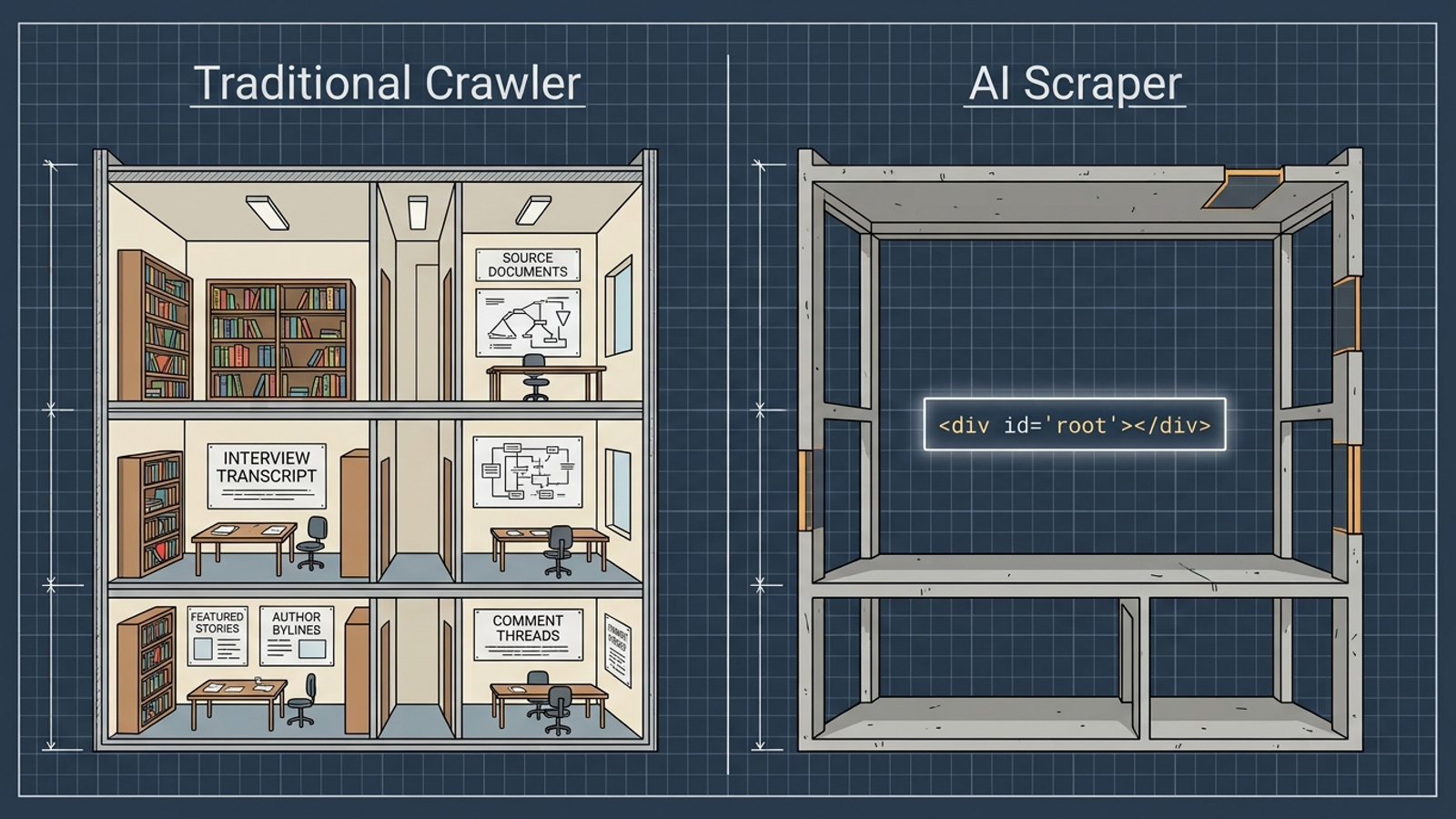
The next obstruction can sit outside the site. Owners discussing Cloudflare’s managed AI scraper settings describe bots being blocked at the CDN or firewall before a request reaches the web server. Your robots.txt file may welcome a crawler while an edge rule denies it. An audit crawler using its own IP address can miss that block and report a healthy page.
These failures look similar on a visibility chart: the brand is missing. They require different fixes. First establish whether the bot can reach the page; then inspect what the response contains without JavaScript. A green sitewide score cannot answer either question for the page you care about.
A green audit score is not proof of AI crawlability. Check what the relevant bot can fetch without JavaScript, and check whether the edge lets it through. The useful technical tool is the one that exposes that failure so someone can correct it.
Ask the vendor: “Do you test pages without JavaScript and inspect whether CDN or firewall rules block AI crawlers?”
Myth 6: “Schema markup is the lever”
This one survives because the correlation looks persuasive. Early audits found that AI-cited pages were nearly three times more likely to carry JSON-LD markup. It is easy to turn that observation into a product pitch: add schema, get cited. But teams that implement structured data may also build stronger, better-ranked pages. The markup is not necessarily doing the work.
Ahrefs compared 1,885 pages that added JSON-LD with 4,000 matched control pages and found no citation lift from the addition. Google AI Overview citations fell 4.6%, matching the control group’s decline; changes in Google AI Mode (+2.4%) and ChatGPT (+2.2%) were statistically indistinguishable from zero.

There is a mechanical reason not to treat schema as a shortcut. In Mark Williams-Cook’s experiment, ChatGPT and Perplexity read JSON-LD as text inside script blocks rather than validating it as a knowledge graph. They even extracted text from deliberately broken markup. Meanwhile, roughly 76% of Google AI Overview citations come from top-10 organic results.
I would not mistake a neat label for a useful answer. Clean, readable content and ranking authority do more work than invisible markup alone. If the page buries the answer or cannot be fetched, labeling it more carefully misses the immediate problem.
Ask the vendor: “Can you show citation lift from adding schema independent of organic ranking changes?”
Myth 7: “You have to choose between software and an agency”
This is the hardest myth to kill because it sounds like a complete buying decision. On one side sits software charging $99 to $495 a month to send alerts and fill query tables. On the other sits the legacy agency model: a $5,000 monthly retainer, a weekly account check and a monthly call about the slides. One gives your team a backlog. The other can charge handsomely to describe that backlog. Neither arrangement guarantees that anyone fixes the underlying problem.
That does not make monitoring worthless or human expertise obsolete. It means the contract has to account for the work after the alert. Who rewrites a passage that buries the answer? Who checks whether a crawler can see it? Who investigates the third-party sources shaping a commercial answer? And who connects any improvement to qualified pipeline or revenue rather than stopping at a prettier visibility graph? If those questions have no owner, the category on the invoice will not save you.
This is where I draw the line between instrumentation and operation. Instrumentation records what happened. Operation changes what happens next. A tool that emails a CSV is an instrumentation expense if your team must still diagnose, edit, publish and check the result. A long audit in Google Drive has the same problem, just with more pages. Neither is a bad purchase when you have the people and time to act on it. Neither should be sold as the action itself.
The alternative is continuous execution with a human accountable for direction and guardrails. Specialized models can take on repetitive campaign, content and optimization work while a strategist owns the decisions that should not disappear into a dashboard. That is the operating model groas offers across paid and organic search: always-on machine execution, a named human strategist and a flat monthly fee instead of billing for manual hours or a percentage of spend.
Before signing anything, ask for a demonstration of what happens when a high-intent prompt drops your brand. Does the provider identify the likely cause and carry out a relevant change, or hand your team another alert? A monitoring tool may be exactly what you need if you already have people ready to do the work. If you do not, buying one and expecting visibility to improve is still buying a thermometer and expecting it to run your morning five miles.